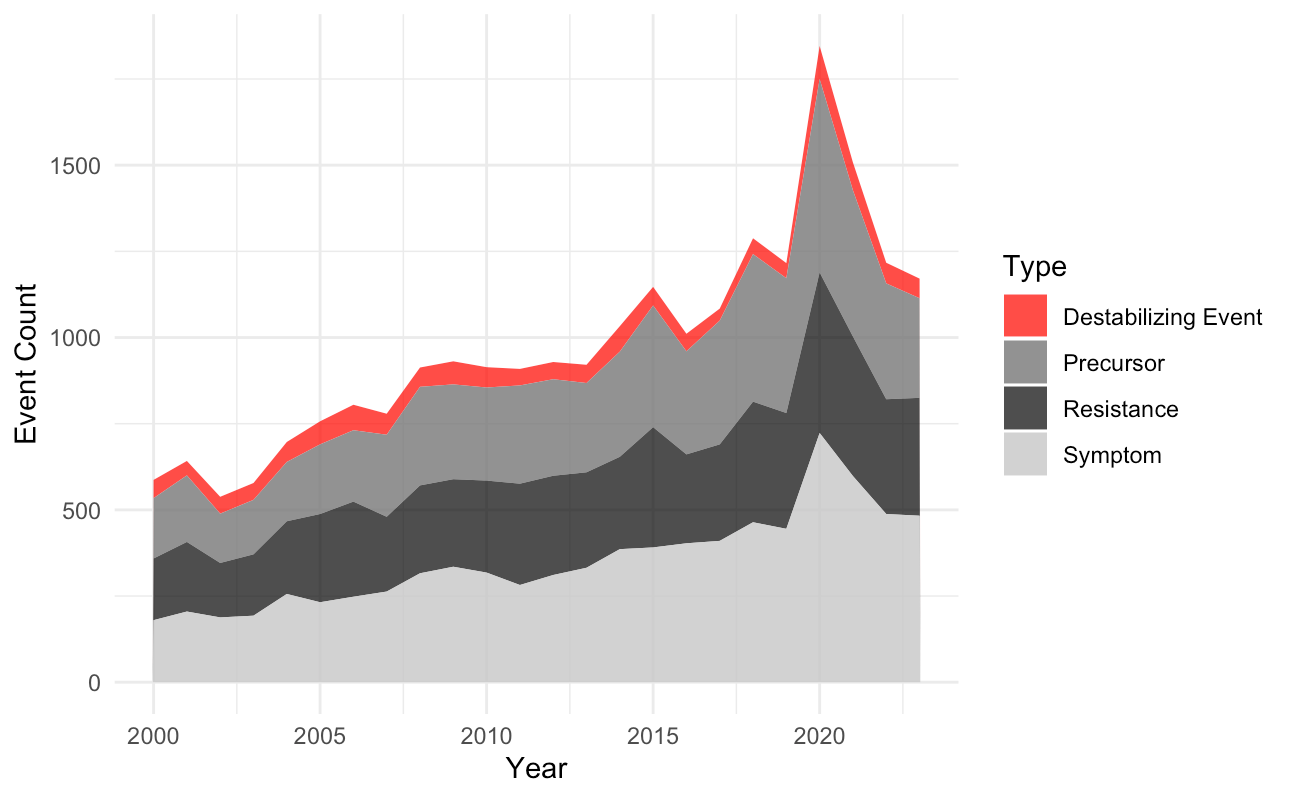
We are excited to announce that Version 7 of the Democratic Erosion Event Dataset (DEED) has now been published! The new version of DEED includes 23,421 event observations related to democratic erosion and autocratic consolidation across 156 countries from 2000 to 2023. DEED v7 classifies events into 76 distinct categories across 4 event types (precursors to, symptoms of, and resistance to erosion, and destabilizing events in authoritarian regimes).
You can now download the DEED v7 dataset, access the latest codebook, and use our updated data viewer and visualizations.
What’s New in Version 7 of the Dataset?
- Increased coverage: quadrupled the number of observations since v6
- Added information about Actors and Targets for all events
- Increased quality: each event reviewed by multiple coders
Increased Coverage
New Actor and Target Variables
The new version of DEED also features new variables that capture the actors and institutions involved in each event. These new variables determine who is driving the event (actor) and who is affected by it (target). For the actor variable, coders identify the individual or institution responsible for planning, implementing or pushing forward the erosion or resistance event. Coders then identify the target category that best represents the individual or institution that the event is directed toward or impacts. DEED v7 features 56 new possible actor and target variables.
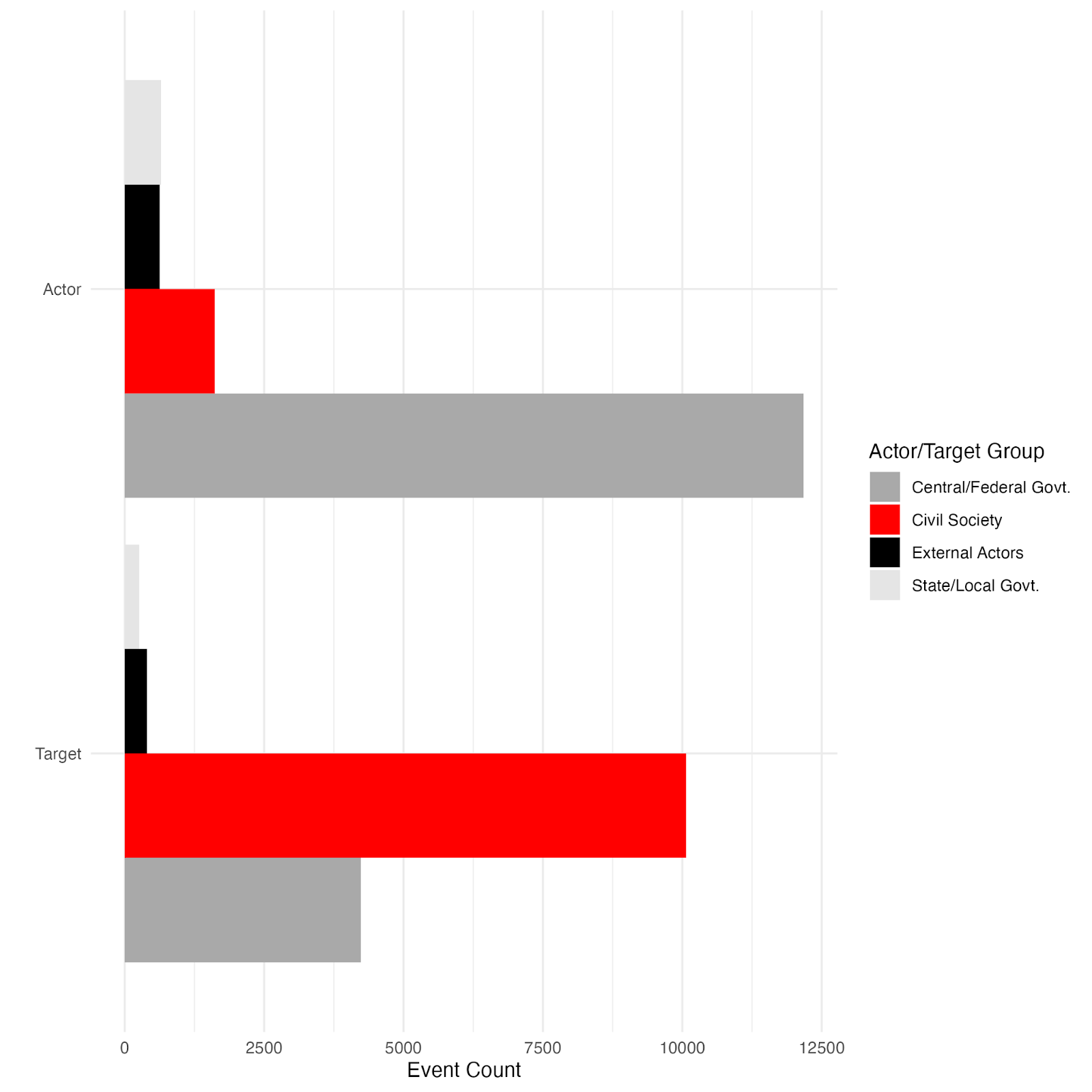
Actors and targets are grouped into Central/Federal Level government actors and institutions (i.e. Heads of State, legislature, Supreme Court); State and Local Level government actors and institutions (i.e. mayors, local governments, local courts); Civil Society (i.e. social movements, journalists, business actors); and External Actors (i.e. foreign countries, international organizations). (You can see the full list of all actors/targets in the DEED v7 codebook.) Figure 1 shows the number of events by different groups of actors and institutions for both the target and actor variables, across the symptom and precursor event types. The figure shows how central or federal level politicians and institutions are driving the precursor and symptom events in the dataset, whereas civil society is the target of those events.
Quality Control and Deduplication Process
Patterns in DEED Version 7: What Does the Data Show?
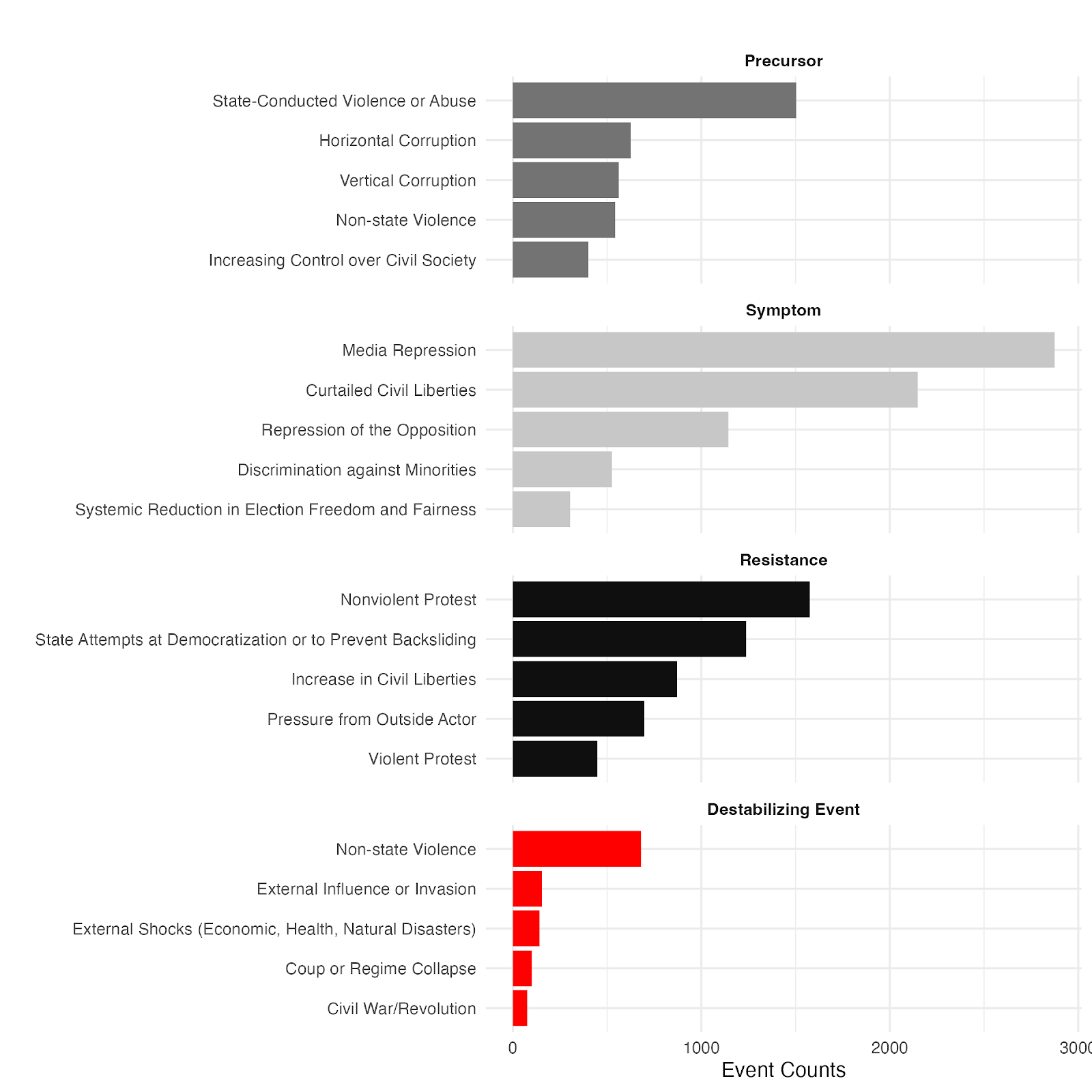
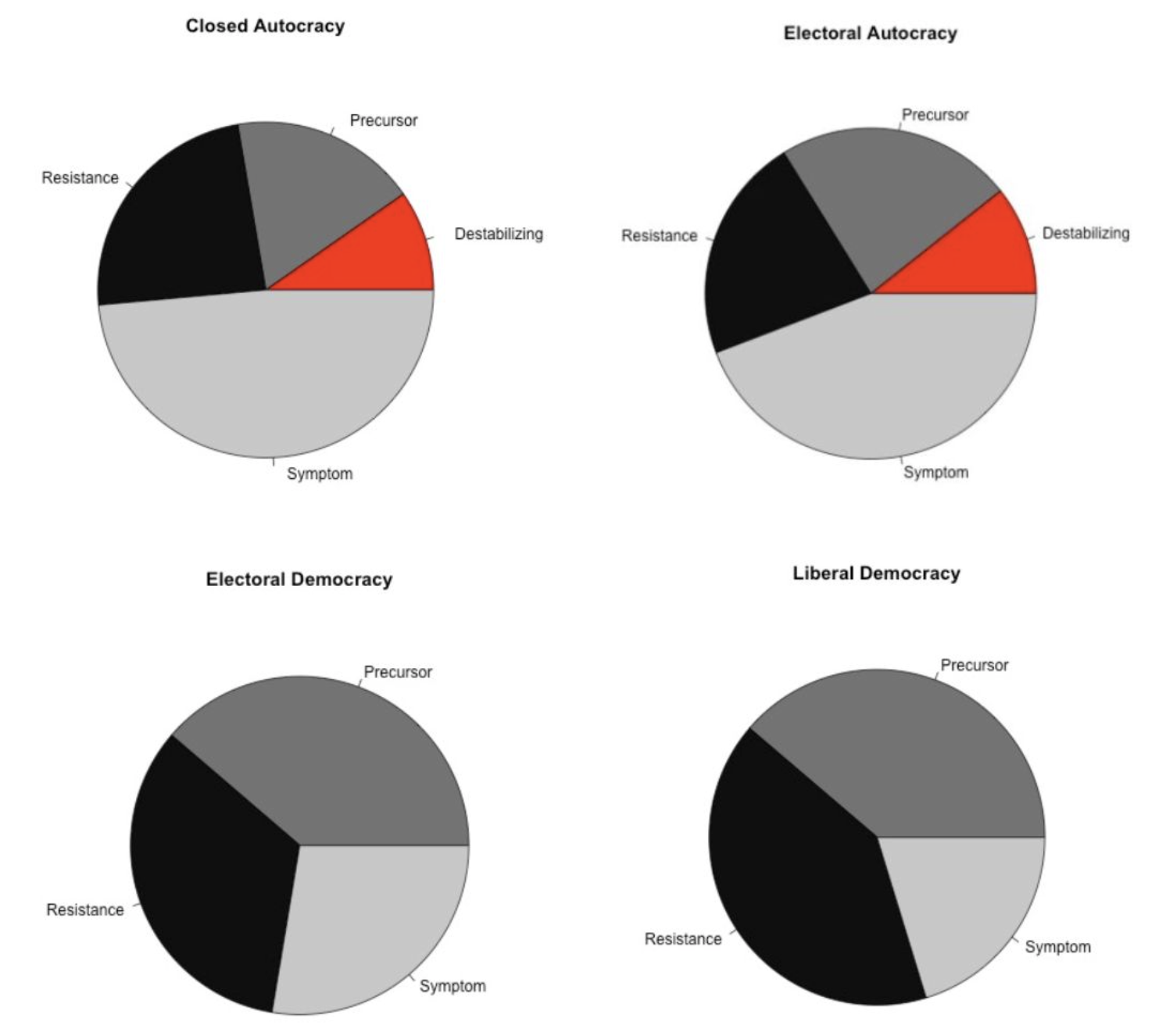
DEED includes both democratic and authoritarian countries, allowing us to track patterns in erosion across regime types. Figure 3 shows the distribution of events by regime across four regime types: closed autocracy, electoral autocracy, electoral democracy, and liberal democracy.
The distribution of event types varies by regime, which offers insight into how erosion can manifest depending on a country’s political environment. Symptom events (shown in light grey) are most common in the two more authoritarian regime types (closed autocracy and electoral autocracy), while precursors (dark grey) are more common than symptoms in the two democratic regime types (bottom row). Figure 3 also shows how democracies tend to have higher levels of resistance events (shown in black) than more closed regimes.
Future Improvements
- Download the v7 dataset
- Access the data viewer
- Interact with the data visualizations
- View the methodology and latest codebook
1 See for example, V-Dem’s report on global democracy from 2020: Alizada et al. 2021. Autocratization Turns Viral: Democracy Report 2021. University of Gothenburg: V-Dem Institute.