
“La Diada,” a Catalan holiday, commemorates the surrender of Barcelona to Spanish forces in 1714 and the defeat of Catalan forces. As a result of this unfortunate incident in Catalan history, the Spanish intentionally stepped on Catalan law, customs, and language in favor of their Castilian counterparts. La Diada celebrates Catalonian traditions and customs in remembrance of the lively culture they once had. The day has also taken on a more political bent, frequently featuring organized protests and marches in support of Catalonia’s independence from Spain.
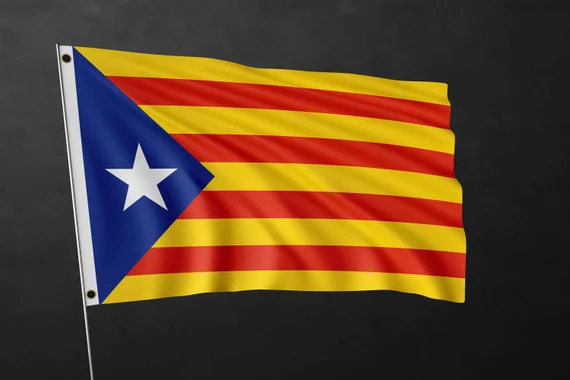
Catalonia Flag
Over 300 years later, Catalonians are still longing for their culture back. In 2017, the Catalan government held a referendum on whether Catalan citizens would secede from Spain. More than 2.2 million Catalonians reported voting out of 5.3 million registered voters. Just under 90% of voters backed independence. A Catalan reporter said there were still 750,000 votes uncounted because polling stations were closed and urns were confiscated, after officers from the national police and the paramilitary Civil Guard commandeered ballot papers and boxes at polling stations. The constitutional court denied the vote, and nearly 900 people were hurt as police tried to stop it from going forward.
The courts concluded that the vote violated the Spanish Constitution because it establishes an “indissoluble unity of the Spanish nation.” Though Spain claims to be one unit, the Catalonians have felt their culture and customs suppressed. Spain’s disregard for the Catalonians preservation of culture has cultivated a polarized country.
Yunus Orhan explores the effects of polarization. He explains that polarization is a primary factor that supports undemocratic politicians and is highly correlated with democratic backsliding. The polarization leads to less accountability, freedom, and rights.
Prime Minister Pedro Sanchez decided to take a different approach to the Spanish courts’ prosecutions of Catalans. Sanchez passed a controversial Amnesty Law that pardoned the prosecution of hundreds of politicians and others involved in the failed attempt at Catalan independence between 2012 and 2023.
Sanchez’s amnesty deal is significantly different from what his opponents were proposing. The tactics for defeating separatism in Catalonia by the conservative People’s Party and the far-right Vox were to prosecute people for non-violent offenses, banning separatist parties and rally meetings. Nothing more can come from that besides pernicious polarization.
“Pernicious polarization,” explained by McCoy & Somer, is characterized by societies separating into mutually distrustful “us vs. them” camps and is a significant global threat to democracy. It arises not from inherent social cleavages or institutional designs, but from political elites strategically using divisive discourse and tactics, as Spain’s People’s Party was looking to enforce the Catalan divide. The divisive process, often fueled by grievances and rifts, deepens societal divisions, erodes democratic norms and institutions, and can lead to democratic backsliding or authoritarianism.
Some feel the amnesty was agreed to by Sanchez’s Socialist Party and two Catalan separatist parties in exchange for their support for his minority coalition in a parliamentary vote that allowed him to remain prime minister. The timing of the amnesty law and the election for incumbent Pedro Sanchez has led many to feel that Sanchez used legislative powers to coerce votes, as they believe those granted amnesty should be held accountable for their crimes.
The European Commission, a politically independent administrative arm of the European Union, which operates in part to propose legislation and enforce EU law, determined that the law meets the definition of a proscribed “self-amnesty.” It also questioned whether the policy served the public interest or was just used to secure a political agreement to keep Sánchez in office. The EU Commission felt that his administration lacked credibility when it claimed that amnesty was essential to promote political reconciliation and institutional normalization between Catalonia and the Spanish state.
As the EU Commission and a large group of Spanish citizens have concerns about the amnesty’s effects. In our current era, defined by democratic backsliding, amnesty might seem like a step backward. However, nothing comes as close to offering peace and reconciliation. Prime Minister Sánchez’s amnesty agreement was a courageous attempt to end the Catalan crisis, delivering a way out of the damaging standoff and deepening polarization.
A deeper historical look at amnesties reveals their positive role in democracies. Spain itself is not new to amnesty law. The Amnesty Law of 1977 marked Spain’s shift to full democracy after four decades of authoritarian rule. The Amnesty Law covered all political prisoners, including Catalan and Basque nationalists, as well as members of the Franco regime. The law served as the anchor of Spanish democratization, ending the Spanish Civil War and enabling most of the political compromises in the 1978 Constitution.
Omar Encarnación explains that political amnesties have a long history dating back at least to the murder of Julius Caesar in 44 B.C. In more recent times, nations have relied on amnesty to find a way out of political headbuds and, however imperfectly, to move forward. The 1660 Act of Indemnity and Oblivion marked the end of the English Civil War and was an element of the English Restoration’s rebuilding. In America, the Amnesty Act of 1872, which removed most penalties against former Confederates, helped shape Reconstruction.
The amnesty has bolstered political stability in Catalonia, killed the argument among separatists that Spain is incapable of compromise, and robbed them of their rallying cry. Amnesty, with all its imperfections and compromises, offers a better remedy for democratic coexistence in Spain, as it opposes polarization.
Works Cited
https://www.reuters.com/world/spains-top-court-upholds-amnesty-law-catalan-separatists-2025-06-26/
0 Comments