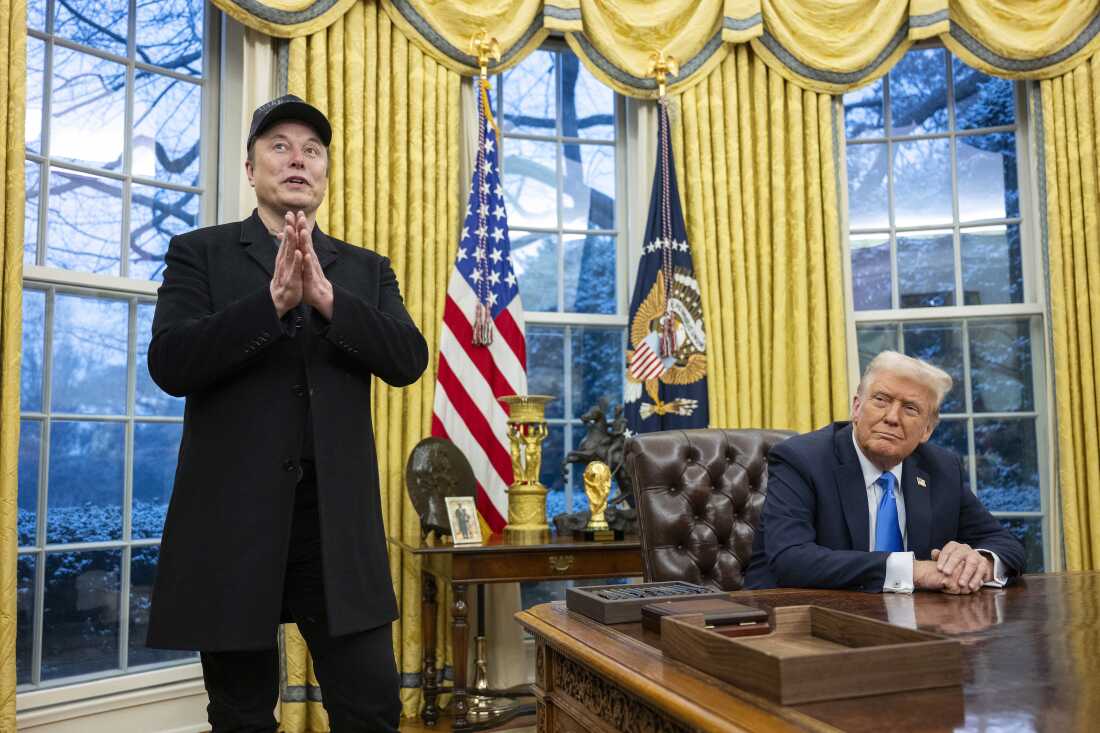
Elon Musk speaks as US President Donald Trump looks on in the Oval Office of the White House in Washington, DC, on February 11, 2025. Tech billionaire Elon Musk, who has been tapped by President Donald Trump to lead federal cost-cutting efforts, said the United States would go “bankrupt” without budget cuts. Musk leads the efforts under the newly created Department of Government Efficiency (DOGE), and was speaking at the White House with Trump, who has in recent weeks unleashed a flurry of orders aimed at slashing federal spending. (Photo by Jim WATSON / AFP) (Photo by JIM WATSON/AFP via Getty Images)
On January 20, 2025, President Trump signed an executive order establishing the Department of Government Efficiency (DOGE), a body embedded within the existing U.S. Digital Service and led by tech billionaire Elon Musk. Framed publicly as a crusade against wasteful government spending, DOGE moved swiftly across dozens of federal agencies; terminating contracts, firing tens of thousands of civil servants, and in some cases attempting to shut down agencies like the Consumer Financial Protection Bureau (CFPB) and the U.S. Agency for International Development (USAID).
By spring of 2025, Musk had claimed $150 billion in savings. This figure is a dramatic downward revision from the $2 trillion dollars originally promised by Musk. For many observers, these actions appear as aggressive fiscal reform. For scholars of democratic erosion, they look like something more nefarious.
Nancy Bermeo’s “On Democratic Backsliding”, presents a useful starting point. Bermeo distinguishes between dramatic forms of democratic collapse, i.e. coups, and autogolpes, and subtler forms, including what she calls “executive aggrandizement”: the process by which elected leaders gradually expand their own power by dismantling the institutions designed to check them. DOGE fits this pattern precisely.
The CFPB, which enforces consumer financial protections, was targeted for elimination within days of Trump taking office. The IRS began laying off enforcement staff. The FAA lost hundreds of employees including air traffic control workers. The National Science Foundation saw $1 billion in already-awarded grants cancelled. None of these actions required a constitutional amendment or a declaration of emergency. They were accomplished through executive orders, budget authority, and personnel decisions, the ordinary legal instruments of government.
This is where Ozan Varol’s concept of “stealth authoritarianism” can shed light on the issue. Varol argues that the most dangerous form of democratic erosion operates through legal means, exploiting the rules and procedures that democracies depend on. Rather than abolishing oversight institutions outright, which may provoke resistance, stealth authoritarianism hollows them out from within, leaving the institutional shell intact, while draining it of its capacity to function independently. The CFPB was not formally abolished; a federal judge blocked the shutdown. But its director was fired and replaced with a Trump loyalist, its website was taken down, and its staff placed on administrative leave. The institution still technically exists. Its ability to act does not.
The parallels to Orban’s Hungary are instructive here. Kreko and Enyedi’s “Explaining Eastern Europe: Orban’s Laboratory of Illiberalism” (2018), describes how Fidesz systematically repacked courts, rewrote electoral rules, and subordinated independent agencies to party control through formally legal procedures. All of which while maintaining the outward appearance of democratic governance. The effect, concentration of power in the hands of the executive, is mirrored in DOGE. No single agency closure or individual firing rises to the level of a constitutional crisis. But a federal government stripped of independent enforcement capacity, staffed by loyalists, and unable to operate as a check on the executive, is a structural transformation of American democracy.
Works Cited
Bermeo, Nancy. 2016. “On Democratic Backsliding.” Journal of Democracy 27(1): 5–19
Krekó, Péter, and Zsolt Enyedi. 2018. “Explaining Eastern Europe: Orbán’s Laboratory of Illiberalism.” Journal of Democracy 29(3): 39–51.
Varol, Ozan O. 2015. “Stealth Authoritarianism.” Iowa Law Review 100(4): 1673–1742.
0 Comments