Imagine winning the most powerful office in the world and still governing like you’re the underdog. That’s the paradox at the center of modern populism and it isn’t accidental.
With Donald Trump’s inauguration for his second term in January 2025, the fight did not end but intensified. The judiciary was his enemy, universities his target, and the media remained on the side of the opposition. In just two months into his second term, 127 cases have been brought against his administration (Al Jazeera, 2025). Instead of slowing down, Trump’s response was to go after the judges who issued the rulings. In the case where Judge James Boasberg blocked flights carrying Venezuelan migrants from being deported, he asked for his impeachment, referring to him as a “radical left lunatic” (Al Jazeera, 2025). While this might appear chaotic to most onlookers, it is much more deliberate from a scholarly perspective on populism: a leader whose structural nature compels him to always keep fighting since fighting is what makes him relevant.
Populism is a “thin ideology” that “only speaks to a very small part of a political agenda” and unlike liberalism or socialism, it doesn’t offer a full governing vision (Mudde, 2004). What it does do is split society into antagonistic groups: “the pure people” versus “the corrupt elite.” That’s also its trap. Populism is good at tearing things down, but has never been very good at building anything to replace them.
Populist politicians are not just believers in such notions, but actors embodying their very meaning. First, as noted by Norris, populist rhetoric rests upon two basic claims: that establishment actors cannot be trusted and that only “the people” have legitimacy (Norris, 2025). The rest follows naturally from there. Sloganeering, appeals to emotions, breaking norms. Any institutions attacked provide a clear demonstration of outsider credibility (Norris and Inglehart, 2018). Attacks on particular judges on Trump’s Truth Social account, references to “vermin” at rallies, the concept of “the deep state”, none of this is rhetoric by chance. That is what they do. It works because the frustration underneath it is real.
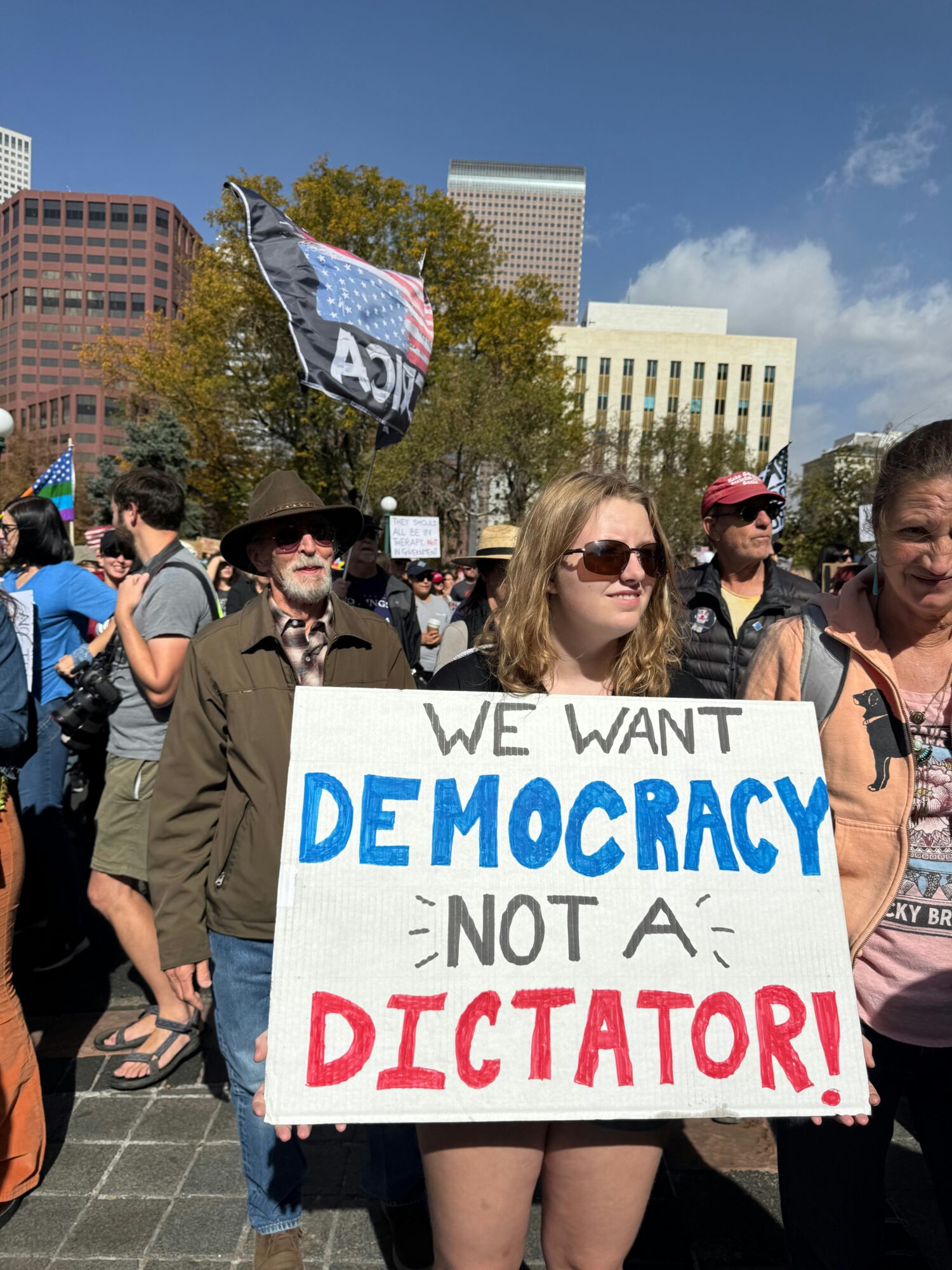
A protester holds a sign reading “We Want Democracy Not a Dictator” at a demonstration in 2025. (Photo courtesy of mana5280 via Unsplash)
Berman argues populism doesn’t emerge from nowhere, starting instead as “a symptom of democratic dissatisfaction” rooted in genuine gaps between what institutions promise and what people actually get (Berman, 2025). When elites failed in 2008, when wages stagnated for years, and when whole communities got left out of the recovery, trust in those institutions eroded in ways that never fully recovered. Populism moved into that space and filled it. The permanent campaign resonates because it speaks directly to people who never felt the system was working for them in the first place, which is also what makes it so difficult to argue against from the outside. The grievance is legitimate even when the response to it isn’t, and populism’s trick is converting that real anger into endless conflict and a governing strategy that never actually has to deliver results.
Trump’s second term makes the structural logic visible. His administration issued dozens of orders pushing legal and political boundaries, with over 94% of federal district court rulings in May 2025 going against it (IBA, 2025). The response wasn’t to pull back but to attack the courts. Press Secretary Karoline Leavitt called each injunction “an abuse of the rule of law and an attempt to thwart the will of the people” (PBS NewsHour, 2026). Every blocked policy became new evidence of elite sabotage. The same logic extended to universities. The Trump administration moved to freeze federal funding to institutions like Harvard, framing elite universities as ideological enemies corrupting the next generation (Inside Higher Ed, 2026). It extended to the press, where outlets critical of the administration were dismissed as propaganda rather than engaged with on the merits. Each new front in the conflict served the same purpose: proving to supporters that the fight was still ongoing, that the establishment was still the enemy, and that only one person was willing to take them on.
The permanent conflict has a cost. When courts get framed as part of the elite conspiracy, they lose legitimacy in the eyes of the people who need to trust them most. When the press is permanently “fake news,” there’s no shared reality left to hold power accountable to. Berman puts it plainly: while populism begins as a symptom of dissatisfaction, once in power it can “actively deepen the erosion of support for democracy” (Berman, 2025). Norris and Inglehart make the same point, arguing that populist rhetoric doesn’t just reflect distrust in institutions but actively manufactures it (Norris and Inglehart, 2019).
It’s worth acknowledging what populism sometimes gets right. Elites do ignore ordinary people. Institutions do fail. Anger isn’t always irrational. But populism channels that frustration into permanent conflict. Tearing down accountability structures doesn’t return power to the people, it concentrates it in whoever’s left standing. The permanent campaign is not only a flaw in Trump’s style, but also a feature of populism itself. Once in power, populist leaders keep fighting, keep naming enemies, keep performing the outsider role, because the moment they stop, the whole project loses its reason to exist (Mudde, 2018). Democracy doesn’t need everyone to vote correctly. It needs institutions legitimate enough to hold whoever wins accountable. When those institutions are the permanent enemy, that capacity disappears.
0 Comments