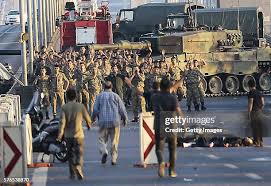
On July 15, 2016, tanks and members of the Turkish military took to the streets of Istanbul in an unsuccessful attempt to overthrow the government. Soldiers invaded the headquarters of the ruling party while fighter jets bombed the capital city of Ankara. This coup attempt would change the future of Turkey’s democracy, restructuring the entire system of government. President Recep Tayyip Erdogan reformed the constitution of Turkey, claiming it was necessary for national security. However, these reforms show clear signs of democratic erosion.
During the attempted coup, the chairman of Joint Chiefs of Staff, Hulusi Akar, was taken captive by his security team. As the news of the coup spread, the people of Turkey took to the streets to join in on the madness. The police and loyal military personnel attempted to break up the crowds. After many unsuccessful tries, they resorted to resisting with force. At least 250 people died during this event, leaving over 2200 injured. The government blamed Fethullah Gulen, a Turkish cleric and businessman. Gulen had been residing in Pennsylvania, United States since 1999 after self-imposed exile. Still, President Erdogan and his allies believed he was responsible for plotting and organizing his followers to execute this plan. Turkey believed Gulen had created an entire network, framing him as a terrorist in charge of the Fethullah Terrorist Organization (FETO). According to Levitsky and Ziblatt, this justification of suspensions allows institutions to weaken to prevent the opponents from gaining an upper hand. Essentially, Erdogan wants citizens to believe if FETO were to win this conflict, democracy would be lost in Turkey. This suspicion followed years of the Turkish government believing that Gulen had been establishing a ‘parallel state’ infiltrating institutions.
Ankara and President Erdogan declared a state of emergency that lasted two years. During this time, thousands were arrested pending trial, and over 125,000 people were fired or suspended from their positions over suspected links to Gulen. The government argued that these decisions were essential to protect national security. Others argue that Erdogan was attempting to eliminate the opposition. Yaprak Gursoy, the chair of contemporary Turkish studies at the London School of Economics, said “because the government was associated with the Gulenists before 2013, some people were being paid through Gulenist banks. These were the innocent victims of the Gulenists.” The idea of pernicious polarization from McCoy and Somer forces citizens to choose a social identity, and anyone not identifying with the majority, are viewed as a security threat.
Following the 2016 failed coup attempt, the Turkish government requested the extradition of Gulen and his affiliates in the United States. They also called for the shutdown of all Gullen affiliated schools and businesses internationally. However, for Gulen to be taken into custody, Western allies would have also had to recognize Gulan’s network as a terrorist organization. Balkan and African governments eventually would recognize FETO, but the Western countries that Turkey had less of a tangible influence in were hesitant.
Prior to the coup, there were concerns over the freedom of expression and media in Turkey. The Turkish government sought the support of Putin, rather than its allies in Europe and the United States. The U.S. needed Turkey’s alliance to help fight ISIS in Iraq and Afghanistan. Turkey is also a member of NATO, making Western NATO allies concerned about its stance with Russia during this time.
In April of 2017, citizens of Turkey voted in favor of changing the constitution by a slim majority of 51.4%. The opposition was distrusting of the elections at this time and therefore called for a recount of 37% of votes. If the referendum was valid, the term limits of the president would change to two terms. However, this meant that Erdogan could reset his tenure and stay in power until 2029. Tana de Zulueta, head of OSCE Office for Democratic Institutions and Human Rights, said that this referendum was not fair because authorities decided to accept ballots without official stamps late in the day. She highlighted that this action “significantly changed the ballot validity criteria, undermining an important safeguard and contradicting the law.”
This referendum would also abolish the position of prime minister, leaving just the President to oversee the government. Historically, the President was not supposed to be affiliated with any political party. This change would allow Erdogan to make himself the head of the Justice and Development Party (AKP). It would centralize power around one position, giving the President the ability to bypass parliament to control ministries and regulate senior civil servants. This is a breakdown of horizontal accountability, taking away key components of checks and balances. Erdogan would have the power to draft the state budget and declare a state of emergency without the Cabinet’s approval.
The judiciary would undergo serious changes if the referendum passed, allowing the president to handpick 12 of the 15 judges on the Constitutional Court. The only authority this Court has is to try a president if parliament opens an investigation, and the majority of the judges would be allies of the president in this scenario. The president would also now be able to appoint 5 of the 13 Supreme Court members. Oran Varol characterizes this as stealth authoritarianism. By keeping functioning courts, elections, and active constitutions, Turkey presents as having democratic practices. However, democratic values are undermined in loyalty-based courts, biased electoral rules, and emergency powers to promote executive control.
The last threat of this referendum is the status of Turkey joining the EU. If Erdogan were to be able to run for office again, he threatened to reinstate the death penalty. This action would automatically abolish the EU bid and without interest in EU membership, their migrant deal would likely end. At the time, Turkey was sheltering around 3 million refugees from the Syrian crisis and without this deal, international conflict could arise.
In the case of Turkey, it’s important to understand that the attempted coup is not the cause of democratic erosion but is a symptom of years of democratic backsliding. The polarization of centralizing power to one party allows elected officials to justify authoritarian actions. It is imperative for the preservation of democracy; the elected leaders are held accountable through fair elections and free courts.
Wow! Really interesting post, I had no idea any of this happened. It is crazy to see the rise of coups/coups attempts over the last ~decade, especially in really high profile nations like South Korea. I think this post did a really good job highlighting Turkey’s very strange place in the gradient of autocracy. It seems to push and pull itself towards Russia, then the U.S., then Russia again, all while having a leader that seems to do the same with his autocratic tendencies. As you point out in your thesis, this very much seems like an event that Edrogen has used not just to really brutally test the boundaries of Turkey’s democracy under the guise of national security, but also use it as a means of flexing its muscles on the international stage. Either way it will be interesting to see how this event is remembered in Turkish history; will it be a time of strength and resilience against a foreign coup, or the point of no return in its slide to autocracy?