
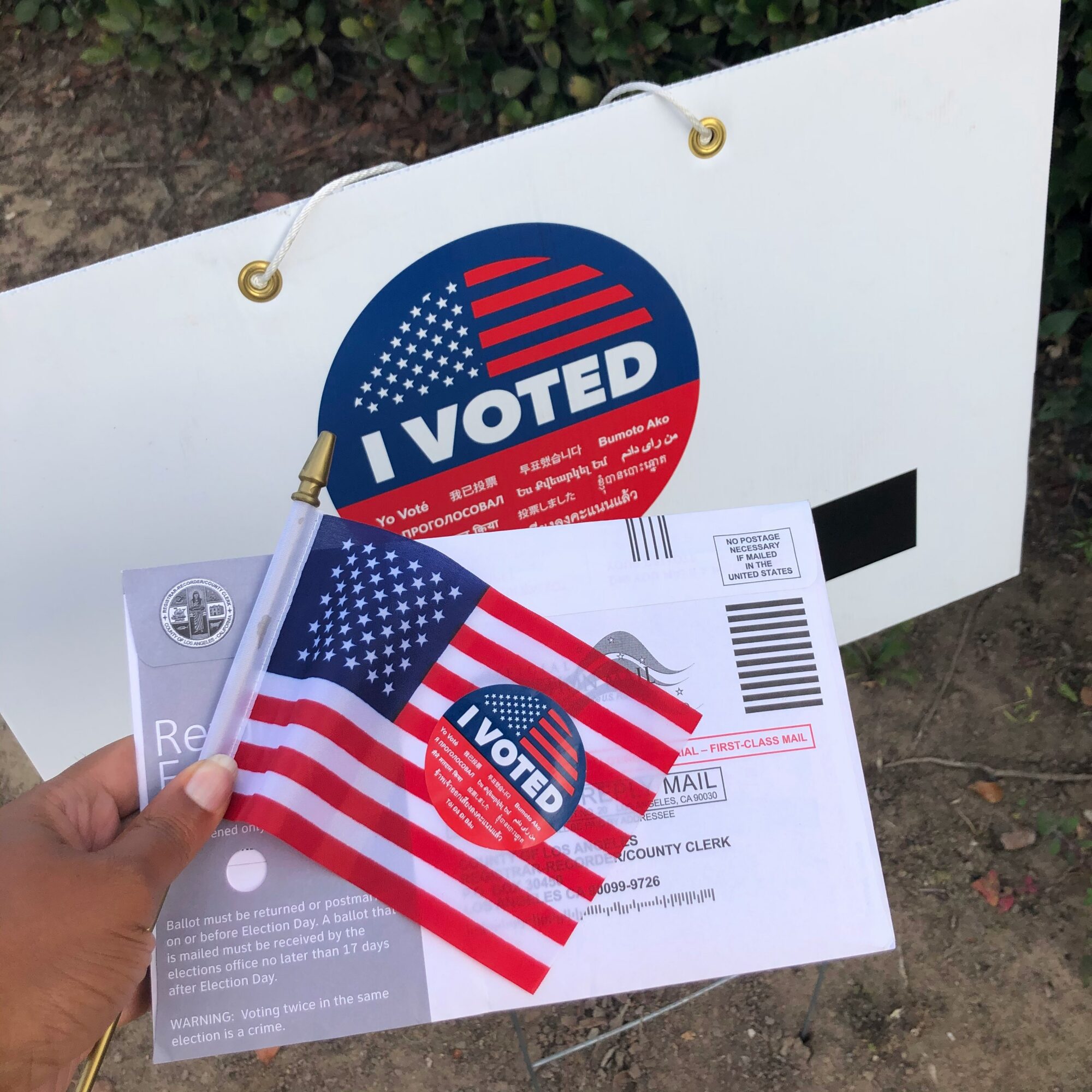
Photo by Janine Robinson, Nov. 3, 2020; Unsplash+ license
By March 24th, Donald Trump had voted by mail in a special election to fill a seat in Florida’s lower chamber. A week later, he signed an executive order directing the federal government to control who else gets a mail ballot.
The order, titled “Ensuring Citizenship Verification and Integrity in Federal Elections,” instructs the Department of Homeland Security (DHS) to compile a national list of eligible voters in each state. DHS must then share that list with the U.S. Postal Service (USPS), which would be barred from delivering mail ballots to anyone not on it. States that refuse to comply face criminal prosecution and the loss of federal election funding. Within four days, 23 states filed suit. They called it a “shocking and unprecedented power grab” that violates the Elections Clause of the Constitution, which gives states primary authority over how elections are run.
Most coverage has treated this as another voting restriction, a chapter in a long push to make voting harder. That framing is accurate, but it misses the core problem. The order reaches beyond individual voter access. It takes gatekeeping power over ballot delivery away from state officials, where the Constitution places it, and puts it in federal agencies under direct presidential control. This is not just a voting restriction. It is a move to seize control of the process determining who gets a ballot at all.
Executive Aggrandizement and the Guise of Reform
In her 2016 essay, Nancy Bermeo defines executive aggrandizement as the process by which elected leaders use legal, incremental moves to weaken the institutions that check their own power. By definition, this order is an act of executive aggrandizement. It does not arrive as a dramatic seizure of power. It arrives packaged neatly in a White House fact sheet about election integrity.
In their research, Steven Levitsky and Daniel Ziblatt identify this as a feature of contemporary democratic erosion. The subtle weakening of critical democratic norms and institutions by those in power, usually under the guise of reform or national security, is exactly what this order does. It presents a major restructuring of election administration as if it were a routine citizenship verification measure. That is exactly how democratic backsliding works. It hides behind ambiguity. It is hard to identify in real time. And, above all, it is framed as something else.
The order is also a deliberate boundary test. Trump’s first election-related executive order, signed in March 2025, was struck down by federal courts for exceeding presidential authority over election administration. He signed a second one anyway. Each new attempt normalizes the claim that the federal executive should control a process the Constitution assigns to the states. Political scientists characterize this as an erosion of forbearance, or the weakening of the expectation that leaders will refrain from exploiting institutional powers beyond their intended scope. Each new order makes the next one less shocking.
Why Infrastructure Is Harder to Fix Than a Restriction
Individual voting restrictions, such as shorter early voting periods or stricter ID requirements, are harmful. This order works at a different level. It builds federal control into the administrative apparatus that determines whether a ballot is sent at all.
The database at the center of the order makes that danger concrete. The DHS SAVE system, which the order uses to verify citizenship, has a documented record of misidentifying U.S. citizens as noncitizens. In St. Louis County, Missouri, about 35% of the roughly 690 people initially flagged by SAVE as noncitizens were citizens, many of whom had registered at naturalization ceremonies. 70 county clerks across Missouri signed a letter warning that citizens they personally knew, and had personally registered, were being incorrectly flagged by the system. In Texas, at least five percent of voters flagged by SAVE were citizens. One county even reported a 14% error rate. Under this order, USPS would use that system to determine ballot eligibility.
Robert Dahl argued that functioning democracies require free and fair elections and the institutional infrastructure that makes those elections possible. When the institution that determines who gets a ballot relies on a database known to be wrong, citizens cannot participate on equal terms. They cannot know whether their name is on a federal list. They cannot know whether their ballot will arrive. That uncertainty, created months before the midterms, is a structural barrier to political participation in the most literal sense.
A common objection is that courts will block this, just as they’ve blocked the 2025 order and other major Trump initiatives. The 23-state lawsuit is moving quickly, and election law experts broadly agree that the order exceeds presidential authority. But the Purcell principle complicates that assumption. Courts often avoid changing election rules close to an election to prevent administrative chaos. If litigation moves slowly, a court may allow the order to stand simply because the election is approaching. USPS rulemaking under the order is not due until May 30, and election law experts have noted that implementing before November would be logistically impossible anyway. Even if the order never takes effect, the damage is already done. It forces state election offices to prepare for a system they do not control. It injects uncertainty into ballot access months before a federal election. That uncertainty is itself a form of democratic harm.
In 1991, Philippe C. Schmitter and Terry Lynn Karl defined democracy as an order in which citizens hold rulers accountable for their actions in the public realm. That accountability depends on citizens being able to vote. Voting depends on administrative processes that operate independently of the executive branch. When a president claims the authority to run those systems by executive order, that accountability breaks down. The machinery of elections is itself a democratic institution. Capturing it, even through legal means, even unsuccessfully, is an act of democratic erosion. Each attempt makes the next one easier to carry out in an increasingly tumultuous environment.
Your analysis is really strong and you used a lot of important democratic erosion terms to support your argument. I was surprised to read how inaccurate the SAVE system is. Trump is clearly making all attempts possible to consolidate power and block the opposition from checking him. By preventing free and fair elections, the Trump administration is violating the constitution and openly hindering US democracy. This blog post is an informative piece on the reality of democratic erosion under the Trump administration.