Although monarchies were once among the most dominant and widely accepted political systems in history, they are now less common yet often remain powerful and untouchable political institutions that continue to influence national governance. This principle extends to the political system as well. Each country maintains its own unique and distinct form of governance and no single political model is perfectly implemented. Throughout history and continuing today some systems such as democracy, authoritarian regime, totalitarian regime, dictatorship and many other forms have existed in different parts of the world. Among these, monarchies also continue to remain present in 2026 with Kings, queens being head of state. However, the coexistence of institutions such as monarchy, royal families, kings, queens, princess and princess with democratic ideals propose doubts and questions. In Thailand, the elites, royal family and military figures play a huge role in shaping the democracy of Thailand(Giles Ji Ungpakorn, 2025). “The elites in Thailand claim themselves as “Thai-style democracy” or a democracy with Thai characteristics.” (Kurlantzick, 2015).They believe that their democratic reflects their own traditions, culture, and history. In this context, elites refer to a minority group of powerful figures who possess influence beyond ordinary citizens. Their concentrated power often allows them to re-shape state decisions without needing broad public support often in their own need. Rather than standard liberal democracy, this framework focuses on a constitutional monarchy with heavy influence from the military and palace.
Thailand’s low level of democracy, shaped by its own distinct political structure, is not just an assumption. According to Freedom House, Thailand is categorized as “Not Free” with Global Freedom score and Political Rights score, Civil Liberties score, internet freedom score and violations of user rights score being low. International IDEA (Global State of Democracy Initiative) also provided meaningful numbers about Thailand; Local Democracy, Absence of Corruption, Access to Justice, Predictable Enforcement, and Rule of Law Global ranking
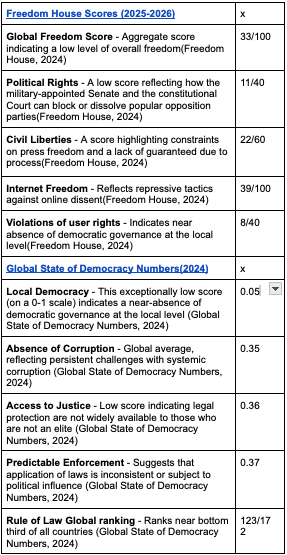
(Freedom House, 2025-2026), (Global State of Democracy (GSoD) Numbers,2024)
Figure 1. Figures suggesting low level of democracy in Thailand (Author Generated graph using numbers from sources)
Figure 1 shows that Thailand’s weak democratic performance is not random but systematically linked to the political influence of the monarchy. The low Political Rights score(11/40) and Global Freedom Score(33/100) reflects how unelected institutions, often aligned with royal interest, can override electoral outcomes and weaken representative governance. Moreover, strict laws and norms protect the monarchy, limiting open criticism and public discourse. This is reflected in the low Civil Liberties(22/60) and Internet Freedom(39/100)scores, indicating restricted political expression and reduced public debate and weakened democratic accountability. The concept of “Thai style democracy” keeps power centralized rather than locally accountable, as shown by the extremely low Local Democracy score (0.05), reinforcing hierarchical structure historically associated with monarchical authority. These figures depict that although democratic institutions formally exist like others, their effectiveness is constrained by a political system where monarchy continues to yield significant influence and power, undermining the core principle of democracy-that power should come from the people. As a result, trust in elections for citizens as voting does not always translate into real policy change. Over time, weak accountability can reduce participation and normalize elite control over democratic institutions.
Thai monarchy acts as a political force and they can not be challenged. It is shown that the Thai monarchy aligns with institutions and powerful elites to repeatedly overturn democratic decisions. A key example is the dissolution of the Move Forward Party (MFP) in August 2024. In the 2023 general election, the party won the most votes, however, the Constitutional Court dissolved it and banned its leader. The court claimed that the MFP’s attempt to reform Article 112 (the lese- majeste law) was seen as an action to possibly overthrow the “democratic system” with the King as Head of State (Freedom House, 2024). This decision shows a lack of democratic accountability, suggesting that laws protecting and benefiting the monarchy can not be changed through normal political procedures. In fact, it may never change (International IDEA,2024).
Beyond the dissolution of political parties such as the MFP, the monarchy’s “untouchable” status is reinforced by strategic partnership with other elites (military) through a 250 member Senate. After the election in 2023, the unelected body, a group composed and handpicked by the previous military junta, functioned as a blocker to block the new emergence of reformist government (Freedom House, 2024). Despite the public’s desire for a change, the elites, given the power to veto a Prime ministerial candidate, ensured that Monarchy power stays preserved and safe (International IDEA, 2023). This demonstrates how elite networks can reproduce their own authority even after elections signal public demand for change. Instead of leadership changing through what may look like a competition, power circulates within the same privileged groups. In this collaboration, systemic lack of democratic accountability can be seen. Traditional power structures are designed to neutralize any fame or power to bring monarchy under modern legal control (V-Dem, 2024). Monarchy power is extending far beyond through usage of lawfare such as the National Anti-Corruption commission’s attempt to impose lifetime political bans of 44 former legislators who only tried to propose a bill to change the lese-majeste law (International IDEA, 2024). These acts show that monarchy stays permanent and can not be challenged through democratic process. If proposing legal reform results in punishment instead of development, opposition groups may self-censor rather than participate openly or ‘democratically’. In long term, this limits policy innovation and prevents democratic development.
In conclusion, despite the elites claiming themselves to be “Thai-democratic”, they prioritize traditional hierarchies over liberal democratic norms to gain their own benefits. Even in 2026 where democracy seems generalized or obvious, monarchy exists and this symbolic figurehead shows a silent gradient in forming political power. The evidence from diverse sources suggests how rule of law has been replaced by the rule of elites. Aggressive dismantling of the MFP and subsequent “lawfare” against its legislators prove that monarchy still functions as an untouchable political actor in Thailand. As long as legal and military figures protect the monarchy, Thailand will remain in their own Thai-democracy cycle that only exists to serve the minor elites.
References
Freedom House. (2024). Thailand: Freedom in the World 2026 Country Report | Freedom House. Freedom House. https://freedomhouse.org/country/thailand/freedom-world/2026
Giles Ji Ungpakorn. (2025, December 7). The power behind the Thai throne – Centre tricontinental. Centre Tricontinental. https://www.cetri.be/The-power-behind-the-Thai-throne?lang=fr
Global State of Democracy Numbers. (2024). Thailand | The Global State of Democracy. Www.idea.int. https://www.idea.int/democracytracker/country/thailand
International IDEA. (2024). POLITICAL FINANCE ASSESSMENT OF THAILAND. https://doi.org/10.31752/idea.2023.42%3E
Kurlantzick, J. (2015, April 8). Is There Such Thing As a Thai-Style Democracy? Cfr.org; Council on Foreign Relations. https://www.cfr.org/articles/there-such-thing-thai-style-democracy
Tourradar. (2019). 10 Best Thailand Tours & Vacation Packages 2019/2020 – TourRadar. Tourradar.com; TourRadar. https://www.tourradar.com/d/thailand
0 Comments