What if a country is called a democracy, but many people are too afraid to vote? Mexico is seen as a democratic country. It has elections, political parties and a constitution. But many people feel something is wrong. There is violence, corruption and low trust in politics. So we can ask a simple question. Is Mexico really a democracy?
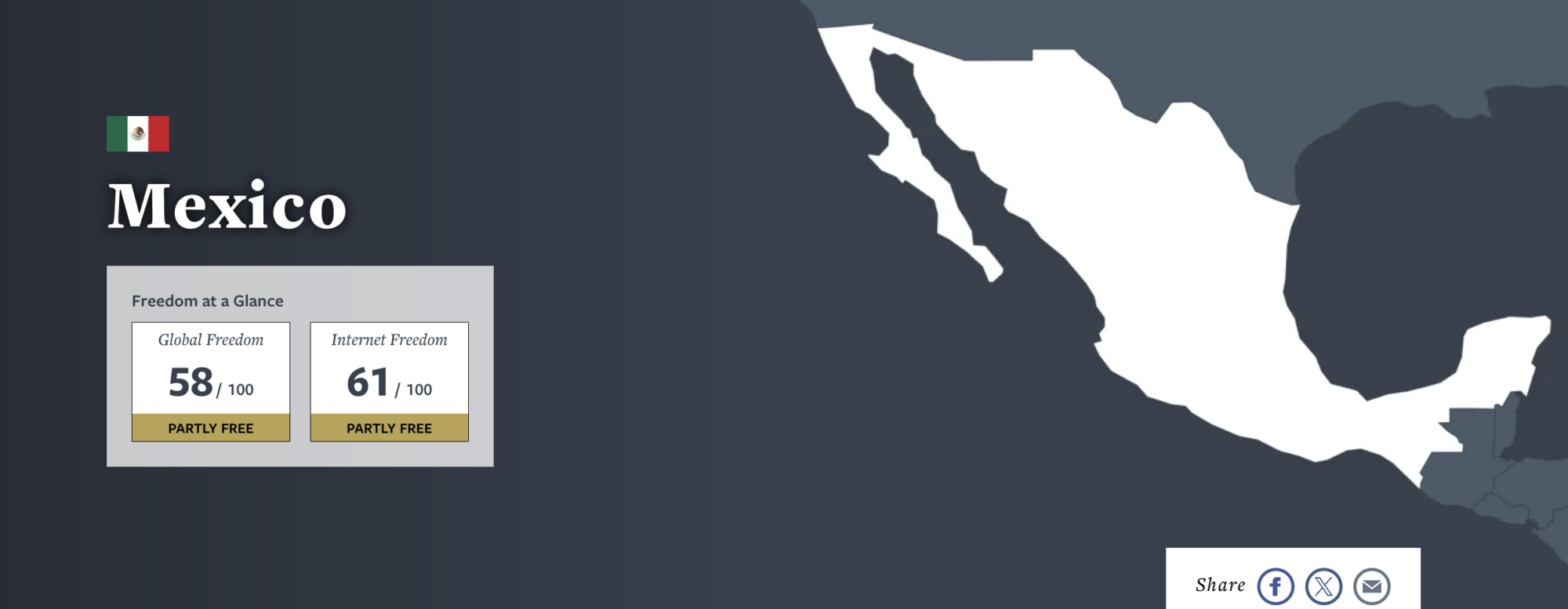
According to the Freedom House 2024 report, Mexico is classified as “Partly Free.” Political rights and civil liberties are not fully protected. V-Dem data also reports a decline in Mexico’s level of liberal democracy in recent years. This decline has been gradual rather than sudden, reflecting ongoing problems in the political system. News reports further describe how elections are affected by violence. For example, BBC reported that elections in Mexico take place under conditions of violence, where both politicians and citizens face threats. Some candidates were attacked orkilled during the election period. Many people feel unsafe when they participate in politics.
 Mexico’s democratic erosion in Mexico has many causes, but is elites, weak institutions, and citizens play the most important roles.
Elites play an important role in Mexico’s democratic erosion. In Mexico, elites include national politicians, party leaders, and local officials. Some of them are connected to criminal groups such as drug cartels. This connection affects elections and political decisions. In the early 2000s, elections were more stable and less affected by violence. But after 2010, the situation started to change. Violence became more visible in politics, especially during elections. By 2018, this problem became very serious. According to BBC, more than 130 candidates and political workers were killed during the election period. This was one of the most violent elections in recent history. These attacks were not random. In many cases, criminal groups tried to control who could run and who could win. Some candidates were forced to stop their campaigns, while others were attacked or killed. This puts strong pressure on political elites. BBC also reports that in recent years, cities like Culiacán have seen constant violence linked to cartels. This violence also affects politics. Armed groups fight for control, and this violence spreads into everyday life. This makes it difficult for politicians to act independently. Political parties are also affected by this situation. Instead of open competition, some parties depend on local power networks, and in some areas these networks include criminal groups. Because of this, elections are not fully fair. Candidates cannot compete freely, and voters cannot make safe choices. This shows that political competition is shaped by voters, and it is also influenced by coercion and informal power structures.
These problems are not just about elites. Institutions in Mexico are also weak. Laws and elections exist, but they do not always work well. In theory, institutions should protect fairness and limit abuse of power, but in reality this often does not happen. Freedom House classifies Mexico as “Partly Free,” and political rights and civil liberties are limited in several areas, so people do not always have full protection under the law. V-Dem data also shows that democracy in Mexico has been declining in recent years, and this change has happened slowly over time. This means the problem is not temporary, but part of a deeper issue. This suggests that institutional weakness is a result of violence and also allows violence to continue, creating a cycle that is difficult to break. A clear example can be seen in levels of violence. According to Reuters, Mexico recorded more than 34,000 homicides in 2019, the highest number in its history, and violence continued even after the government tried to control it. The government also proposed reforms to improve the justice system and reduce corruption, but these efforts have not solved the problem. Corruption and impunity are still serious issues, and many crimes are not properly investigated or punished. Because of this, people cannot fully trust the system. In the end, institutions are not strong enough to control violence and crime, and this makes it harder to keep politics fair and accountable.
Citizens also play an important role in Mexico’s democratic erosion. In a democracy, people are expected to take part in politics, vote, and hold leaders accountable. In Mexico, this has become harder over time. Violence has changed how people act in politics. According to BBC, election violence has created fear in society and affects daily life. In some areas, people do not feel safe even leaving their homes. Because of this, many people avoid politics. Some do not vote at all, and others feel pressure when making choices. Violence also affects which candidates appear on the ballot. According to BBC, some candidates are removed through violence, so voters have fewer choices. This means people cannot always choose freely. Trust in politics is also lower. When people see violence, corruption, and weak institutions, they lose confidence in the system. As a result, they are less willing to participate. Over time, this leads to lower participation and weaker public involvement. Democracy depends on active citizens, so when people are afraid or stop participating, democracy becomes weaker.
In conclusion, Mexico shows how democracy can become weaker over time. This case reflects a broader problem in comparative politics: when violence and weak institutions persist, democracy becomes procedural rather than substantive, meaning that elections exist but do not guarantee real political choice. Elections and laws still exist, but they do not always work well in real life. Elites, institutions, and citizens all play a role in this problem. Some elites are linked to criminal groups, and this affects political competition. Institutions are weak and cannot control violence or enforce rules well. Citizens feel fear and lose trust, so they take part less in politics. These problems are connected and make democracy weaker. Elections alone are not enough. Democracy needs safety, trust, and fair competition. Without these, people cannot take part freely, and democracy may exist in name but not in reality. This lesson matters for other countries as well. Many countries hold elections, but that does not always mean democracy is strong. If violence, corruption, and fear continue, democratic systems can weaken over time. Democracy needs more than rules. It needs real protection for citizens and clear limits on power. It also depends on active participation and public trust. Without these, democracy cannot work properly.
“We can’t even go outside without fear.”
0 Comments