 Indonesia has experienced continuous democratic backsliding since 2017. Despite pervasive executive aggrandizement and other continuing challenges, domestic actors have worked from above and below to resist democratic erosion. This post focuses on student movements, civil society groups, and the judicial branch as key arbiters of necessary accountability.
Before discussing the areas of resistance, it is important to emphasize the relevance of executive aggrandizement and its impact on democracy in Indonesia. A current struggle that Indonesia faces within the executive is a lack of political opposition parties. This in ways, gives the executive branch a lot of opportunity for overreach. Indonesia also has legislative and judicial branches to establish checks and balances within the political system, though these checks have been weakened in recent years. An example of this was the reduction of power for the Corruption Eradication Commission (KPK) in 2019, which revoked the independence of the institution’s work and furthered anticorruption and antidemocratic actions, much of which would be used by the executive branch.
Student Movements:
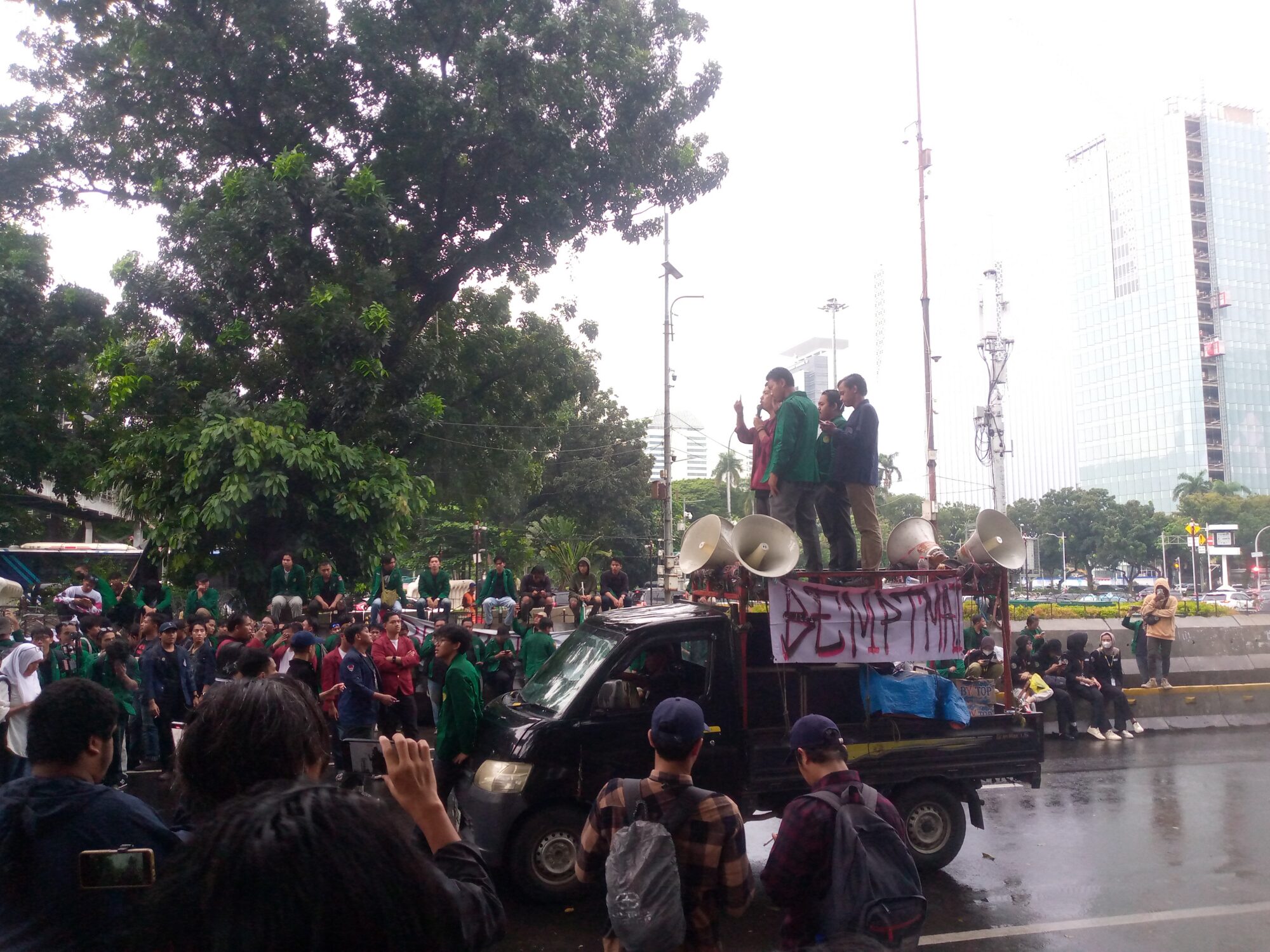
Now that we have set the stage for what is occurring in Indonesia and its implications, we can start to take a look at how institutions and groups are opposing these measures. Last year, there was a student movement called ‘Indonesia Gelap’ (“Dark Indonesia”), which set out to shine light on the controversial decisions and policies of the current president, Prabowo Subianto’s administration and policies. On X alone, 3 million tweets were written under the phrase ‘Indonesia Gelap’, creating domestic and international exposure to the movement. The trigger was largely based on educational budget cuts and the protests consisted largely of an interest to have officers removed from bureaucratic positions. This movement was widespread, from the country’s capital in Jakarta, to smaller towns across the nation. There was much anxiety and worry about the economic state of Indonesia, and also the trend “Kabur Aja Dulu”, which means (“just run away first”), which quickly became a key piece of the “Dark Indonesia” movement. The middle class was shrinking and youth unemployment was growing, which played a large role in the desperate sentiment of this movement.
At the same time, these sentiments helped to shape a way forward for Indonesia and its people, even if it did not have a direct impact on policy or the administration in office. The movement became international through the use of social media, making the world more aware. The State Secretariat Minister, Prasetyo Hadi, spoke on behalf of the government that they had heard the students’ demands and would be taking them into account. Knowing these things, we can see that there were positive impacts on societal-governmental relations through the discourse shared via protests against the government in this movement. The changes do not need to be specifically traced back to a policy change to have an impact on a better future. This serves as a mode of diagonal accountability.
Civil Society:
A vertical system of accountability that we have seen in Indonesia is civil society groups and NGOs. NGOs in Indonesia played a role in the student movement previously discussed, but have helped to influence a variety of things like: structural changes in government, change to truly represent democracy, human rights transgressions, and more. A specific instance came over the Contentious Jobs Law, also called the Omnibus Law, which “aimed to attract investment by slashing regulations and other red tape”. Civil society groups actually filed a judicial review for this law within the Indonesian Constitutional Court. Later on, there were also protests outside the Court on this very issue. Through the contesting of this law, the Constitutional Court ruled the law partially unconstitutional, meaning that civil society was able to have a positive and democratic impact on the governing system.
Judicial Checks:
As discussed in conjunction with NGOs and civil society, the Indonesian Constitutional Court, which has stood as Indonesia’s strongest institutional check on the executive branch, works as a vertical system of accountability. The Court’s independence has eroded periodically because of executive aggrandizement, like the KPK deductions that was discussed towards the beginning of this article. Regardless, we have still seen a multitude of instances where the Court has been able to uphold democratic values and resist executive aggrandizement. A recent example being the ruling against a minimum threshold of votes for political parties to nominate a presidential candidate as legally binding. This decision allows voters to have more freedom to express their opinion over a broader landscape of candidates, rather than being forced to vote along strict lines between less than ideal candidates for their personal values and beliefs.
This article reinforces the importance of above and below accountability, specifically with three key indicators for resisting anti-democratic action: a strong student and youth education, civil society that works as intended, and a judicial branch capable of upholding democratic values. It is also important to note that Indonesia does not strongly display all three of these indicators, though they do have instances where it has been visible and had a positive impact. If all three of these instruments of democracy can be strengthened and corroborated within Indonesian society, then democracy is likely to see worthwhile and meaningful strides in the right direction going forward.
I thought that this post was really interesting and gave a detailed account of the democratic backsliding happening in Indonesia. I think that you touched on some key actors in the resistance movements, and there importance as standing against executive aggrandizement. I particularly found it interesting how big of a role young people had in Indonesia. It is becoming more and more common for young people to come out en masse and fight back against executive overreach trying to consolidate power.
Overall, I think you did a good job exploring all of the facets of resistance to Indonesia’s current struggle.