
Modern Day Scarlet Letter: Women in Afghanistan Being Shamed for Men’s Actions
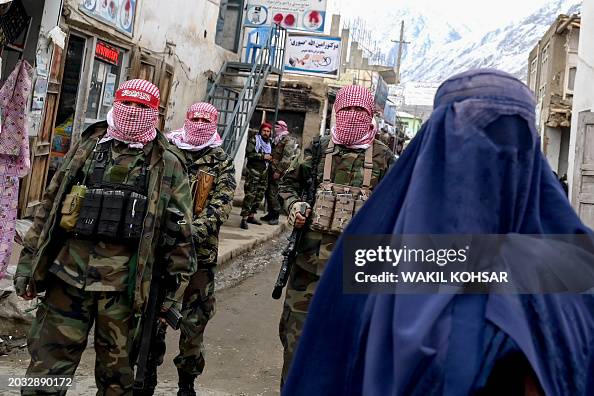
TOPSHOT – Taliban security personnel stand guard as an Afghan burqa-clad woman (R) walks along a street at a market in the Baharak district of Badakhshan province on February 26, 2024. (Photo by Wakil KOHSAR / AFP) (Photo by WAKIL KOHSAR/AFP via Getty Images)
A 16 year old girl named Gulnaz was raped by her cousin’s husband and subsequently thrown in jail due to her own tragedy. How can this be? In Afghanistan, Gulnaz was charged with adultery due to her rapist being married, the blame being totally put onto her. Not only was she jailed and charged for adultery, but also faced public shaming from her community due to the crimes committed against her. After all of this, she was then forced to marry her rapist because he got her pregnant. She was assaulted, jailed, ostracized from her community, then forced into a marriage she didn’t want all due to a man’s heinous actions.
A place where talking in public could have you facing grave consequences; women are barred from getting an education; where a woman cannot even go outside her home without the company of a man; where women do not have the freedom to choose their garments, instead forced to cover up as to appease men. After the 2021 withdrawal from Afghanistan, women and girls are quickly being erased from society. This is the reality for women in Afghanistan under Taliban rule.
Afghanistan, a country in the Middle East, was not always under the rule of the Taliban. While the Taliban always had presence within Afghanistan, they were not able to fully regain control over the country until 2021. This was a direct result of United States president Joe Biden withdrawing all American troops from the country.
Before the Taliban took over, Afghanistan was governed by the Afghanistan 2004 Constitution. This document was established after the 2001 United States invasion of Afghanistan after the September 11 attacks on the United States. The country was a constitutional republic that was helped by the United States led by a president. Along with this there was an elected parliament and legal protections for all citizens, including many for women.
Under this system, women could attend school and university and work in many professions, freedoms they are now stripped of. With this, there were thriving political parties, the citizens having more political input and freedom. While these freedoms were granted, the country still faced a long ongoing war with the Taliban.
So what is the Taliban? It is a terrorist organization, made up mostly of guerrilla fighters, that emerged after a Civil War within Afghanistan caused by Soviet withdrawal from the country in the 1990s. The group was officially founded in 1994 by Mullah Mohammad Omar and gained support from the Afghan people due to its promise of order, security, and Islamic government. This was something that Afghans desperately wanted after the distress of the nation through the Civil War.
The Taliban movement quickly swept the nation, defeating warlords, opening trade, and overall reducing crime. This allowed the movement to gain popularity from much of Afghanistan.
When the Tabian first took over the government in 1996, they imposed Sharia Law, a strict Islamic law. This law made it so that women could not attend school, work most jobs, need to fully cover their bodies in public, as well as have a male guardian at almost all times. Along with this there were many social restrictions for all Afghans, like music, TV, and art. If these laws were not upheld their government would punish you, often amputating a limb or executing a citizen.
After the 2001 United States invasion of Afghanistan, the Taliban temporarily lost power. They regained power after the United States and NATO withdrew all troops from the country. This allowed for the Taliban to make a quick sweep of the nation starting in Kabul. The Islamic Republic quickly collapsed, the president at the time Ashraf Ghani fleeing from the nation.
Since the regain of power, the Taliban has imposed more restrictions by the day, many targeting specifically women and girls. Today, women cannot go to school after sixth grade, cannot work almost anywhere in the country, need to travel with a male guardian, recognize childhood marriage, and require women to be fully covered in public.
On June 12, 2026 it was reported that at least 30 women were arrested in the city of Herat, due to violating the rules regarding how women must dress. Because of this, they protested the Taliban, but not without repercussions.The U.N. Assistance Mission in Afghanistan reported that there was excessive force used on these protestors, protestors reportedly being sprayed with bullets and beaten. This resulted in the death of at least two people, one being a young boy, and the injury of many.
In opposition to this, there have been protests throughout the world. In Paris and Italy on Saturday June 13, many gathered to fight back against this oppressive rule. Protestors emphasized the idea that this one incident in Herat does not stand alone, but is one of many incidents to erase women from public life in Afghanistan.
American actress Meryl Streep when speaking to the U.N. in 2024 regarding the Taliban’s oppressive rule stated,
“Today in Kabul a female cat has more freedom than a woman. A cat may go sit on her front stoop and feel the sun on her face, she may chase a squirrel in the park.” This quote is sad, but entirely true.
While looking at this, we see that in the year 2026, women still face discrimination simply based on the gender they were born as. Though the Taliban cannot be eradicated overnight, we can look at how to better support women throughout the world, further the issue of feminism and emphasize the importance of equality for all. Gulnaz’s story is one of many. We must strive to help girls like her and women under oppressive rule. We cannot let these women live in the shadows. We must share their stories and work to help them. These women cannot be forgotten.
0 Comments