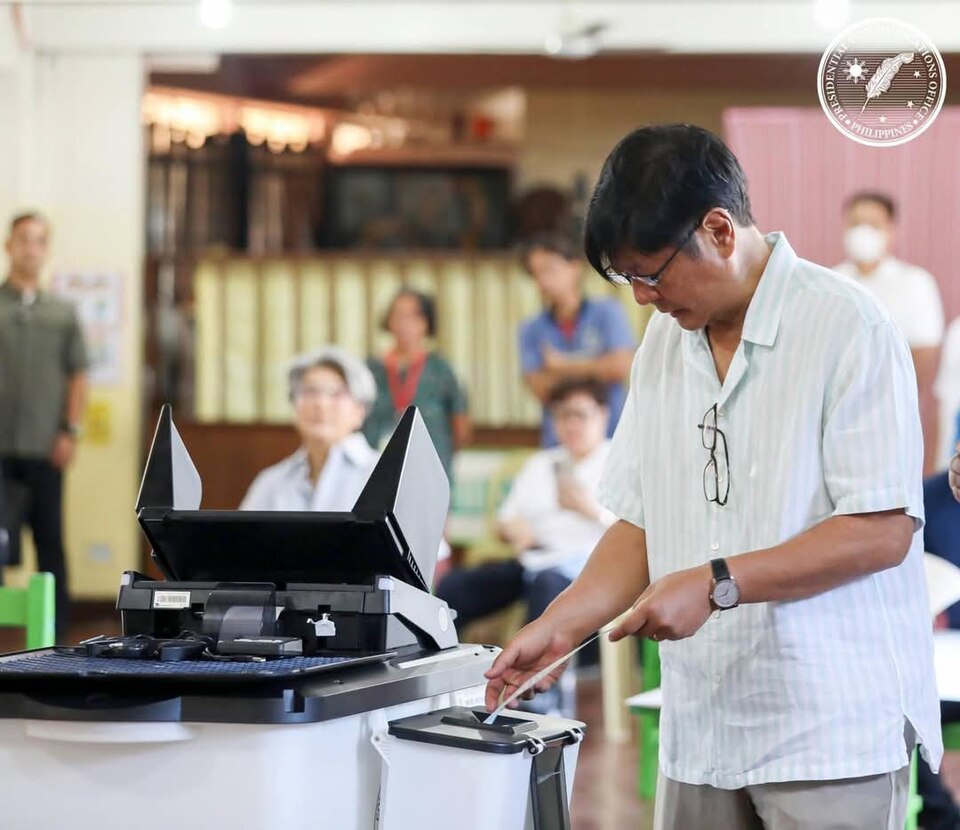
President Ferdinand Marcos Jr. casts his ballot during the 2025 Philippine midterm elections. Photo: Presidential Communications Office / Wikimedia Commons (Public Domain).
In 2022, Ferdinand “Bongbong” Marcos Jr. was elected president of the Philippines. This was more than 30 years after his father’s authoritarian rule ended in the people power revolution. His victory was achieved through elections, not through a military coup or the overthrow of democracy. That is why this case is important. Democracy does not always disappear at once. Sometimes elections continue, but democratic institutions and political competition gradually weaken. The Philippines still maintains an electoral democracy. People vote, opposition candidates run for office, and the country has a constitution, courts, and political parties. Yet these institutions exist alongside powerful political families, patronage networks, and weak checks on political power. The Philippines shows that democracy can erode even when elections continue. Political dynasties concentrate power and patronage networks weaken genuine political competition, and democratic institutions often fail to deal with powerful elites. Economic development and regular elections have not been enough to solve these problems.
At first, the Philippines may not look like an obvious case of democratic erosion. Elections remain competitive, and this shows political opposition has not disappeared yet. However, elections alone do not tell us how well a democracy is functioning. Freedom House’s 2026 report on the Philippines gives the Philippines 58 out of 100 points and classifies it as “Partly Free.” Elections remain competitive. However, the report points advantages held by established political elites, vote buying, and organized disinformation. Also, the Philippines receives only 2 out of 4 points for whether the opposition has a realistic opportunity to gain power.
This creates a contradiction. Citizens have the right to choose their leaders, but political competition is not equally open to everyone in reality. The 2022 presidential election shows this clearly. Marcos Jr. entered politics as a member of one of the most powerful political families in Philippine history. His father, Ferdinand Marcos Sr., ruled the country for more than two decades and imposed martial law before being removed from power in 1986. This does not mean that the 2022 election itself was undemocratic. Millions of Filipinos participated and Marcos Jr. won the election. His victory shows that democratic elections can continue while powerful political families maintain their influence.
Political dynasties have long been a major part of Philippine politics, and Marcos family is also not an exception. According to Freedom House, about 70 percent of seats in the Philippine House of Representatives were controlled by political families that had been in power for decades. Political dynasties remain a major part of Philippine politics. Political dynasties matter because they give advantages to established families and make it difficult for other non-elite people to compete. These families already have political connections, financial resources, and name recognition. Once one family member gains office, these connections and networks help other relatives enter politics easily.
According to Freedom House’s 2026 report on the Philippines, established political elites benefit from structural advantages, while widespread vote buying and organized disinformation undermine fair political competition. This means that citizens have the right to participate in politics, but not all candidates have the same chances in elections. This can be explained through an elite approach to democracy. Political rights may be available to everyone, but powerful elites can still have much more political influence than ordinary people. The continued influence of families such as the Marcoses and Dutertes shows how political power can remain concentrated even when competitive elections continue. In politics, sometimes personal relationships are valued more than politics itself. This is where patron-client relationships become important. Patronage politics involves politicians providing resources, services, jobs, or other benefits while building political support and loyalty. This does not mean that Filipino politics itself is causing the erosion of democracy. However, when personal and family ties become more important in a weak system, they can lead to erosion of democracy. Since political parties in the Philippines are often formed around individual politicians, personal alliances become more important than party platforms. Under these conditions, powerful families can have established names, money, local organizations, and networks of supporters. Political power provides access to resources. Those resources strengthen political networks, and those networks make it easier for family members to win future elections. As a result, this cycle continues even when elections are competitive.
This problem can also be explained through an institutionalist approach. The Philippines has democratic institutions such as elections, a constitution, and courts. However, having these institutions does not always mean that they can effectively control political power. Freedom House’s 2026 report gives the Philippines only 1 out of 4 points for safeguards against corruption, 2 out of 4 for judicial independence, and 1 out of 4 for due process. These weaknesses make it more difficult for democratic institutions to hold powerful political actors accountable. The influence of political families also shows this problem. Even though elections remain competitive, political power can still be concentrated among a small number of elite families, such as the Marcoses and Dutertes. This shows that having democratic institutions does not always mean that they can actually control political power. The Philippines complicates modernization theory, which generally holds that economic and social development strengthens the prospects for democracy. According to the World Bank, the Philippines has experienced strong economic growth alongside increasing urbanization. Also, UNDP reports long-term improvements in human development and literacy. Yet these developments have not eliminated political dynasties or patronage politics.
This does not mean modernization theory is wrong. Development can create conditions that support democracy. However, the Philippine case shows that development itself does not guarantee democratic consolidation. Economic growth can occur while political power remains concentrated. Elections can continue while institutions remain weak. In the Philippines, modernization cannot be understood separately from institutions and political power. Becoming wealthier or more developed is not enough. Institutions also need to make political competition more equal.
The Philippines is important to the study of democratic erosion because democracy has not simply disappeared. Filipinos still vote, opposition politicians still compete, and political debate remains active. These are meaningful democratic features, but at the same time, political dynasties, patronage networks, and weak institutional checks can reduce political competition and accountability. The return of the Marcos family to the presidency in 2022 illustrates these tensions. It was achieved through elections, but it also showed how political influence can endure across generations. The case of the Philippines shows why the erosion of democracy does not always mean the sudden end of democracy. Voting can continue even as meaningful political competition and institutional accountability gradually weaken. Elections are essential to democracy, but elections alone are not enough.
0 Comments