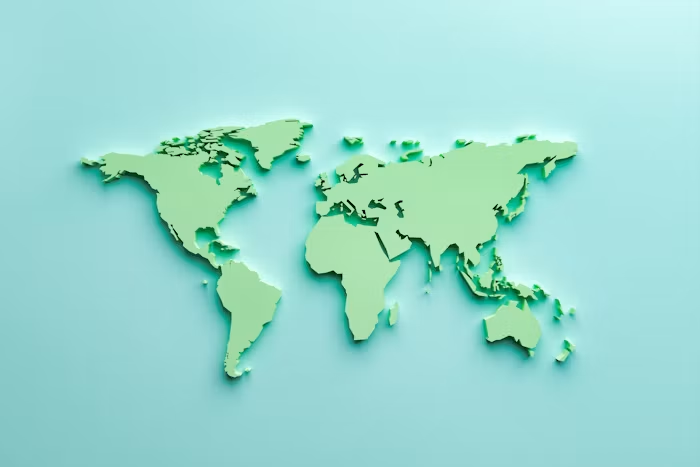
When you look at the map, Mongolia is positioned at the heart of the Eurasian continent—a location that catches your eye, yet seems a difficult geopolitical position for democracy to survive. Here are a few reasons why Mongolia has political disadvantages in forming a democratic regime.
The Dilemma of Mongolian Democracy
First, geographically, Mongolia looks like a ‘ham’ in the sandwich of Russia and China both of which are governed by authoritarian regimes. Both neighboring countries are classified as “Not Free” by Freedom House. These geographic locations pose a challenge to Mongolia, as Russia and China may seek to expand their political influence, by using trade agreements as bargaining chips. Second, Mongolia is a typical resource-dependent economic country. Major corporations in Mongolia are involved in the production and manufacturing of natural resources. It is because the country has vast coal reserves. When the government relies highly on land-based revenue, which is less mobility than human capital, citizens lose the power to control the government. Even without citizen’s taxes, the government can continue to generate revenue. So these types of countries do not take the public’s demands. This leads to institutional corruption known as the resource curse. Lastly, Mongolia did not experience gradual democratization. In 1990, through a rapid revolution, Mongolia transitioned from a socialist regime to a democratic system. While other European countries gradually developed institutions to consolidate their democracies, Mongolia’s democratic history began under Punsalmaagiin Ochirbat, immediately after the communist regime ended. Although Mongolia faces these vulnerable conditions, according to the Freedom House indicator, Mongolia is rated at 84 out of 100. And we wonder, “How can Mongolia maintain democracy despite such unfavorable situations?” The answer lies in civil society’s self-correcting capacity: when elites pursue their own interests, citizens proactively challenge their power.
The Coal Theft Scandal: Elite Collusion and Symptoms of Backsliding
In 2022, Mongolia faced a serious corruption known as the ‘The Coal Theft Scandal’, which shows how institutions act on democratic backsliding. According to Gandhi, elites calculate ‘procedures for modifying laws and institutions’, while ignoring the ‘spirits of the law’. This stealthy movement makes it difficult to detect democracy being eroded, because it does not visibly show up in the “bright line” that is explicitly revealed. In Mongolia, the great corporation Erdenes Tavan Tolgoi (ETT), abused the point that ‘The mineral law’ states that ‘strategic mineral deposit are linked to national security’. They utilize off-take contracts with a Chinese corporation and secretly smuggled intentionally. And they undervalued coal across the border for private gain. The scandal was disclosed through a social media post by Member of Parliament (MP) Dorjkhand Togmid, which claimed that Mongolia had lost approximately 6 million tons of coal to corruption over a decade. Furthermore, it turned out that a number of government elites, including six incumbent members of parliament, secretaries, inspection officials, and a former president, were involved. This case illustrates how economic and political elites formed alliances and weaponized legal power, and destroy checks and balances. The Mongolian government became picky eaters to protect its corruption from public scrutiny ; rather than keep spirits of duty to disclose information to its citizens, it downplayed the principle of transparency for private gain.
This event caused Mongolian citizens to doubt whether the democratic system reflected their interests, which ultimately led to a disconnect between the trust of state and civil society. We can vividly see the consequences of declining public trust in the government through two indicators from V-Dem. First, control of corruption. In Mongolia it’s gradually declining, and it remains at a low level. Secondly, The civil society participation has noticeably declined from the 2010s to the 2020s. Eventually in 2022 it reaches its lowest level. We can interpret these symptoms through Foa and Mounk’s The Democratic Disconnect. From Foa and Mounk’s perspective, this demonstrates Mongolia’s path toward “democratic deconsolidation.” They argued that when citizens lose trust in their ability to control dishonest society through democratic rules, the demand for authoritarian alternatives becomes higher, such as military force. Moreover, when “vertical accountability”—in other words, the trust between citizens and the government—breaks down, it can lead to withdrawal from democratic participation. The case of established democratic countries since 1960 proved this logic. The voter turnout has fallen, and political-party membership has declined. Based on the data we see above, Foa and Mounk’s argument suggests that Mongolia’s democracy could also face a dark future. This is because Mongolia’s democracy indicators show that citizens have lost confidence to participate in democracy and that there is an internal risk of growing support for authoritarian alternatives.
The Response of Mongolian Civil Society
However, Mongolia’s democratic crisis did not end with democratic erosion. Rather, it created an opportunity to show how Mongolian civil society exercised its self-correcting capacity. And to fight institutional corruption. As the “Coal Theft Scandal” spread through social media, it provoked anger among many Mongolians. In December 2022, thousands of Mongolian citizens gathered in Sukhbaatar Square despite brutally cold temperatures of -30 degrees Celsius. During the protests, they made several demands of the government. It includes appropriate punishment for those responsible for coal theft. Specifically, to “name the thieves” and prescribe harsher sentences for the restoration of sovereignty over mineral resources to ensure the livelihoods of Mongolians. As the protests intensified protesters often clashed with police, and attempted to charge toward the State Palace (Төрийн ордон), angered by the government’s downplaying of the issue. This protest can be explained through the theory of Economic Origins Of Dictatorship and Democracy, in which Acemoglu and Robinson distinguish between two forms of power: de jure political power, which is “allocated by political institutions,” and de facto political power, which emerges through the use of force. In most democratic countries, citizens entrust both power to political institutions, such as parliament, which exercises legislative authority, and the police, which represent actual force. But when an economic crisis, such as Mongolia’s coal scandal occurs, citizens can challenge de jure power; the Mongolian protesters’ shouting of slogans, tearing down barricades, and clashing with police are clear examples of this. When citizens exert real force, they inevitably face the challenge of maintaining it. Governments already know that this physical force is temporary; elites just suggest foggy and non-credible promises to suppress public anger. To turn their demands into action, citizens institutionalize their demands. In Mongolia’s case, following the protests, they succeeded in converting their demands into permanent action. Finally, the Mongolian government amended the Criminal Law, extended the statute of limitations, and imposed harsher sentences for coal theft, as the protesters had demanded. Under this amendment, the minimum sentence for major corruption offenses became imprisonment.
Democracy Without Prerequisites?
Mongolia is considered a democracy without prerequisites or an inner Asian anomaly of post-communism because it does not seem to fit the conditions that political scientists expect of a democracy. This phenomenon occurs because systems are originally made by humans for distributing the power that naturally emerges among people. Therefore, the most important factor that influences democracy is not rigid institutions and unchangeable history, but rather active citizens themselves. This means that democracy is not a form of lottery that is determined by luck. Mongolia’s experience implies that if people continually demand accountability from the system, the country can develop into a democratic society. In other words, like angered Mongolians taking to the streets to demand systemic reform, the institution also could change when people take action against the ‘elite’ hiding under a sheep’s clothing in the name of democracy.
0 Comments