 Most people when they hear the word democracy think of elections. Indonesia appears to demonstrate just that. Since the beginning of Suharto’s authoritarian rule ended in 1998, Indonesia has experienced peaceful transition of power through elections that are holding regularly. But elections do not a democracy make. In this post I will argue: Indonesia has good elections and participation, but weakening rights and checks.
In order to understand this argument, I bring in literature from my comparative politics course. Schmitter and Karl say that democracy is not only election but not existence of elections. Robert Dahl defined actual democracy, polyarchy, as a regime that meets two conditions: contestation and inclusion. Contestation means the opposition can compete in election. Inclusion means that nearly all adult can vote and compete in election. Dahl also specified which factors can facilitate these two conditions: freedom of speech, movement, assembly, alternative sources of information, and having independent groups. I use three sources to analyze these parts of the regime that satisfies Dahl’s necessity, which are Freedom House, V-Dem, and International IDEA.
The numbers are now showing real improvement. Freedom House scores Indonesia 56 points out of 100 and ranks it as “Partly Free.” It recognizes Indonesia’s “democratic advances” made since 1998, such as increased political and press diversity. The 2024 election was also large. International IDEA reports that 82.39% of voters cast their ballot for the president, legislators, and local governments. Prabowo Subianto also took over as president in October 2024. High voter participation and a new leader indicate a strong democracy.
However, the other sources paint a different picture. Freedom House scored Indonesia with only 28 out of 60 points for civil liberties. They cite corruption, minority discrimination and in Papua, violence. They also cite defamation and blasphemy laws that are subject to political manipulation. V-Dem’s Democracy Report 2026 is even more negative. A summary of the report on the Democracy Report 2026 concluded, quote, “Indonesia’s score for liberal democracy has decreased from around 0.5 in 2016 to 0.3 in 2025, the lowest in a decade, (and) has been attributed to years of missing and compromised elections, failed electoral management, diminished citizen participation, and worsened performance of the electoral integrity index,” end of quote.
The news stories shed some light on these figures. In October 2023, Indonesia’s Constitutional Court overturned Gibran Rakabuming Raka’s age barrier, allowing Jokowi’s son to run for vice president. His chief justice was later appointed to the country’s highest court after an ethics inquiry. The election seemed to be normal as he was changing the rules. A Jakarta Post analysis did the same by noting that Indonesia slipped three spots to 59th of 167 nations in the Economist Intelligence Unit’s 2024 democracy index, even in a major election year.
This pattern is similar to a concept I learned about in my course on democracy called stealth authoritarianism, by legal scholar Ozan Varol. That is the use of legal instruments that appear neutral or procedural in order to weaken political opponents while preserving a democratic veneer. Varol classifies the use of law as a tactic, not a regime type. Examples he offers are judicial review, libel litigation, and electoral systems. You can apply each to Indonesia’s cases. An appellate decision paved the way for the president’s son. Libel suits raise the cost of criticism. A draft election law revision would have countermanded judicial decisions. Each case was a law, so each case could appear legitimate.
Writes the other authors of the study, Sana Jaffrey and Eve Warburton: “The bigger picture.” In a study published in the Bulletin of Indonesian Economic Studies, Sana Jaffrey and Eve Warburton write Indonesia is “at the brink of competitive authoritarianism”. They also write in another report for Carnegie that the court that opened the door for Gibran was led by Jokowi’s brother in law; that Jokowi weakened the anti-corruption commission (KPK); and that he brought the political elites into line. Those are of course questions of horizontal accountability, the system where a court keeps parliament in check and parliament keeps the anti-corruption commissions in check; that is, horizontal accountability. That of course is what elections and protests are about, they are meant to hold the leaders to account, so that is (or was) vertical accountability. The high voter turnout suggest it is indeed alive and well, but the lower score in civil liberties and rule of law indicate that horizontal accountability may be weekend.
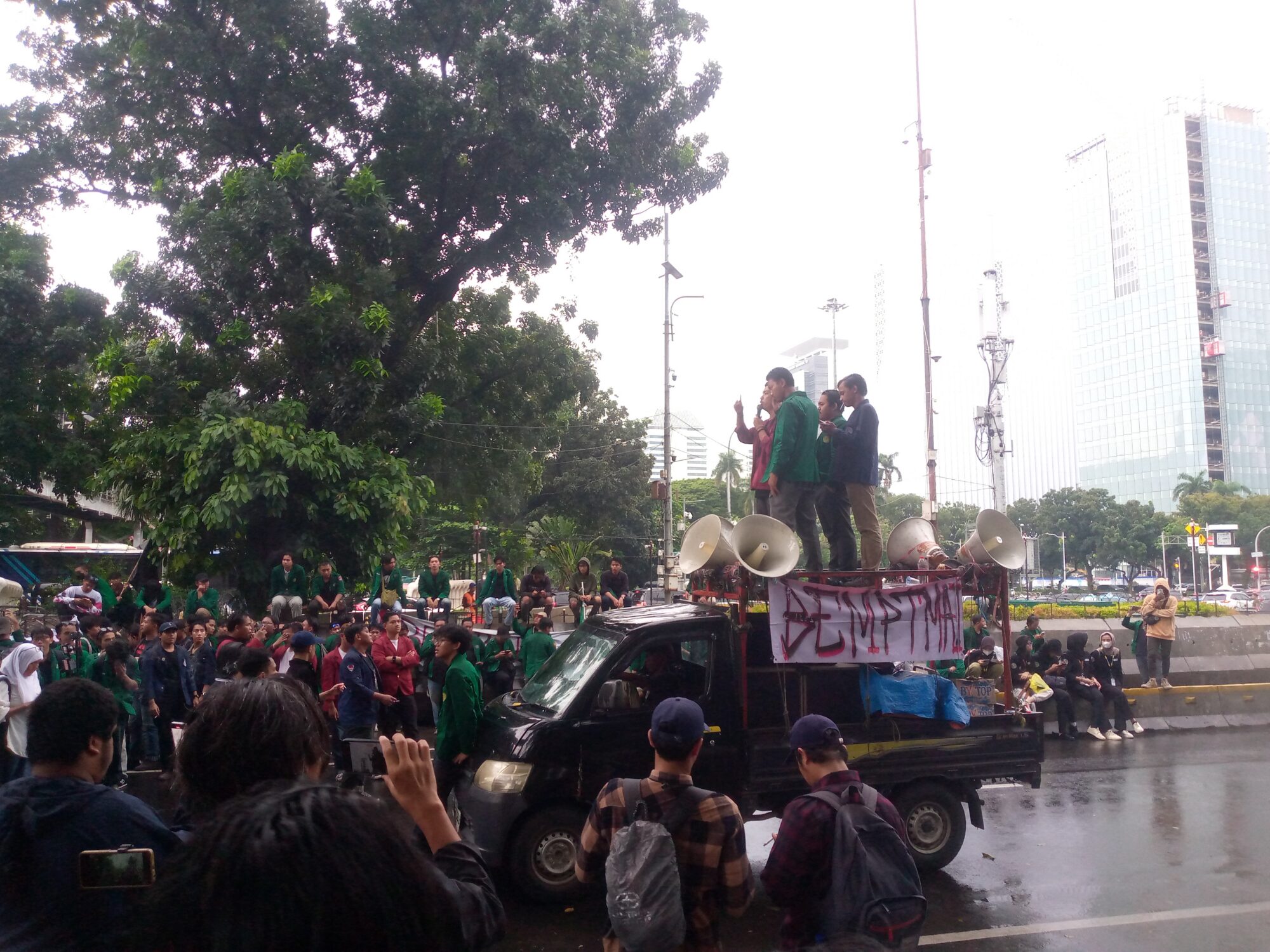
Citizens also responded. In August 2024, the Indonesian parliament held a special meeting in order to get around two Constitutional Court decisions on regional elections. One decision kept a governor’s age limit intact which would have prevented Jokowi’s youngest son from becoming governor himself. Arab News reports that thousands of citizens demonstrated in the Indonesian capital and other cities. The parliament then called off a vote on the issue after they failed to meet a quorum. This illustrates two key points. First, citizens can still hold their leaders to account via protest (though this is one of Dahl’s freedoms). Second, the rules were on the verge of being changed to benefit the powerful, and it was only protests on the street – not the courts or parliament – that stopped this from happening.
A second is the military. In March 2025, the House of Representatives voted unanimously for a revision of the military (TNI) law (Jakarta Post), which critics claim could allow active officers to have civilian positions without ever leaving the military. Mass protests resumed in multiple cities again. The House Speaker pointed out the revision order back to civilian supremacy and human rights. Still, the controversy illustrates why such controls are necessary.
These examples illustrate a rift between inclusion and contestation. Indonesia has generally been good in terms of inclusion, given the high voter turnout. When it falters is in contestation, when a court decision benefits a family, when parliament attempts to rewrite a decision by the court, and when the military could be likely to occupy civilian positions again-competition is less than fully equal. Voters still cast ballots, but the game they’re playing is perhaps more rigged than it appears. That is why a high abstention rate can be deceptive; it signals a transparent display of votes, but not whether that vote will impact who gets into power.
Others might contest my argument. They might argue that elections are the most vital element of democracy – through them, a government can be held to account. This is a valid argument. Freedom House ranks Indonesia perfectly on whether its president and legislature were directly elected in free and fair elections, and it racked up higher-than-average turnout levels in 2024. But elections only matter when people are able to vote freely, when their courts are independent, and when rules are not rewritten to increase the advantage of one group over another. The 2024 protests highlight how many citizens value those safeguards.
So Indonesia demonstrates the limits of judging democracies by their elections. Citizens are active but their rights, the rule of law, and accountability to other institutions is eroding. A syndicate of pieces presents a more accurate portrait than turnout alone. If Indonesia is to defend its democracy, it should be defending independent courts, civil liberties, and transparent lawmaking-not just holding elections to schedule.
Indonesia: Democracy Is More Than Just Elections
Student Author: Taeeun Kim
This is a student blog post written by a student participant in the Democratic Erosion Course. This post was not written by nor does it represent the views of the Democratic Erosion Consortium.
Sign Up For Updates
Get the latest updates, research, teaching opportunities, and event information from the Democratic Erosion Consortium by signing up for our listserv.
0 Comments