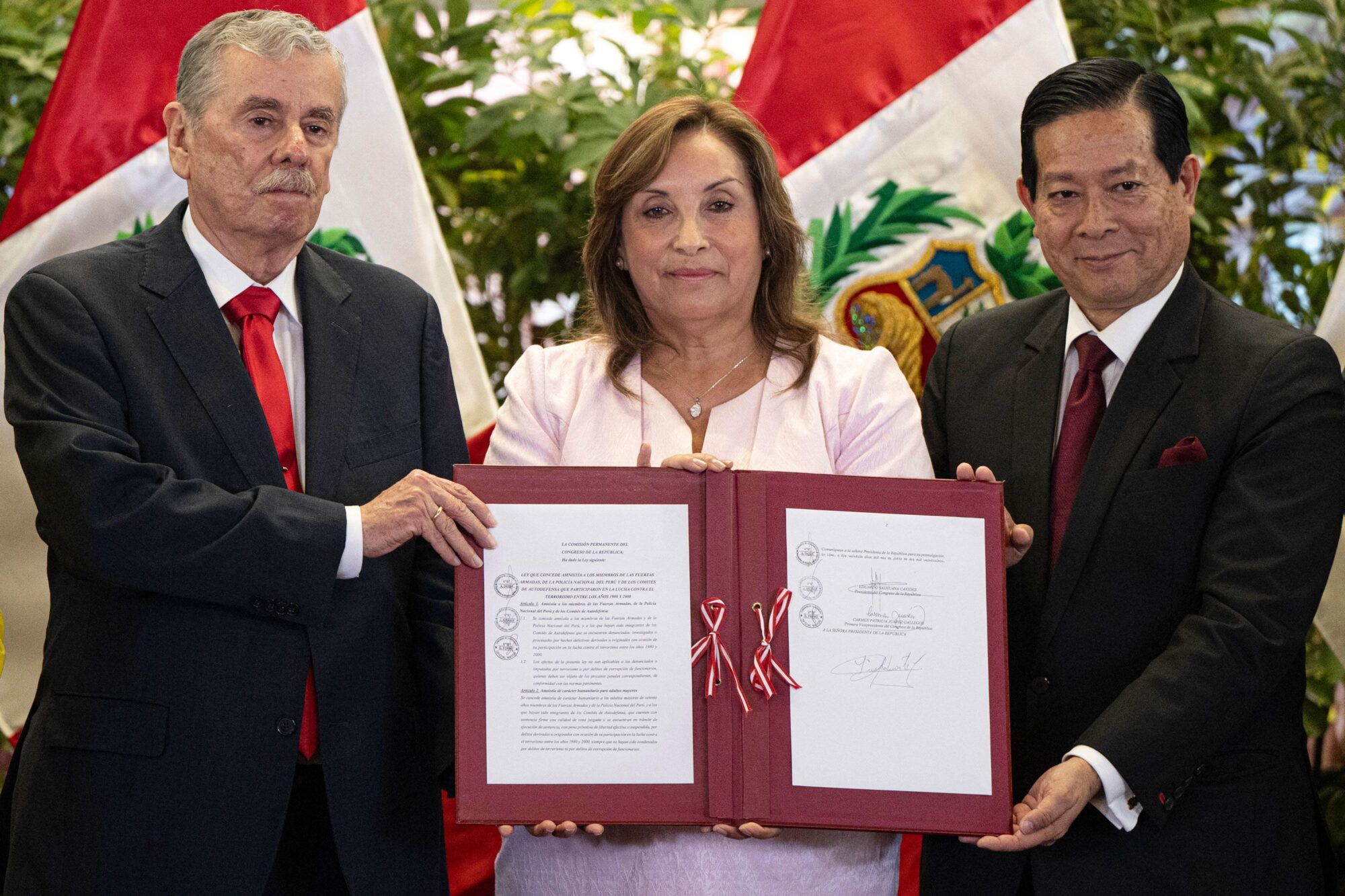
Peru’s President Dina Boluarte, center, in Lima after signing bill No. 366 of 2023 into law. (Ernesto Benavides/AFP/Getty Images)
On August 13 2025, recently impeached Peruvian President Dina Boluarte signed bill No. 366 of 2023 into law, which provided amnesty to those who committed crimes against humanity during the country’s internal conflict between 1980 and 2000. Throughout the conflict, the military, police, and various self defense committees carried out human rights abuses while fighting the Maoist Shining Path insurgent force. Many of those who committed such atrocities went on to ally themselves with the president and the nation’s legislative majority. The law garnered swift criticism from citizens and human rights organizations as it violated the nation’s obligations under international law. Boluarte defended her decision by claiming that it provided justice to those who fought against terrorism, even though many of the injustices such as forced sterilizations were conducted on civilians. This was not an isolated incident, as Boluarte routinely implemented measures to consolidate her power, protect her supporters, and suppress dissent after she ascended to the presidency in 2022. Since 2016, Peru has endured a period of political instability, evidenced by a revolving door of presidential impeachments and resignations. Given this trend, how has Peru’s legacy of internal conflict and political instability affected the current period of democratic erosion?
Presidency of Alberto Fujimori and Peru’s Internal Conflict
Peru’s current political crisis is rooted partly in the legacy of the nation’s internal armed conflict (1980–2000), a period marked by violence, economic collapse, and democratic backsliding. The conflict began when the Maoist Shining Path launched a violent insurgency following the country’s transition from a military dictatorship to a burgeoning democracy. Amid hyperinflation, mass unemployment, and food shortages during the “Lost Decade” financial crisis, the group gained influence among impoverished rural and indigenous communities by exploiting their minority status. In response, the Peruvian government, influenced by Cold War anti-communist strategies in Latin America, targeted these same populations with brutal counterinsurgency campaigns. The result was a cycle of violence that killed thousands, weakened democratic institutions, and entrenched social divisions that remain today.
Alberto Fujimori was elected to the presidency in 1990 on a promise to resolve the economic crisis and the internal conflict. Amid conflicts with Peru’s legislature, Fujimori carried out a self-coup in 1992, in which he dissolved the constitution and implemented Plan Verde—an authoritarian plot that centralized power, censored the media, and enacted state-sanctioned atrocities such as the forced sterilization of about 300,000 rural Indigenous women. His government used death squads and the military to suppress dissent under the guise of fighting terrorism, resulting in a consistent pattern of human rights abuses. Though the Shining Path was largely defeated, Fujimori normalized corruption, executive overreach, and the militarization of politics. Additionally, his legacy cemented the distrust of institutions, political polarization, and the endurance of populism that continues to shape Peru’s democratic crisis today.
The theories on democratic erosion defined in Walder and Lust (2018) can conceptualize how backsliding occurred at the time. Foremost, their agency-based theory explains that political leaders take actions to hurt democratic institutions when they could have made separate decisions that instead strengthened democracy. For example, the Peruvian Government could have helped to defeat the Shining Path by strengthening the political and civil rights of the country’s rural and indigenous populations, instead of restricting them. Furthermore, Walder and Lust’s theory on social structure details how economic and cultural divisions influence the formation of political coalitions. At the time, widespread corruption and violence pitted the wealthy and lower classes, rural and urban areas, and the native and non-native populations against each other making it harder for a heterogenous coalition to form and fight back against the authoritarian regime.
Bill 366’s Effect on Peru’s Democratic Crisis
Although Bill 366 only consists of about 200 words, it holds the power to ensure that the crimes against humanity committed during Fujimori’s Presidency and the internal conflict are forgiven permanently. It grants widespread amnesty to any member of the military, police, or self-defence committees who were “accused, investigated, or prosecuted for criminal acts” from 1980-2000. Notably, it excludes those who were suspected or convicted of terrorism, as many of them were a part of the Shining Path and thus opposed to the Peruvian government. The legislation also provides humanitarian amnesty to those over the age of seventy who are currently serving prison sentences, allowing them to walk free.
The context around the legislation’s passage helps to explain not only why it was created, but also how it undermines democracy. The amnesty bill was first introduced in April 2024, months after Fujimori was released from prison after a legal battle over whether a pardon he received in 2017 was valid. He was previously convicted in 2009 for committing crimes against humanity during his presidency, including the authorization of kidnappings and murders by the Grupo Colina death squad. The former president intended to run for reelection at the next general election, and his allies in the Popular Force Party (the largest in Peru’s legislature) wanted to ensure that he would not go back to prison if his pardon was overturned. Overall, the bill damaged Peru’s democratic institutions by weakening horizontal accountability. In the words of Levostky and Ziblatt (2019), Boluarte and the legislature used the amnesty bill to “sideline the referees” by ensuring rulings and investigations from the nation’s courts were powerless against Fujimori and his allies.
Although Fujimori has been out of office since 2000 and ultimately died in 2024, the right wing populist movement he started continues to influence Peruvian politics. His daughter Keiko has led the Popular Force Party since 2009, and unsuccessfully ran for president three times. During this period the Popular Force has primarily controlled the country’s legislature, and used its position to fight against the executive branch when held by members of opposing parties. Popular Force has also attempted to collaborate with individuals who were convicted of crimes against humanity to ascend Keiko to the presidency. Vladimiro Montesinos, the former head of Peru’s Intelligence Service under Alberto Fujimori, was convicted of crimes against humanity for forcefully disappearing multiple individuals in 1993. While imprisoned in 2021, he conspired with judges to prevent leftist Pedro Castillo from entering office, and ensure that Keiko would not be arrested upon her attempted rise to the presidency. Although the plot failed, it serves as an example of how Popular Force and Boluarte used their positions to aid Forjimorist allies such as Montesinos, who will benefit from the amnesty bill by having his crimes expunged.
While Dina Boluarte did not enter politics as a member of Popular Force or any of its allied parties, she chose to align herself with Fujimorism to help maintain her power. Although this failed, Boluarte’s leadership style, highlighted by her support of the amnesty bill, shows how Peru’s political institutions are structured in a way that incentivizes opportunism and limitation of horizontal accountability. In order to prevent further backsliding in the future, the nation’s form of governance must change in a way that simultaneously limits presidential and legislative power while strengthening the impact of independent judicial and governmental bodies.
Bibliography
Carranza Ko, Ñusta P. “Making the Case for Genocide, the Forced Sterilization of Indigenous Peoples of Peru.” Genocide Studies and Prevention 14, no. 2 (2020): 90–103. https://doi.org/10.5038/1911-9933.14.2.1740.
Chavez Linares, Carlo. “A Case for Disastrous Party Politics in Peru.” Res Publica – Journal of Undergraduate Research 27, no. 1 (2022). https://digitalcommons.iwu.edu/respublica/vol27/iss1/9.
Collyns, Dan. “Former Peru Spy Chief given Another Jail Sentence for 1993 Forced Disappearances.” World News. The Guardian, September 28, 2016. https://www.theguardian.com/world/2016/sep/28/peru-spy-vladimiro-montesinos-sentenced-forced-disappearances.
“Conspiraciones telefónicas.” IDL, June 26, 2021. https://www.idl-reporteros.pe/conspiraciones-telefonicas/.
Correa, Javier. Alberto Fujimori, Deceiving Democracy: Source of Power for Neo-Populism and Neo-Authoritarianism in Peru, 1990 to 2000. May 21, 2021. https://nrs.harvard.edu/URN-3:HUL.INSTREPOS:37367673.
Jima-González, Alexandra, and Miguel Paradela-López. “The Negative Impact of Shining Path on Indigenous Mobilization in Peru: An Approach from Political Opportunity and New Social Movements Theories.” Latin American Perspectives 48, no. 6 (2021): 194–209. https://doi.org/10.1177/0094582X211031920.
LA NACION. “Presidenta de Perú rechaza orden de Corte IDH de suspender ley de amnistía a militares.” July 31, 2025. https://www.lanacion.com.ar/agencias/presidenta-de-peru-rechaza-orden-de-corte-idh-de-suspender-ley-de-amnistia-a-militares-nid31072025/.
Levitsky, Steven, and Daniel Ziblatt. How Democracies Die. First edition. Broadway Books, 2019.
Manifold | BFI. “The Case of Peru | The Case of Peru.” Accessed January 22, 2026. https://manifold.bfi.uchicago.edu/read/the-case-of-peru/section/12466d4e-8123-4775-be11-3cc718678fcf.
Peru: Amnesty Bill Signed into Law | Human Rights Watch. August 13, 2025. https://www.hrw.org/news/2025/08/13/peru-amnesty-bill-signed-into-law.
Schmidt, Gregory D. “Fujimori’s Coup and the Breakdown of Democracy in Latin America. By Charles D. Kenney. Notre Dame: University of Notre Dame Press, 2004. Pp. Xvi, 380. Tables. Figures. Notes. Bibliography. Index. $30.00 Paper.” The Americas 62, no. 1 (2005). https://doi.org/10.1353/tam.2005.0145.
Waldner, David, and Ellen Lust. “Unwelcome Change: Coming to Terms with Democratic Backsliding.” Annual Review of Political Science 21, no. 1 (2018): 93–113. https://doi.org/10.1146/annurev-polisci-050517-114628.
0 Comments