
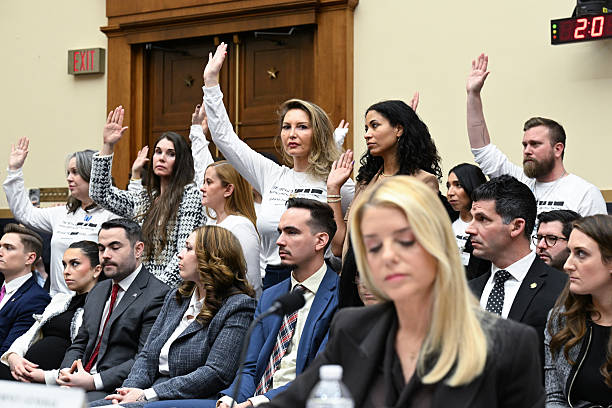
Victims of convicted sex offender Jeffrey Epstein react as US Attorney General Pam Bondi testifies before a House Judiciary Committee hearing on “Oversight of the Department of Justice” on Capitol Hill in Washington, DC, on February 11, 2026. (Photo by ROBERTO SCHMIDT / AFP via Getty Images)
In a June 2024 Fox News interview, then presidential candidate Donald Trump claimed that when in office, he would support the release of the full Epstein files. These files pertain to convicted sex trafficker Jefferey Epstein. Epstein was a financier who pleaded guilty to state charges in Florida for soliciting prostitution and procuring child prostitution in 2008. In November 2018, the Miami Herald released a report stating that Alexander Acosta, Trump’s secretary of labor, was the same prosecutor who, in 2008, gave Epstein the “plea deal of a lifetime”. Epstein, who already faced a 53-page federal indictment that would have given him a lifetime in federal prison for his crimes, just had to plead guilty to the two state charges, and with that, he and any accomplices or “potential co-conspirators” would have federal immunity. The plea was sealed until after it got the judge’s approval, which stripped the victims of their right to contest the plea. This was just the beginning of a case that would be hidden at every given opportunity. Epstein finished serving his time for his state charges just 13 months later in July 2009. Nearly a decade later, in February 2019, a federal judge ruled the Department of Justice had broken the law in 2008 by not conferring with Epstein’s victims, and thus Epstein lost his immunity and was charged again in July 2019 with sex trafficking of minors. Epstein committed suicide a month later, before any trial could have been had. Due to his original plea deal and his untimely death, the full extent of the evidence against him had never been shown to the public. Small amounts of evidence had been released due to victims’ lawsuits against him and his associate, Ghislaine Maxwell, but it has never been seen in its entirety.
Some might wonder why Trump’s quote in 2024 carried so much importance and why there is a push for these investigative files to be shown to the public. The answer to that is simple. Epstein had known ties to many wealthy and influential people. The American people want to have assurance that the rule of law, an important principle of democracy, is being executed in the United States. Regardless of status, all people will be held to the same laws and standards. People want to know that laws aren’t being selectively enforced, as that would present a danger to democracy. The concern of many from his initial state case in 2008 to his federal arrest in 2019 is that influential people are being cleared of the grotesque crimes based on their power and wealth and not based on their actual innocence, thus undermining principles of democracy.
Moving forward to February 2025, President Trump has been elected for his second term, and Pamela Bondi has been confirmed as his attorney general, making her head of the Department of Justice. The Justice Department holds the power to fulfill President Trump’s campaign promise, satisfying the American people and putting their uncertainty about whether crimes had been covered up to rest. This could be accomplished by releasing these files. Bondi claims in a February Fox News interview that the Epstein client list is “sitting on her desk”.
By July 2025, the narrative had completely changed. Bondi’s Department of Justice released a memo stating there was now no “client list”. This was the first major sign of accountability and answerability deteriorating. The lack of these two things could be seen as a sign of democratic erosion. However, as Bermeo points out, democratic erosion is “incremental decline”; this means Bondi’s change of facts and failure to follow campaign promises once isn’t full proof of democratic erosion.
Once in power, the people have virtually no systematic checks they can place on the president or his cabinet to hold them accountable to campaign promises, except to vote him out of office in his next term. However, as stated by Przeworski, if they have hit their term limit or aren’t running for office again, like President Trump, the people can’t execute that check. Not all hope of holding the executive is lost, though. It will just transition from the people and vertical accountability to other government entities and horizontal accountability, holding the executive branch accountable.
Following the DOJ’s memo and the confusion/outrage it left the public in. Representative Ro Khanna and Representative Thomas Massie introduced the Epstein Files Transparency Act in an attempt to provide the public with long-awaited answers surrounding this case and the case’s connection to high-profile figures. This was a way to hold the executive accountable on a horizontal level. This act was signed into law by President Trump on November 19, 2025. However, that didn’t end the fight for holding the executive accountable.
The Epstein Files Transparency Act gave the Department of Justice a timeline to release the files. The release would show that two core components of democracy were being fulfilled. One being that the rule of law is being followed, and anyone incriminated in the files will be charged to the fullest extent of the law, and that no one is above the law. The second is that there is an ability to hold the executive accountable for their actions with vertical accountability.
On December 19th, the Department of Justice did not comply with the law imposed on it, as admitted by Deputy Attorney General Todd Blanch. They did not release all files, and the ones they did release were greatly redacted (as in whole pages). On December 23, 2025, 4 days after the given deadline, 30,000 more documents were released. Then, on January 30, 2026, 42 days after the files were legally supposed to be released in full, another 3 million pages were released.
All three releases of documents came under scrutiny due to heavy redactions. The redaction did not just symbolically but physically showed the executive’s deficiency in answerability, transparency, and accountability to the public and to other governmental entities. In February 2026, Pam Bondi testified in front of a congressional Judiciary Committee about the release of the files. In the hearing, she continued the same pattern as the release, where she failed to answer questions and, in turn attacked and name-called representatives who questioned the department’s negligence to comply with the law.
As stated prior, to be determined as democratic erosion, there should be a pattern of behaviors or decline. From 2008, when Epstein got an illegal sealing of his plea agreement, this being the first violation of the rule of law, a pillar of democracy, to 2026, the Department of Justice has been openly denying to follow a system of accountability that keeps the government accountable to the people. A pattern has been established. Democratic erosion fluctuates, though. Meaning this is not the end-all, be-all of democracy in the United States. However, to reverse these failures of the government, experts have laid out a plan that “it is imperative that governments act decisively to hold perpetrators accountable”.
I believe that this post presents a compelling case connecting the Epstein case to the broader questions of democratic erosion and accountability of the elite. And what I appreciated about this article is how the author explains that democratic problems often develop gradually over time which is a concept discussed by Bermeo in which democratic erosion is an “incremental decline” that happens through small, repeated actions rather than a single event.
An aspect of this article that felt effective in presenting their argument is the discussion of accountability. Throughout this article it is stated that elections are not the only way that leaders can be held responsible. Even when voters may not directly have the power to punish leaders that seem to be more autocratic and corrupt, other institutions like Congress (checks and balances) can step in and provide their insight and attempt to create change. The Epstein Files Transparency Act serves as an example of an institutional check.
At the same time, however, I believe that the argument the author is making could be strengthened by considering alternative explanations for the delayed and heavily redacted document releases. And the legal cocncerns, privacy protections, and ongoing investigations related to that may also influence how the information is being released. Addressing the other possibilities would help clarify whether the situation truly reflects democratic decline or a larger complexity in America.
Overall, this post was insightful and raised an important question which is also connected to Przeworski’s research: Democracy depends on institutions continuing to question and limit executive power. While in many ways the lack of transparency from elites is concerning, the presence and work of congressional investigation and public debate can also suggest that democratic institutions are still functioning and attempting to hold leaders accountable in America.
I totally agree that the correlation between the Epstein files and democratic erosion. As this shows how corruption is now controlling our country. The people we have to trust to run our government and country are hiding things from the people, and lie about it. Trump needs to be held accountable for his actions such as other people. We can not let people with power and money hide in the shadows and be able to do as they please. Democratic erosion is growing much faster in our country than we ever thought and we as the people need to stop this.