
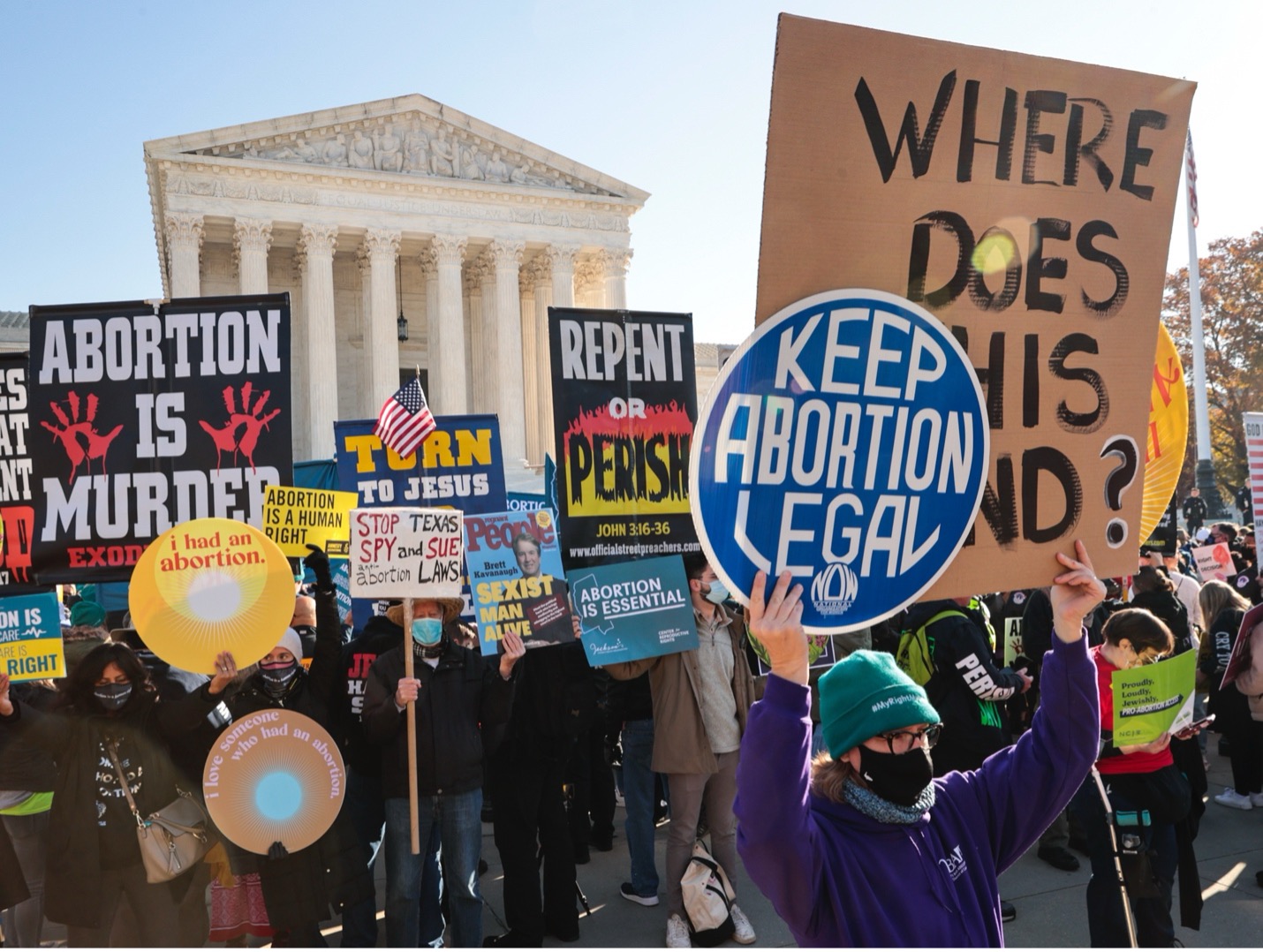
In 1973, the United States Supreme Court made a landmark decision in Roe v. Wade to legalize abortion prior to fetal viability, prohibiting any state bans. At the beginning of the 1900s, abortion was illegal in every state in America. During the 60s and 70s, states such as California, Colorado, and New York began to legalize abortion, ultimately leading to the discussion on a national level. For almost 50 years, this was a legal medical practice throughout the country that saved the lives of many women.
In 2022, the Supreme Court heard the case of Dobbs v. Jackson Women’s Health Organization to rediscuss the legality of abortion. This case reversed the Roe decision and left the decision up to each state to create their own laws about abortion. Some states, such as Alabama, Texas, and North Dakota have total bans on abortions. Other states like Florida, Iowa, and Nebraska have bans within the first 18 weeks of pregnancy. Other states have bans later in pregnancy or no ban at all such as Alaska, Michigan, and New Jersey. This act of federalism was supposed to give more power to the people but instead has fragmented the country.
When looking at the states with the most restrictive abortion policies, there is a pattern of gerrymandering. When voting is prioritizing certain people over others, policies in those areas will not accurately represent the majority opinion. In Texas, one of the states with total abortion bans, the Supreme Court allowed the state to adopt a new congressional map that created the possibility of five additional Republican seats in Congress. This polarized political climate in Texas results in democratic backsliding, as there is less competition and manipulated elections.
The Supreme Court as an institution is unlike any other democratic institution. The Justices are not elected, as almost all other leaders and decision makers are. When looking at the statistics, 60% of adults say they believe abortion should be legal in most or all cases. Therefore, the Court is not ruling in favor with the preferences of most citizens which can lead to overall distrust in the institution. When citizens start to feel like they can no longer trust these institutions to reflect their needs, democracy begins to weaken.
The distrust continues with the Dobbs decision in particular because of the sudden change in precedent. For 50 years, this medical practice was legal and relatively accepted nationwide. This sudden change can present as instability, which will threaten democracy. Women suddenly had less autonomy, and it felt like society had regressed. When citizens feel like their rights are at risk, democracy will begin to fall apart.
The Court had also recently seen major changes in its Justices. Of the nine Justices, three of them had been appointed by Donald Trump within just three years of one another. Trump has openly expressed his anti-abortion views along with other extreme views he has. This move by the Court seemed to be more politically driven than constitutionally, suggesting that the current Justices are not as neutral as they are intended to be. Courts are one of the institutions that holds democracies together and when they can no longer be trusted to be bipartisan, trust will erode. The topic of abortion has always been very controversial, and the Dobbs decision is no exception. Some believe it restores democracy by promoting federalism. Others feel their rights have been stripped and therefore democracy is failing.
In January of 2025, an arrest warrant was issued to a doctor in New York that had sent Misoprostol to a minor in Louisiana. Louisiana is one of the few states to have a total ban on abortion and therefore a District Court charged Dr. Margaret Carpenter, Nightingale Medical, and the girl’s mother with a felony in relation to the abortion pills. This case was the first of its kind after the Dobbs decision and created an entirely new issue between states. The governor of New York was protecting the doctor while Louisiana was protecting the young girl and her pregnancy.
Issues between states will weaken democracy and create more political polarization. Legal disputes between states are handled by the Supreme Court, but if there is a lack of trust in the institution, states will be reluctant. It will also create large areas where citizens views are not being prioritized or looked at. If the Justices remain partial to a particular political candidate or point of view, all the decisions made in the Court will reflect that. In the case of abortion, the majority opinion of the Court seems to be opposed to legalizing it. Therefore, the cases they hear regarding abortion will likely not end in the favor of the woman.
This piece artfully articulates what I believe to be one of the largest warning signs of the United States’ democratic backsliding and effectively illustrates the danger so many Americans, not just women, have been put in by a largely unpopular decision made by an ideologically stacked court. When the rights of half of a country’s population begin and end where state lines do, that is an unequivocal assault on Przeworski’s maximalist dimensions of democracy, and erodes crucial aspects of his minimalist dimensions of democracy, such as political participation, as trust in the government and democracy itself disappears. Your work here strongly showcases the many ways this decision has been detrimental to the stability of democracy in the U.S. and vividly appeals to detractors; the inclusion of the issuing of an arrest warrant for a minor seeking healthcare is particularly impactful in this manner. I think of the ways the 2022 Dobbs ruling has impacted this country frequently, and I will no doubt think of this piece just as often, albeit in a much fonder way!