
Syria is not transitioning to democracy. It is stuck in a political system that prevents democracy from taking hold.
That may sound obvious. But it isn’t. Many discussions concerning Syria’s future continue to focus on “post-conflict transition” or ultimate democratization. That framing ignores what is actually happening on the ground.
My position is straightforward: Syria’s existing political order is not a failed transition to democracy, but rather a fragmented system in which the grounds for democracy have been methodically destroyed.
And unless those circumstances are met, democracy is not only unlikely. It is structurally impossible
A nation without a single government.
Begin with a basic question: who runs Syria
The answer is not straightforward.
Bashar al-Assad’s regime continues to control a large portion of the country. However, it does not have complete control over everything. Kurdish-led governments rule sections of the north. Other territories are under the control of opposition factions.
Each of these actors asserts authority. Each manages its own institution. Nobody governs Syria as a cohesive state.
This is important. A functioning political center is required for democracy-a site where norms are developed, debated, and enforced. Syria does not have one.
Instead, it has several systems of control. This fragmentation renders national elections, accountability, and representation practically difficult.
What does democracy genuinely require?
Political scientists frequently characterize democracy with three fundamental elements:
- Contestation (actual political competition)
- Citizens can participate in politics.
- Accountability (leaders may be removed or restrained)
Syria fails to meet all of these benchmarks.
According to Freedom House, Syria is consistently rated “Not Free.” Their latest report shows a near-total absence of political rights and civil liberties. You can explore their data here: https://freedomhouse.org/country/syria/freedom-world
The Varieties of Democracy Project goes further. It classifies Syria as one of the world’s most closed autocracies, with extremely low scores on electoral democracy. Their dataset is available here: https://www.v-dem.net
The Economist Intelligence Unit Democracy Index ranks Syria near the bottom globally. Full reports can be found here: https://www.eiu.com/n/campaigns/democracy-index-2024/
These are not simply labels. They mirror a more fundamental reality: Syrians have little meaningful ability to elect leaders, organize opposition, or hold power accountable.
How the Transition Collapsed
Syria looked quite different in 2011.
Massive protests erupted across the country. Citizens wanted reforms, dignity, and political representation. For a brief moment, democratic reform appears conceivable.
But the moment did not last.
The regime replied with force. Protest movements have fragmented. Armed factions emerged. Foreign powers involved.
What started as a political rebellion escalated into a civil war.
Some communities experimented with local government. Community councils coordinated services and, in some situations, elections. These were little but significant advances towards participatory politics.
Then they started to disappear.
Militarization took over civilian authority. Armed actors increased influence. The resources dwindled. External sponsors supported warring factions.
The outcome was not democratic degradation in the conventional sense. It was something different: the disintegration of the very underpinnings that allowed democracy to emerge.
This isn’t democratic backsliding.
It’s tempting to compare Syria to nations like Hungary and Turkey, where democracy has weakened over time.
However, the comparison does not fully fit.
In those circumstances, democratic institutions existed but steadily degraded. Scholars such as Steven Levitsky and Lucan Way define this trend as the breakdown of “competitive authoritarian” systems, in which elections persist but are increasingly unfair.
Syria never had that type of system.
Instead, it is more consistent with what Eva Bellin refers to as authoritarian resilience. In her Middle Eastern research, Bellin contends that strong security institutions enable regimes to persist even in the face of widespread unrest.
Syria validates her point.
The government did not steadily undermine democracy. It violently stopped it from emerging.
Why fragmentation impedes democracy
Even beyond regime-controlled areas, democracy fails to establish itself.
Why?
Because fragmentation alters how power operates.
Political players in a unified state compete through institutions including elections, courts, and legislatures. In a fragmented system, power is distributed through force, territory, and external support.
This causes three primary issues:
First, there are no shared rules.
Distinct regions follow distinct laws and authorities. There is currently no national structure for political competition.
Second, the institutions are weak.
Courts, legislatures, and electoral systems are either non-existent or lack authority.
Third, militaristic politics.
Armed groups frequently wield more power than civilian leaders. This undermines accountability.
Together, these characteristics make democracy extremely difficult to establish.
A plausible objection
Some may claim that the local governance attempts in Syria demonstrate that democracy is still viable.
That is not wrong.
Local councils in some locations have given services and allowed for some level of participation. These experiments are important. They demonstrate that Syrians are capable of self-government.
However, these measures are insufficient.
Local democracy cannot replace national institutions. Without coordination, protection, and stability, these endeavors are vulnerable.
In many situations, they have already been degraded or replaced by more coercive methods of control.
Why does this matter?
Syria is more than just a tragic case. This is a warning.
For decades, historians assumed that when autocratic regimes weakened, democracy would emerge. Syria defies this assumption.
It demonstrates that removing or weakening centralized power without establishing institutions can lead to fragmentation, not freedom.
It also reflects a broader trend.
Modern threats to democracy do not necessarily result from unexpected coups. They can originate from prolonged instability, in which institutions never fully materialize.
That’s why Syria is so crucial to research.
What happens next?
Syria’s future remains unknown.
Democracy is still possible-but under certain conditions:
- A decrease in armed warfare
- The formation of unified national institutions.
- Protecting political participation and civil liberties
- A transition from military to civilian power.
These aren’t modest steps. They take time, cooperation, and political will on both the domestic and international levels.
Until then, Syria will remain as it is: a country where democracy has yet to take root, rather than one in decline.
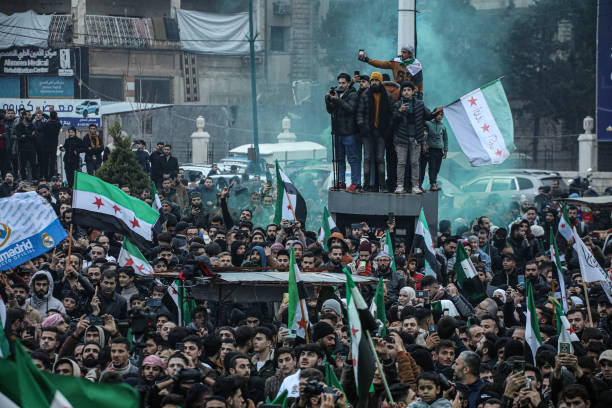
ALEPPO, SYRIA – DECEMBER 22: People gather at a concert featuring Yahya Hawwa, organized by the London-based humanitarian organization, Syria Relief, as life begins to normalize in Syria under opposition-controlled areas with residents continuing to celebrate newfound freedoms in Aleppo, Syria on December 22, 2024. (Photo by Izettin Kasim/Anadolu via Getty Images)
0 Comments