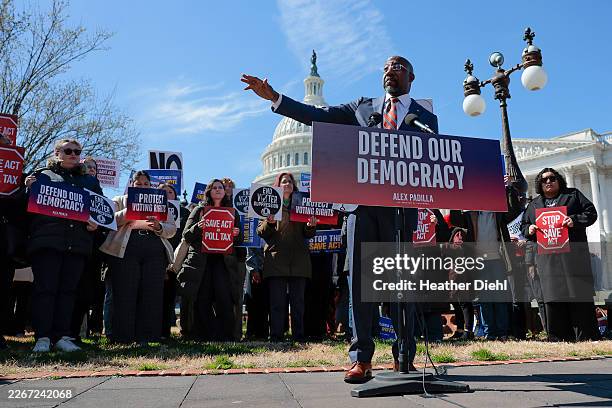
WASHINGTON, DC – MARCH 18: U.S. Sen. Raphael Warnock (D-GA) attends a rally to speak out against the SAVE America Act outside the U.S. Capitol on March 18, 2026 in Washington, DC. Members of congress join leading voting rights advocates and impacted voters from across the country to rally against the SAVE America Act. (Photo by Heather Diehl/Getty Images)
A core component of democracy is representation through free and fair elections. Free and fair can be defined by who qualifies to vote and then by the actual ability of that group to vote. The SAVE Act, which presents stricter voter ID laws, with the intention of creating freer and fairer elections, but in reality makes it more difficult for many Americans to vote. These current events show clear obstacles being created by the government, where, although not eliminating elections, it is causing confusion and creating obstacles to make participation in government for everyday Americans more difficult and unequal, thus undermining both the free and fair nature of elections, which is incredibly relevant in democratic principles.
The Safeguard American Voter Eligibility Act (SAVE Act) stated goal is to make sure only US citizens vote in elections. However, data from the Bipartisan Policy Center shows that non-citizen voting (.04% of cases) is rarer than deceased voting (.53% of cases) in voter verification. For example, in Utah, when performing a review of over 2 million registered voters, they only confirmed 1 noncitizen registered to vote, and that citizen didn’t even vote, making absolutely no impact on the election. This then makes many wonder if this issue is truly salient or a way to discourage eligible people from voting. This law would require people to register in person at election offices, which only 6% of today’s registered voters have done. It would also create extra documentation to prove citizenship. Things like a standard driver’s license, REAL ID, and military ID would not qualify as sufficient proof of citizenship. Instead, one would need to present an enhanced driver’s license (which only 5 states currently provide), a passport, a certified birth certificate with photo ID, or a naturalization certificate. All of these documents will have an additional cost to obtain if the person did not already have these documents or had lost them. The new process would require voters to not only take time out of their lives to drive to an in-person election office, but also take time and money to get the new required documents to participate in a democracy that is supposed to represent them. How can it be a democracy, though, when at the same time passing laws creating these obstacles that will lower voting and thus the consent of the governed?
This law will disproportionately hurt groups, such as people living in rural areas, young people, and married women. On average, rural voters would have to drive upwards of 260 miles to reach their closest election officials to show proof of citizenship. This could be around 4.5 hours round trip, with gas prices on top of that, showing both the time and financial commitment they are expected to make just to have a say in who represents them. It will be more difficult for younger or first-time voters, especially those of color, who do not have the required documentation. 24% of Americans under 30 don’t have the required documentation, and specifically, almost half of black Americans under 30 don’t have these documents. Then, one of the biggest groups to be affected by these new standards would be married women. 69 million women who took their spouses’ last name do not have a birth certificate matching their legal name. This means married women would need to obtain a passport, which over 50% of Americans don’t and would have to pay a fee to obtain it. One of the authors of the SAVE Act, Rep. Chip Roy, actually admitted that the system for obtaining a Real ID, very similar to what the SAVE Act is proposing, is much more difficult for married women. Proving, the authors of the bill recognize there are groups of people at a disadvantage with the new law. There are many Americans who will fall into one or more of these groups with additional barriers.
What does this all show about America’s current democratic state, though? Author Robert Dahl, in his book Polyarchy, emphasizes the importance of participation in a democracy. Greater participation will lead to increased consent and legitimation of the government from the people being governed. He defines participation as giving all citizens equal access to vote in decisions, but the SAVE Act destroys this with the regulations it wants to implement. Dahl also points out the need for competition in free elections. There can’t be fair competition when groups of eligible voters are being faced with a huge disadvantage when registering due to the new hurdles they have to overcome. Another sign of the SAVE Act presenting an erosion to democracy is from author Ozan Varol in his book Stealth Authoritarianism. Varol points out that a telltale sign of stealth authoritarianism is voter ID laws changing and disenfranchising millions of what should be eligible by the constitution. The stealth part being the legislators are using institutionalized systems to do it and presenting the bill as something that will inevitably increase the integrity of the election. Even though there is an underlying motivation to limit Americans’ freedom to voice their concerns through voting. The SAVE Act is a clear sign of democratic erosion and abuse of power and trust by the United States government. More Americans need to familiarize themselves with this law to prepare for how they will ensure they can still have a say in government.
I liked this post a lot because it makes the argument feel really concrete. The examples about rural voters, young people, and married women make it easy to see how the SAVE Act could create real barriers for eligible voters, even if it is being framed as election security.
I also thought your use of Dahl worked really well. You show that democracy is not just about having elections, but about whether people can actually participate equally. The connection to stealth authoritarianism was strong, too, because it shows how rules that seem administrative or neutral can still weaken democracy in practice.
Overall, this was really clear and convincing. I think your biggest strength is that you do not just make a broad claim that the SAVE Act is harmful, but actually explain who it would affect and why that matters for democracy.