A ‘Franken State,’ The Future of Israeli Democracy
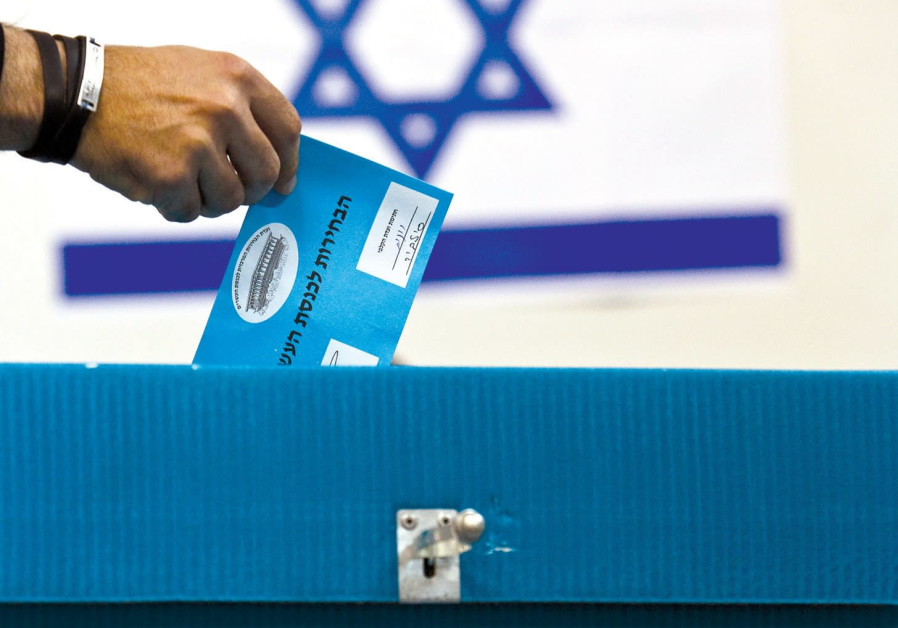
voting box in the last Israeli election in 2015. (photo credit: REUTERS)
“For my friends, everything”: Israel as a Democracy, but for whom?
In 1948, Israel was established as a parliamentary democracy. Despite Israel’s title as a democracy, Palestinian citizens remained under military rule until 1966. Following the six-day war in 1967, Israel established a dual legal system in the West Bank, applying different legal systems to Palestinians and Israelis. This inequality persisted into 2018 through Benjamin Netanyahu’s populist ideals. Netanyahu created the 2018 the Nation-State Law, which the Israel Democracy Institute states to have no reference to equality or the creation of a Jewish as well democratic state. The ongoing disregard for equality equates to discriminatory legalism as discussed in Jan Müller’s What is Populism under the concept of, “for my friends, everything; for my enemies, the law” (Müller 46). Taken together, these developments suggest rising democratic erosion in Israel as populist leaders push their anti-pluralist agenda under the veil that “they and only they, and only they, represent the people,” limiting mutual toleration and enabling conditions that tolerate authoritative governance (Müller 20).
Israel’s ‘Weimar’ Moment: What could this mean for Israeli Future?
The pitfall of a state cannot be attributed to the rise of populist leaders alone but rather the ability for institutions to constrain the power of populist threats. In a 2025 Clingendael Institution opinion piece, Erwin van Veen addresses Israel possibly arriving at its own ‘Weimar moment,’ of which institutions have become pivotal in preserving the state’s democracy. This perspective aligns with Daniel Ziblatt’s argument in Foreign Affairs that the failure of the Weimar Republic showed that “no democratic constitution [is] self-enforcing.” As Ziblatt notes, “extremism never triumphs on its own” and rather, grows capable through fear and ambition, and the erosion of institutional and democratic safeguards.
The Formula for Achieving a ‘Weimar’ Moment: How can nations avoid it?
The collapse of a democracy is not driven by populist leaders alone but rather through additional support from the actions of centralized elites. Within How Democracies Die by Daniel Ziblatt and Steven Levitsky, they note that a day after Hitler rose to power a “prominent conservative” who helped Hitler, admitted to having “committed the greatest stupidity of [his] life” through aligning with “the greatest demagogue in world history’” (Ziblatt and Levitsky 19). Although Germany fell into Hitler’s trap, Levitsky and Ziblatt note the successful avoidance by Belgium, Britain, Costa Rica, and Finland through their elite leaders excluding extremists from power. Another example of successful democratic preservation was more recently in Austria, of which the mainstream conservative party—the Austrian People’s Party—kept the radical-right Freedom Party out of power. Thus, with the proper mechanisms and incentive in place, democratic erosion is preventable.
Importance of Public and Institutional Resistance in Safeguarding Democracy
Noam Gidron argues in Why Israeli Democracy is in Crisis that Israel’s institutional changes of 2023 are reminiscent of the actions of populist parties on the right in Hungary and Poland. Among these changes was Netanyahu’s proposal that the Knesset should be able to overrule the Supreme Court of Israel despite it historically being limited in its power. Although this was pushed back, it is planned to be revisited, reflecting an ongoing pattern of attempts to weaken institutions. Yet, through public protests and uproar surrounding the reform, Netanyahu was forced to pause his reforms. Furthermore, internally, Isaac Herzog, the President of Israel, alongside the President of the Supreme Court and Israeli Attorney General all contested the plan. The playing out of Netanyahu’s proposal proves the arguments of Jan-Werner Müller and Daniel Ziblatt in which democratic erosion depends not only on populist leaders but also on whether mainstream conservative elites enable a populist’s rise to power.
Rule of Law and Ben-Gvir: Examples of Rising Democratic Erosion
The question of the security of Israel’s democracy was discussed in “Israel’s rule of law and democracy are on the brink of collapse” by Luc Bronner within Le Monde. Bronner’s work brings light to a law passed on March 30th, 2026 which mandates the hanging of individuals convicted of terrorist attacks, intended to apply primarily to Palestinian prisoners. Passed by the Knesset, this law was championed by Itamar Ben-Gvir, Israel’s Minister of National Security. Bronner proclaims this law to be applied disproportionately to Palestinians rather than Israelis in the West Bank. Former Supreme Court president Aharon Barak deemed this law to be “a process in which essential aspects of democracy are under severe attack, and democracy is weakening.” The law is ultimately expected to be checked by the Supreme Court of Israel. The question becomes whether the court can strike it down through judicial review or if the Knesset can have the capabilities that Netanyahu tried for in 2023. Accordingly, Netanyahu is in the position to exploit judiciary weakness, arguing that “when a strong right-wing leader wins an election, the leftist Deep State weaponizes the justice system to thwart the people’s will.” Furthermore, Ben-Gvir, serving as Minister of National Security, has been labeled as executing a reign of terror. His aims include the possible annexation of the West Bank which could undermine Israel’s democracy. An April 15th opinion piece in the Haaretz Editorial, notes his behavior to be harmful to the Arab community and supportive of police brutality. Despite rhetoric against Ben-Gvir’s rise to power, he still holds a position in which he can execute authoritative practices. However, a recent court hearing has brought into light the legitimacy of his position, but the final verdict is pending.
A ‘Franken State,’ Is the Democratic Veil Falling?
Taken together, the changes in Israel are beginning to reflect a ‘Franken State.’ Noam Gidron’s work notes the concept of a ‘Franken State’ which hides illiberal reforms under liberal institutions. The state lacks a fixed constitution, a secondlegislative chamber to oversee the Knesset, and is not bound by any international courts. By default, Israel’s democracy is weaker comparatively to many other Western democracies as it relies on active enforcement of norms and safeguards, making it particularly susceptible to erosion.
Total words: 1,000
Works Cited
Ashkenazy, Anat Thon, and Daphne Benvenisty. “A Review of the Main Steps to Weaken Democracy in Israel (Summary of 2025).” Israel Democracy Institute, Jan. 2026, https://en.idi.org.il/articles/24241
Chemin, Ariane, and Anna Koriagina. “Israel’s Rule of Law and Democracy Are on the Brink of Collapse.” Le Monde, 7 Apr. 2026, https://www.lemonde.fr/en/international/article/2026/04/07/israel-rule-of-law-and-democracy-on-the-brink-of-collapse_6752168_4.html
Daniel Ziblatt. “Warnings from Weimar: Why Bargaining with Authoritarians Is Dangerous.” Foreign Affairs, 28 Aug. 2025, https://www.foreignaffairs.com/germany/hitler-warnings-weimar-democracy-daniel-ziblatt
Gidron, Noam. “Why Israeli Democracy Is in Crisis.” Journal of Democracy, vol. 34 no. 3, 2023, p. 33-45. Project MUSE, https://dx.doi.org/10.1353/jod.2023.a900431.
“Israel Has One Last Chance to Stop Ben-Gvir and Give Democracy a Lifeline.” Haaretz, 15 Apr. 2026, https://www.haaretz.com/opinion/editorial/2026-04-15/ty-article-opinion/israel-has-one-last-chance-to-stop-ben-gvir-and-give-democracy-a-lifeline/0000019d-8d9c-d0e6-ad9d-adbff0ce0000
van Veen, Erwin. “Occupation as Cause of Israel’s Democratic Erosion.” Clingendael Institute, 26 Mar. 2025, https://www.clingendael.org/publication/occupation-cause-israels-democratic-erosion
0 Comments