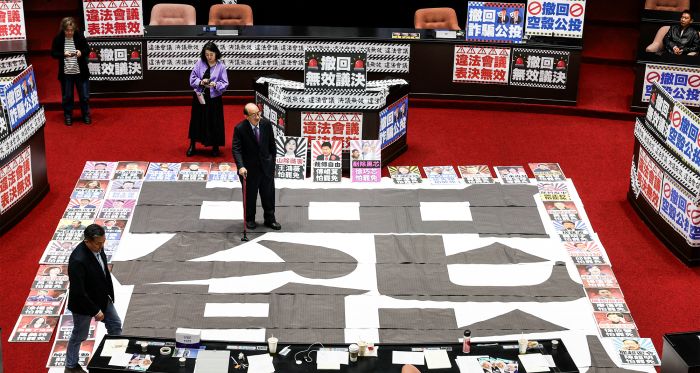
Taiwan’s 2025 “Great Recall” campaign marked an unprecedented moment in the island’s democratic history. On July 26, voters were asked whether to recall 24 of 113 legislators—21% of the legislature—making it the first large-scale, coordinated use of recall provisions across multiple constituencies. The campaign emerged after the 2024 elections produced a divided government: while the Democratic Progressive Party (DPP) retained the presidency, the Kuomintang (KMT) and Taiwan People’s Party (TPP) secured a legislative majority, creating a persistent political deadlock that has hindered President Lai’s agenda and deepened partisan confrontation.
Both camps framed their positions as a defense of democracy. The DPP justified recalls as a safeguard against pro-China influence, while the KMT condemned them as an abuse of democratic institutions, accusing President Lai of authoritarian tendencies. This conflict raises a central question: to what extent do recent recall efforts in Taiwan reflect intensifying political polarization and democratic erosion, as opposed to functioning within the bounds of normal democratic contestation?
Defining Polarization: An “Us vs Them” Divide
To assess this question, it is necessary to clarify what “polarization” actually entails. As Jennifer McCoy and Murat Somer define it, polarization is a process in which “the normal multiplicity of differences in a society increasingly align along a single dimension,” producing an “us versus them” divide. This definition emphasizes not just disagreement, but the collapse of cross-cutting identities into a single dominant cleavage. We can further distinguish between ideological polarization, which refers to the distance between policy positions, and affective polarization, which captures the emotional hostility and distrust between partisan groups.
Affective polarization is particularly dangerous because it transforms partisanship into a social identity. Individuals begin to see opposing partisans not merely as political rivals, but as morally suspect out-groups. This process is often intensified by social segmentation and media fragmentation, which expose individuals primarily to like-minded perspectives and reinforce existing biases.
Taiwan as a Puzzle: Sorting Without Ideological Extremes
Taiwan presents a compelling puzzle within this framework. By conventional ideological measures, it does not appear highly polarized. Surveys such as the Taiwan Election and Democratization Study (TEDS) show many citizens cannot place themselves on a left–right spectrum, and among those who can, nearly 60 percent identify as centrist. The perceived ideological distance between the KMT and DPP is also relatively small, leading some scholars to describe Taiwan in terms of “sorting,” where individuals align with parties without becoming more extreme. At the mass level, a large number of independents and moderates further suggests that partisan polarization is limited.
However, this ideological lens obscures a more consequential divide. In Taiwan, political conflict centers not on left–right issues but on national identity and cross-Strait relations with China. This cleavage has become dominant, with the DPP emphasizing sovereignty and the KMT favoring a more pragmatic approach toward Beijing. At its extreme, each side casts the other in existential terms, reflecting affective polarization in which emotional distrust overrides policy differences.
Evidence of Affective Polarization: Trust, Identity, and Media
Empirical evidence supports the presence of this affective polarization. Research on Taiwan highlights political trust as a key driver: when trust in institutions and opposing parties declines, partisan hostility increases. Taiwan’s recent history offers clear examples, most notably the 2014 Sunflower Movement, in which mass protests against a trade agreement with China revealed deep suspicion toward political elites and cross-party intentions. These dynamics have only intensified in recent years. Studies of the 2024 election, including surveys conducted by Doublethink Lab, found that conspiracy narratives and misinformation played a significant role in shaping public opinion, reinforcing in-group biases and out-group distrust. This aligns closely with media fragmentation, where individuals increasingly consume information that confirms their existing beliefs, reducing exposure to alternative perspectives and heightening polarization.
The 2025 Recall Campaign: Polarization in Action
The 2025 recall campaign provides a vivid case study of how these dynamics operate in practice. Supporters of the recalls framed their efforts as an “anti-communist” movement, targeting KMT legislators they accused of being “pro-China” or even collaborators with Beijing. Although concrete evidence for such claims was often limited, the framing itself reflects a moralized worldview in which political opponents are not simply wrong, but fundamentally disloyal or dangerous. In response, KMT leaders denounced the recalls as an abuse of democratic institutions, with party chairman Eric Chu going so far as to label President Lai Ching-te a “dictator.” This reciprocal escalation mirrors the characteristics of pernicious polarization: the division of society into two hostile camps, the portrayal of opponents as illegitimate, and the erosion of mutual tolerance.
Why the Recalls Failed: The Limits of Polarization
Yet despite these concerning features, the outcome of the recall movement complicates any straightforward narrative of democratic backsliding. Every single recall attempt ultimately failed because voters rejected the proposal outright. Several factors contributed to this result. First, voter fatigue played a significant role; many citizens viewed the recalls as an unnecessary extension of an already intense election cycle. Second, there was a clear backlash against what was perceived as excessive partisanship. Efforts to frame the campaign in stark ideological terms, including labeling opponents as “pro-CCP” or targeting dissenting businesses, alienated moderate voters. Moreover, President Lai’s “Ten Lectures on National Unity,” which framed those not aligned with the “Resist China, Defend Taiwan” stance as “impurities,” drew criticism for its polarizing rhetoric and for potentially alienating centrist constituencies.
The failure of the recalls suggests that, while polarization is present, it is not yet hegemonic. Taiwan’s electorate retains a substantial centrist segment that is unwilling to fully embrace extreme partisan narratives. Moreover, democratic institutions functioned as intended: the recall mechanism was used, but it did not produce destabilizing outcomes. Rather than enabling democratic erosion, the process may have reinforced institutional boundaries by demonstrating the limits of partisan mobilization.
Conclusion: Polarization Without Collapse
This duality is crucial for evaluating whether Taiwan is experiencing democratic backsliding. On one hand, the rise of affective polarization poses real risks. As McCoy, Somer, and Tahmina Rahman emphasize, when political opponents are viewed as existential threats, citizens may become more willing to tolerate illiberal actions or abandon democratic norms in pursuit of victory. The rhetoric surrounding the recalls, along with increasing distrust between parties, indicates movement in this direction. On the other hand, Taiwan’s political system continues to exhibit resilience. High levels of political engagement, a competitive party system, and the presence of moderate voters all act as constraints against democratic erosion.
Ultimately, Taiwan’s 2025 recalls reveal a democracy under strain, but not one in significant decline. The island is experiencing a form of polarization that is emotional, identity-driven, and increasingly visible in political discourse. However, this polarization has not yet solidified into the kind of entrenched, mutually exclusive camps that define pernicious polarization. Nor has it translated into systematic violations of democratic norms or institutions. Instead, Taiwan remains in a more ambiguous position, where the forces of division and resilience coexist. The trajectory of its democracy will depend on whether future political actors choose to amplify polarization for short-term gain or to rebuild trust across partisan lines.
0 Comments