Tunisia shows that ‘economic development alone’ is insufficient to ensure democratic survival- as political institutions and leadership play a critical role. Tunisia was once considered a successful case of democratization after the Arab Spring as Tunisia is the only country that has successfully transitioned to Democracy among those countries that were related to Arab Spring. However, recent political developments show signs of democratic erosion and backsliding : Why did this happen? In this Blog, an author will analyze the democratic backsliding in Tunisia comparing Lipset and Preworzski’s cases
Arab Spring
https://www.aljazeera.com/wp-content/uploads/2020/12/AP_110128121974-e1608200818567.jpg?resize=1920%2C1440
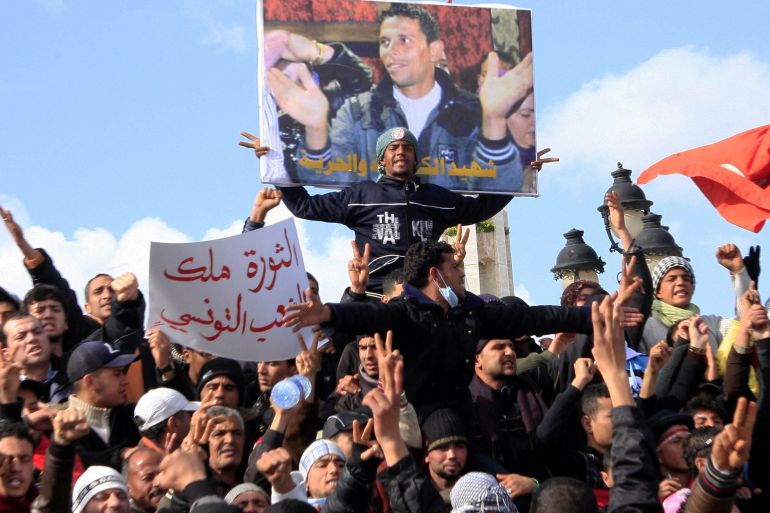
Arab spring operates as a key factor in understanding the democratic trajectory in Tunisia. Arab spring is a democratic phenomenal protest started in Tunisia which proliferated all along the Arab region – triggered by repulsion toward an autocratic regime. Following this movement, Tunisia underwent a transition from autocracy to democracy and was widely regarded as the most successful case among Arab Spring countries. Unlike other states in the region, Tunisia managed to establish democratic institutions and hold competitive elections, raising expectations for long-term democratic consolidation. However, this initial success did not guarantee stability. Over time, internal political tensions, weak institutional foundations, and unresolved economic challenges began to undermine democratic governance. This raises an important question: why did Tunisia’s democracy, despite a promising transition, fail to sustain itself?
To answer those questions, we have to figure out the background in a holistic view. According to Al jazeera, Tunisia was considered as a successful case of democratization after the Arab Spring, However, economic grievances such as unemployment and inequality persisted even after the revolution. These unresolved structural issues later contributed to democratic backsliding of Tunisia. Due to the Arab Spring, Tunisia was able to shift the regime since the dictator Ben Ali, who lasted for 23 years exiled to Saudi Arabia. Buazizi’s self immolation triggered the whole citizens being part of the protest and that proliferated throughout the country, demanding resignation of Ben Ali. The resistance and the immolation toward long-term dictatorship resulted in the change in political sides as the dictator was ousted. However, fundamental problem within country wasn’t resolved, this indicates economic development is also operated as a crucial factor in ensuring democracy.
Trajectory of Democracy in Tunisia
Tunisia demonstrates that Lipset overestimates the stabilizing effect of economic development, as political institutions and leadership play a critical role. Following the Arab Spring in 2011, Tunisia went through a transition from autocracy to democracy and was widely regarded as a successful case of democratization. However, recent political developments show clear signs of democratic erosion. This raises an important question: why did Tunisia’s democracy weakend despite its initial success? According to Lipset(1959), emphasizes that both economic development and legitimacy are key conditions that sustain democratic systems, expanding the middle class, and encouraging political participation. His modernization theory suggests that as societies become wealthier, they develop social conditions that support democratic governance. From this perspective, economic growth can be understood as an important factor that facilitates the transition from autocracy to democracy. However, economic development does not automatically lead to democracy, nor does it guarantee its stability. While Lipset’s theory is useful in explaining the emergence or transition of democracy, it is less effective in explaining whether democracy can be sustained over time. Therefore, it is important to distinguish between the transition and the survival of democracy. A country may successfully transition into democracy, yet still struggle to maintain it.
Limitations
Tunisia clearly demonstrates this limitation. Tunisia demonstrates that economic development alone is insufficient to sustain democracy without strong institutions. Although it successfully transitioned to democracy after the Arab Spring, its democratic institutions remained weak and lacked a strong foundation. Over time, internal political dynamics began to undermine democratic governance. In particular, Tunisia’s democratic erosion originated from within its own political system. President Kais Saied consolidated power by altering constitutional and electoral mechanisms in ways that strengthened his authority. This demonstrates that when institutions are weak, leadership decisions can undermine democracy from within. This limitation in democracy can be interpreted as ‘Democracy would be rapidly collapsed without a strong base and what facilitated democratic backsliding can be codified as the corrupted political system which is deadlocked and divided, an institution’s lack of actual check-in balance procedure, a weak sanction toward anti-democratic actions. Those things come down to the lack of underlying things that would protect democracy, limiting the progression in building a democratic country. Tunisia’s political trajectory reflects a shift from formal democracy to a weakened regime, eventually approaching a competitive authoritarian in which democratic institutions continue to exist in form but are systematically eroded in practice through executive dominance and constrained political competition.
Survival : Implement through Adam Przeworski’s case through Tunisia’s case
While Lipset explains the emergence of democracy, Przeworski’s argument helps explain Tunisia’s case in a more specific way, where democracy initially emerged after the Arab Spring but later weakened due to fragile institutions and internal political dynamics. Przeworski argues that economic development does not create democracy, but it increases the probability that democracy survives. In this sense, it is harder to maintain democratic status in an economically unstable country as there’s a strong request for redistribution. Tunisia’s economic status is not in a stable status, rather internal economic problems should be resolved in order to be operated if economic stability is set up as a prerequisite for democracy. Tunisia’s economic problem stems from structural weaknesses including low investment, weak competition, including innovation and regional polarization which comes down to a matter of inequality. This article demonstrates that distributive economic conflict in Tunisia has not been mitigated, which results in an instability in measuring democracy. Przeworski’s argument shows that economic development does not establish democracy but helps explain why democracy is more likely to survive under conditions of economic stability – showing up as a transparency and pluralism.
Conclusion
In conclusion, Tunisia should not be understood as a case of failed economic development, but rather as a case that exposes the limits of economic explanations of democratic stability. While Lipset’s modernization theory helps explain the transition to democracy, it does not fully account for its long-term stability. Tunisia’s democratic erosion was driven by weak institutions, the breakdown of democratic norms, and executive aggrandizement under political leadership. In such a way, Tunisia should not be understood as a case of failed economic development, but rather as a case that exposes the limits of economic explanations of democratic stability. While Lipset’s modernization theory highlights the role of economic development in facilitating democracy, Tunisian case suggests that its stabilizing effect is often overstated when institutional foundations are weak. In such a way, Tunisia aligns more closely with Przeworski’s argument that economic development conditions the survival of democracy rather than its emergence. From the materials we have passed through, Tunisia’s democratic erosion can’t be thoroughly explained through Lipset’s theory but can be explained through Przeworski’s theory as it touches the underlying problem ‘how democracy is sustained. Tunisia illustrates that economic development may enable democratic transition, but without strong institutions and managed distributive conflict, democracy cannot survive. Therefore, the Tunisian case highlights a broader implication: the survival of democracy depends less on economic growth alone and more on the resilience of political institutions and their ability to manage internal pressures over time.
Democracy survival vs emergence / Internal erosion / The importance of institutions
0 Comments