
Elections Without Democracy: The Case of Thailand
In 2023, the people of Thailand chose change. The Move Forward Party, which carried a progressive platform, won the election by a landslide. But shortly after, the party was forcibly dissolved by the court.The suspension of Pita Limjaroenrat, the leader of the Move Forward Party, from his parliamentary duties and his exclusion from the premiership following the 2023 election serve as the most recent and shocking examples of how Thailand’s elite forces overturn the public will by mobilizing the judicial system. This act was not merely about dissolving a single political party; it was a neutralization of the voting rights of millions who demanded change.They won the election, but they were made to disappear. Can this really be called democracy? Can we say that Thailand is a democratic country?
Having an election alone does not make a country a democracy.
Many people think that having an election means a country is a democracy. But having an election and being a real democracy are different. Real democracy, known as Liberal Democracy, is not only about having elections, but also guaranteeing freedom of the press, equality before the law, and the protection of individuals’ rights in practice. As Steven Levitsky and Daniel Ziblatt argue in their book How Democracies Die, democracy is maintained not only by codified laws but also by ‘invisible guardrails’ such as mutual tolerance and institutional forbearance. However, Thailand openly disregards these norms, falling far short of the standard that liberal democracy demands.
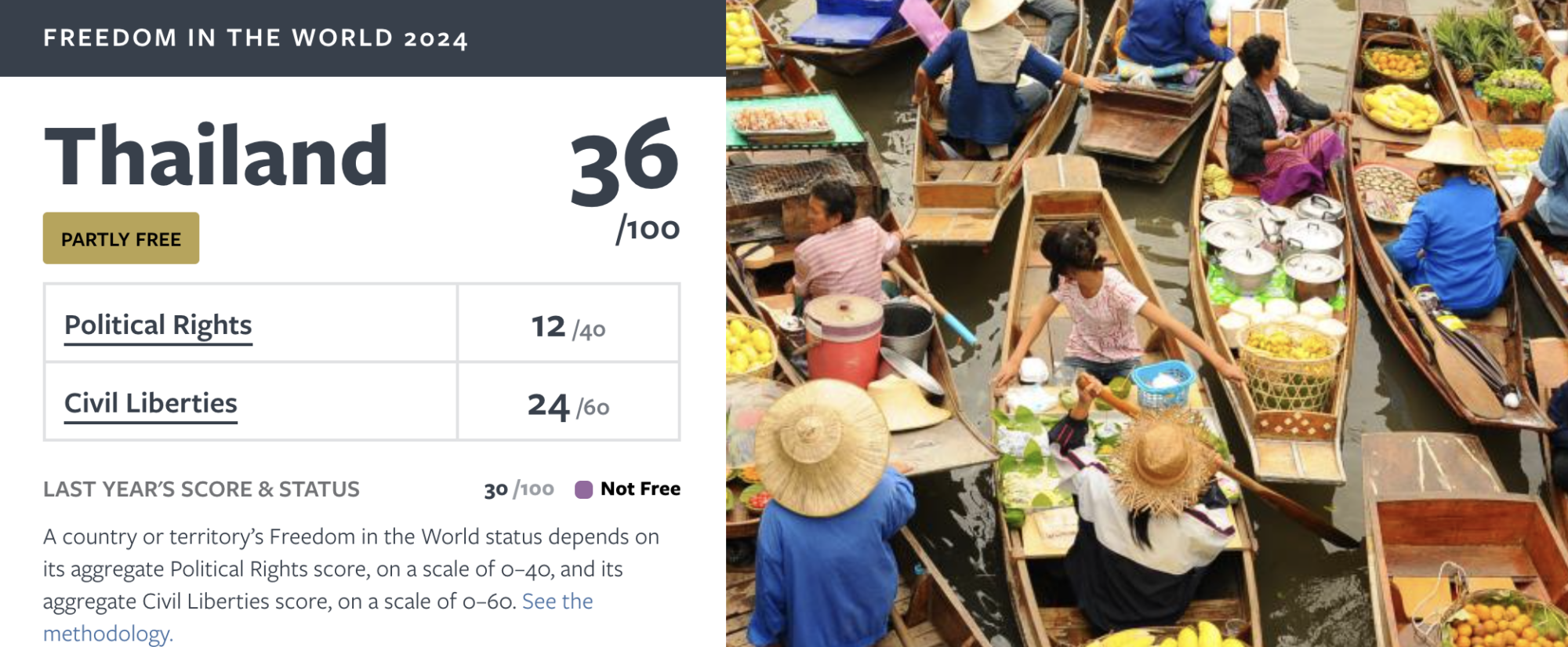
According to the Freedom House 2024 report, Thailand is categorized as ‘Partly Free,’ scoring 36 out of 100 — a marginal improvement from its ‘Not Free’ classification in the previous year. However, this slight uptick should not be mistaken for meaningful democratic progress. This low score in political rights and civil liberties quantitatively supports the argument that Thailand operates as a hybrid regime where democratic forms are hollowed out by authoritarian practices.
One might argue that Thailand maintains a regular electoralcycle—however unstable—which represents a form of meaningful democratic participation, distinguishing it from outright authoritarian regimes that hold no elections at all. However, this argument conflates procedural form with democratic substance. As scholars of democratic backsliding point out, the most dangerous and critical democratic erosion in the modern world stems not from the abolition of elections, but from their “hollowing out.” In other words, democratic erosion occurs when elections are held, but their outcomes are selectively nullified by those in power. Thailand exemplifies precisely this case: while the election and the ballot box exist, the transfer of power that the ballot box is meant to guarantee does not.
Why does this keep happening?
This is not the first time something like this has happened in Thailand. Since 1932, Thailand has experienced more than 13 military coups. Whenever the people chose a government, the military would overturn it—this pattern has been repeated over and over. According to the CFR, Thailand’s traditional elite forces, namely the military and the monarchy, have consistently intervened in politics.
This is because the established elites regard opposing political forces as ‘enemies of the state’ rather than legitimate rivals. This absence of mutual tolerance serves as a pretext to justify extreme measures, such as military coups or the dissolution of political parties, whenever election results conflict with their interests. For the elites, elections are not a means to transfer power. They operate only within the boundaries that the military and royal family have designed and permitted. No matter how much the people desire change, the moment that change threatens the elites, the outcome of the election can be overturned.
Then Why Do Citizens Keep Voting for the Same Side?
There is a very interesting question about why the people of Thailand keep voting for the same side, even though their voices keep being suppressed by the elites and the government. The answer can be found in the Shinawatra family.
Thaksin was a self-made billionaire who built his fortune through the telecommunications industry — not a member of the hereditary elite, but a political outsider whose popular appeal posed a direct challenge to the established order. When he came to power, he introduced the widest welfare policies in the entire history of Thailand. He created a healthcare policy where people only needed to pay 30 baht at any hospital they visited, a village development fund that provided 1 million baht to every rural village, and a program to relieve farmers’ debts. The rural poor and marginalized communities of Thailand felt, for the first time, that a leader was truly on their side. His party won subsequent elections with overwhelming support, consistently reflecting the will of Thailand’s rural and working-class majority.
But the problem was his mass popularity. The established elites — the military, the royal family, and the urban middle class — saw this as a threat, sensing that their own power was at risk. So Thaksin was removed from his position by a military coup, and his sister Yingluck Shinawatra was removed through a similarly orchestrated process — ousted by a Constitutional Court ruling on charges of abuse of power in 2014, before yet another military coup followed to complete the political transition.
In Thailand, gaining widespread public support became a dangerous thing. This is the great paradox of Thailand’s democracy. The support of the masses should be the greatest strength in a democracy — but here, it became the very reason for removal.
The Real Power Behind the Elections
Thailand’s power structure looks very different from what it appears on the surface. It seems like the country is controlled by a government chosen by elections, but the reality is that it is under the control of the military and the royal family. These two forces help each other, supporting their shared interests and maintaining a mutually beneficial relationship. The military justifies coups in the name of being the protector of the monarchy, and the royal family gives its tacit approval, lending legitimacy to the military’s actions.
The current king, Vajiralongkorn, has further consolidated this structure. After his accession to the throne, he transferred the royal assets into his personal name and amended the law to allow himself to directly command the royal guard. This demonstrates that the Thai monarchy is not merely a symbolic institution, but a real political actor.
What is even more important is that they do not maintain their power through force alone. After each coup, the military rewrote the constitution to serve their own interests. The 2017 constitution is one of the most representative examples. They designed it so that the
military could directly appoint all 250 senators, allowing them to maintain their grip on power even in the event of an election loss. The Constitutional Court has also been filled with figures close to the military, giving them the ability to dissolve any party that poses a threat.
This situation is a clear manifestation of ‘elite capture,’ where the military and the royal family are eroding democracy not simply out of a desire for power. The Thai military functions not merely as a traditional defense force but as a massive corporate conglomerate that controls major national industries, including telecommunications, banking, and real estate. Their fear of democratization stems from a perceived existential threat; they believe that the introduction of a transparent democratic system would dismantle the opaque privileges and monopolistic economic interests they have long enjoyed. If democratization were to take place, these elites would face serious consequences on the economic front. The royal family’s wealth is similarly estimated to be among the largest of any monarchy in the world. For them, blocking democracy is a strategy for survival and wealth preservation — not merely a political choice.
As the preceding analysis makes clear, this cycle of elite intervention is not incidental — it is structural. The following section examines the precise institutional mechanisms that make this control not only possible, but self-reinforcing.
The numbers make it even clearer

The numbers make it even clearer. According to International IDEA’s Global State of Democracy (GSoD) report,Thailand scores significantly lower than the Asian average in core categories such as Representation (0.42) and Rights (0.40).
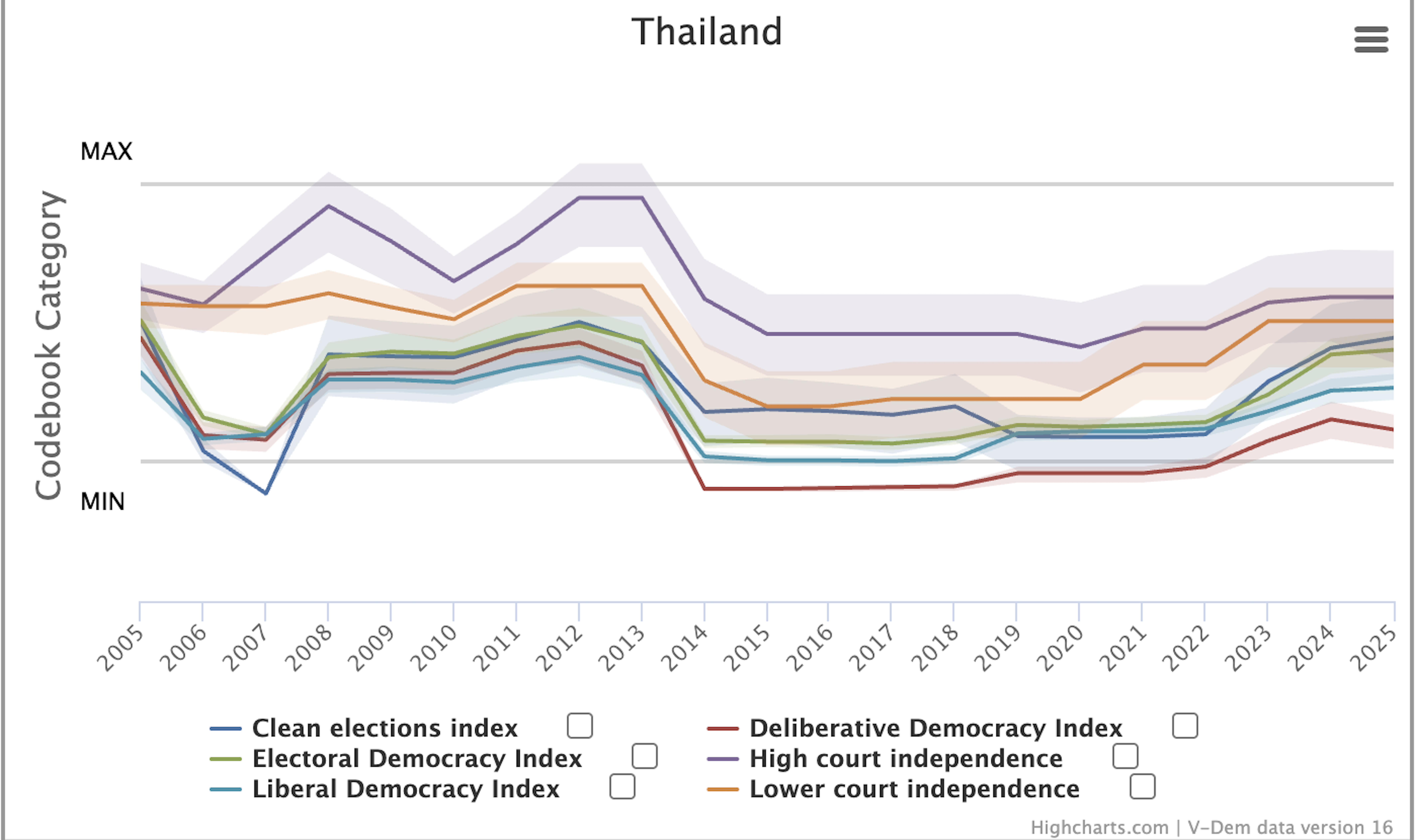
Notably, as evidenced by the V-Dem (Varieties of Democracy) datasets, Thailand’s scores for Judicial Independence and the Rule of Law have been in consistent decline over the past decade. This empirical data, particularly the sharp drop in the ‘High Court Independence’ index after 2014, proves that the ‘weaponization of the law’ is not merely an isolated incident, but rather a manifestation of systematic structural backsliding. Specifically, the low scores for individual rights and civic participation highlight the formidable barriers that prevent the people’s will from being reflected in actual governance.
The structural instability of Thailand’s governance is quantitatively evidenced by the V-Dem (Varieties of Democracy) 2024 report, which tracks the erosion of democratic institutions. While the Polity Project has historically categorized Thailand within the ‘anocracy’ range—a volatile middle ground between democracy and autocracy—recent data shows a more definitive slide into ‘electoral autocracy.’ This ambiguous and regressive state creates a structural loophole that allows elites to weaponize legal frameworks, ensuring their persistent political intervention while maintaining a veneer of democratic process.
The way the judiciary used its legal authority to disregard the public will and dissolve the majority party shows that institutional forbearance has completely collapsed. This is a typical case of democratic erosion, where those in power weaponize the law to neutralize the democratic process. It highlights that modern democratic erosion is a gradual process that occurs within the legal system, making it harder for the public to recognize the decay until the substance of democracy is already gone.
In Thailand, there is a law called lèse-majesté, or royal defamation law. If someone criticizes the monarchy, they can face up to 15 years in prison. In practice, between 2020 and 2024, hundreds of people were prosecuted under the lèse-majesté law—including children as young as 14. Consequently, it is not surprising that Thailand scored only 36 out of 100 in the Freedom House 2024 report. The severity of this judicial weaponization is starkly illustrated by the tragic death of activist Netiporn “Bung” Sanesangkhom, who died in detention after a hunger strike while protesting against the denial of bail for political prisoners. This incident suggests that Thailand’s judicial barriers have moved beyond mere institutional procedures to directly threaten the lives and fundamental rights of its citizens. The idea that a personal thought or a single word can send someone to prison is difficult to reconcile with any meaningful definition of democracy. It simply does not make sense.
Why does Thailand matter?
The aspirations of the youth who filled the streets of Bangkok demanding democracy remain stifled by judicial and institutional barriers. The case of Thailand suggests that democracy cannot be realized solely by the act of placing a ballot in a box; it requires a profound social consensus and norms that compel the establishment to respect and accept the results.
Thailand is not simply a country without democracy.International IDEA highlights that achieving ‘institutional integrity’ is far more important than merely holding an election under the name of democracy. Thailand’s low performance in these indices does not necessarily mean that the elections are fraudulent; rather, it signifies the existence of high institutional barriers that prevent the mandates chosen by the people from translating into actual governance. It maintains the appearance of democracy through elections, while hollowing out its substance from within. This is exactly the pattern that many other countries are experiencing—the gradual erosion of democracy while its outer form remains intact.
Ultimately, Thailand serves as a warning about the risks of ‘hybrid regimes,’—a form of governance that combines democratic appearances with autocratic substance—where the outward appearance of democracy such as elections is maintained while its essence, including norms and freedoms, is destroyed. The case of Thailand demonstrates that protecting democracy requires more than just the act of voting; it demands the existence of core norms, such as the tolerance of opposing views and the restraint of power (institutional forbearance). And Thailand starkly demonstrates that having an electoral system alone is not enough to call a country a democracy.
0 Comments