Forget the tanks! In the 21st century, the most dangerous weapon against democracy isn’t a gun. It’s a law. In a democracy, a “coup” is not the only dangerous thing when armed soldiers show up one day and topple them. The scariest thing is that the president will eat away at democracy little by little, saying, “I’m defending the law!” Zambia in Africa went through such a crisis. But Zambian citizens overcame these clever attacks to regain their democracy. The story of Zambian society tells us what the real power to protect democracy is. Let’s look at what kind of crisis Zambian people went through and how they restored democracy.
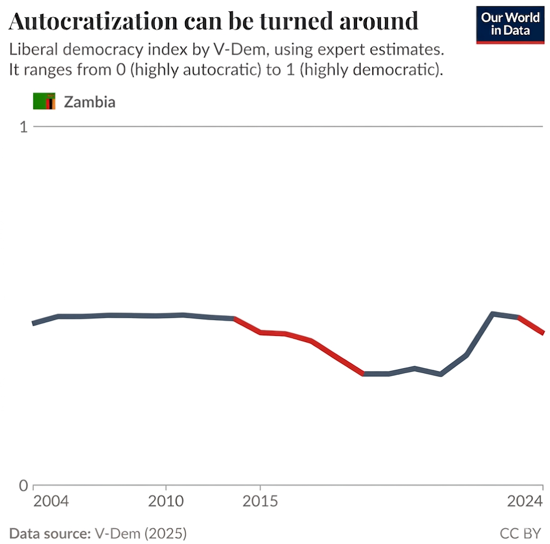
Photo: Zambia’s Liberal Democracy Index shows a sharp decline during the Lungu administration, followed by a dramatic recovery in 2021. (Data source: V-Dem 2025)
: https://ourworldindata.org/data-insights/four-countries-that-have-successfully-reversed-democratic-decline-in-recent-years
1. The “I’m Not a Dictator” Tactic (The 2017 Crisis in Zambia)
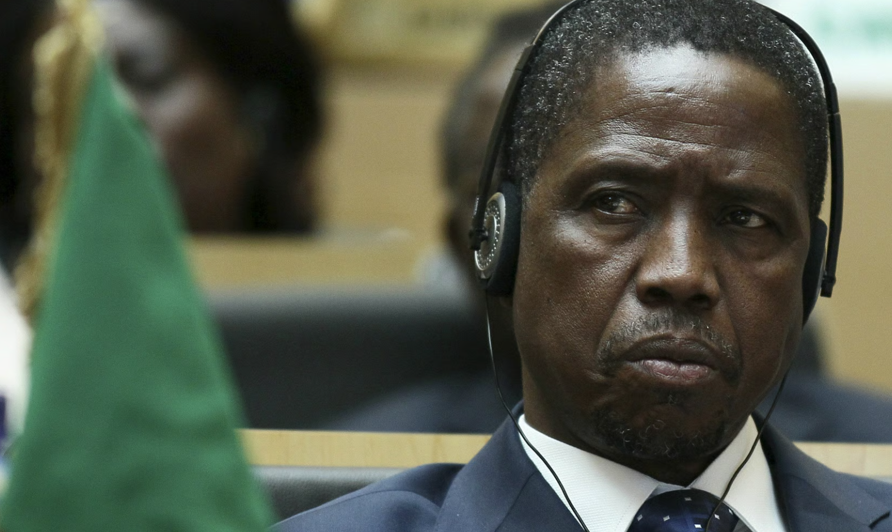
Photo: President Edgar Lungu, who utilized “Stealth Authoritarianism” to consolidate power under the guise of legal defense. (Source: Quartz)
:https://qz.com/africa/1023400/zambias-president-edgar-lungu-puts-the-country-in-a-state-of-emergency-but-says-it-isnt
In 2017, President Edgar Lungu of Zambia made a remarkably calculated move to wield the sword of dictatorship while evading international backlash and economic sanctions. Although he craved absolute power, he feared that declaring a formal “State of Public Emergency” (Article 30) would brand Zambia as a “dictatorship,” potentially jeopardizing much needed bailouts from the International Monetary Fund (IMF). To circumvent this, he opted for the softer-sounding “State of Threatened Emergency” (Article 31).
Lungu strategically bypassed Article 30 the formal ‘State of Public Emergency’ in favor of the more ambiguous Article 31 that is a ‘Threatened State of Emergency.’ According to Cheeseman (2017), this was a strategic move to maintain “plausible deniability. Analyzed this as a strategic move to maintain “plausible deniability.” While the name appeared mild, it granted the executive terrifying powers to detain citizens and conduct searches without warrants. This is called “Stealth Authoritarianism”, which is to wear the mask of the law and do dictatorship.
What is “stealth authoritarianism” here? This is a deft way of governance in which a ruling force appears to use a legal and democratic legal mechanism on the outside, but it undermines the opposition and monopolizes power. This is key to gradually destroying the values of democracy by hiding behind the mask of “democracy” and using laws and institutions as tools. In other words, Zambia has shown the epitome of “stealth authoritarianism,” which uses the artful legal apparatus of “threat emergencies” to avoid international surveillance and yet strengthen its authoritarian control.
2. Why Did Lungu Take Such a Risky Gamble? (The Destruction of Democracy)
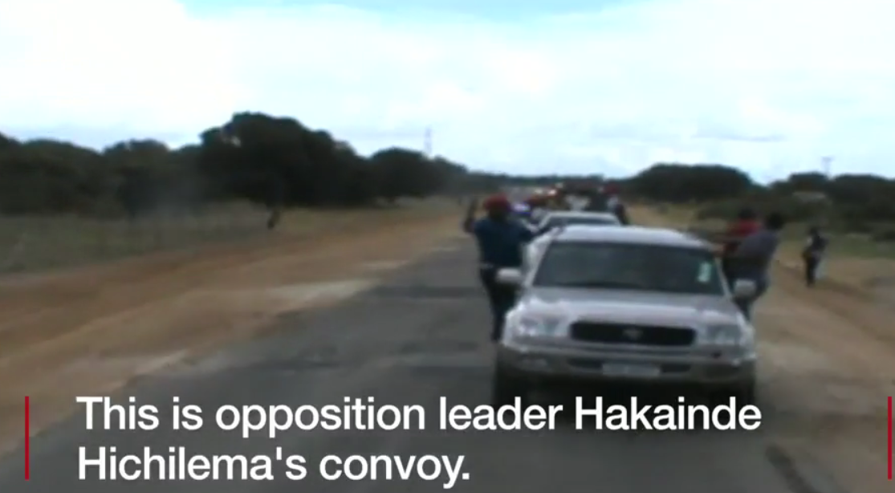
Photo: The controversial motorcade incident that led to Hakainde Hichilema’s treason charge, signaling the death of mutual tolerance in Zambia. (Source: BBC News)
: https://www.bbc.com/news/world-africa-39577230
President Edgar Lungu’s decision to push forward with these measures, despite international condemnation, was driven by calculated political ambition. His primary objective was to suppress opposition by making an example of Hakainde Hichilema (HH) and other lawmakers to dampen their influence. Simultaneously, facing internal skepticism within the Patriotic Front (PF), Lungu aimed to silence dissent and consolidate control through an atmosphere of intimidation. Ultimately, these actions were part of a strategic plan to secure absolute power over legal institutions, paving the way for a constitutionally questionable third term in 2021.
However, the fundamental issue is that the core norms essential for a healthy democracy were catastrophically broken. According to Levitsky and Ziblatt (2018), a pillar of democracy is ‘mutual tolerance’ the requirement to treat political opponents not as existential ‘enemies’ to be eliminated, but as legitimate ‘rivals’ with an equal right to compete for power. As reported by BBC News (2017), Lungu shattered this vital norm through the symbolic arrest of HH. Lungu broke the principle of ‘mutual tolerance’ by charging Hichilema with treason for a simple traffic dispute. This wasn’t just targeting one person. In other words, he treated his rival as an enemy of the state and let the world know that the legal system is now a political tool. In other words, this move made people silent in fear.
Furthermore, while Lungu possessed the constitutional authority to command the police, he deliberately abandoned institutional forbearance the vital democratic norm of restraining one’s legal power to avoid crushing rivals. By weaponizing the law for personal gain, Lungu moved into the realm of systemic repression. This strategic arrest triggered a pervasive chilling effect across Zambian society; after witnessing a high profile figure like HH jailed over a minor motorcade dispute, journalists and civil society groups began to self censor, fearing they would be the next targets. Ultimately, Zambia demonstrated the epitome of ‘stealth authoritarianism,’ utilizing the artful legal apparatus of ‘threatened emergencies’ to consolidate power under a mask of law while strategically evading international surveillance.
3. Happy Ending Rewritten by Citizens: The 2021 Democratic Restoration
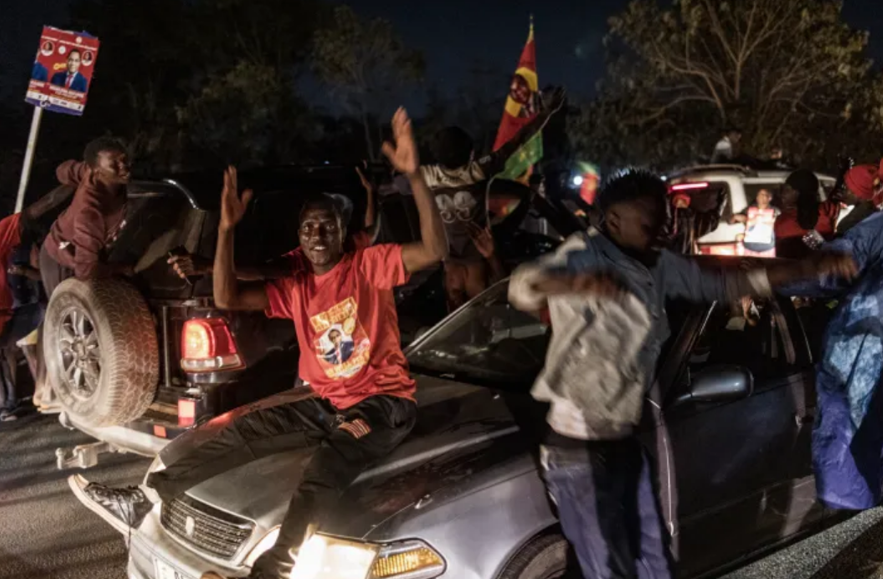
Photo: Zambian citizens celebrating the 2021 election results, marking the restoration of polyarchy through historic voter turnout. (Source: BBC News)
: https://www.bbc.com/news/world-africa-58226695
While President Edgar Lungu’s ‘stealth’ tactics appeared to secure his grip on power indefinitely, the 2021 general election delivered a profound reversal that showcased the remarkable resilience of democracy.
This revolution serves as a definitive case study of how the two pillars of democracy proposed by Dahl, ‘Inclusion’ and ‘Public Contestation’ can dismantle even the most entrenched authoritarianism. According to Dahl (1971), democracy relies on two fundamental pillars: inclusiveness and public contestation. In detail, the Lungu administration sought to minimize public contestation by weaponizing the legal system and restrict inclusiveness through pervasive intimidation and strategic internet shutdowns. However, the 2021 election witnessed an explosion in youth participation that maximized inclusion, while the overwhelming margin of victory restored genuine contestation. This collective shift allowed Zambia to reenter the realm of polyarchy, as conceptualized by Robert Dahl.
Despite regime intimidation and strategic internet shutdowns, citizens led by a youth population desperate for change demonstrated the power of inclusion through a historic voter turnout of over 70%. Furthermore, as reported by BBC News (2021), Hakainde Hichilema (HH) secured an overwhelming victory with over 2.8 million votes, defeating Lungu by a margin of more than one million votes in a clear display of robust contestation. This landslide victory was the ultimate result of citizens collectively shattering the ‘chilling effect’ that had paralyzed Zambian society since HH’s 2017 arrest. Ultimately, it reaffirmed a global truth: the ballots of an informed electorate are far more powerful than any weaponized authority.”
4. Conclusion: The Hope Zambia Gives Us
Zambia’s case clearly demonstrates how democracy can be cleverly undermined by law-masked ‘stealth authoritarianism’ rather than by a violent coup. President Edgar Lungu weaponized the legal system to oppress his rivals and create a ‘chilling effect,’ but he overlooked one thing: the will of the citizens, the true owners of democracy.
The overwhelming turnout and participation in 2021 proved that when ‘inclusion’ and ‘competition’ are alive, any sophisticated dictatorial strategy can be neutralized. Zambia has set a powerful milestone, showing that even in an era of democratic retreat, vigilant citizens can restore a collapsed democracy if they stand together.
After all, the strongest shield for democracy is not a grand legal code, but the informed consciousness of citizens who monitor power and use their votes to judge those who abuse the law. Zambia’s ‘Happy Ending’ is a true victory for democracy.
Let me ask you…
“Are you ready to defend your democracy?”
Featured image: Photo by Nightstallion (Wikimedia Commons), “Flag-map of Zambia,”
0 Comments