Changes in Bolivia’s Democracy
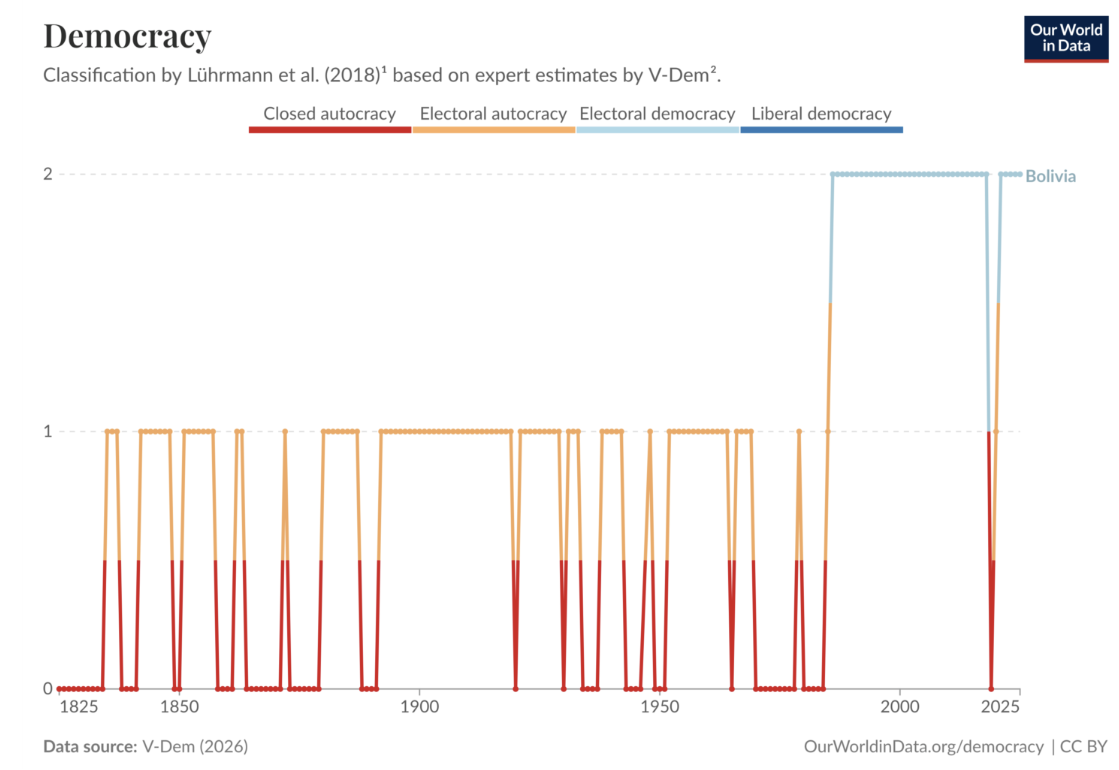
V-Dem. (2025). Political regime (Bolivia). Our World in Data.
The Hidden Decline of Democracy in Bolivia
Why isn’t the path to true democracy easy? The case of Bolivia shows that the system can be maintained on the outside but has decreased internally over time. In particular, before the recent presidential election, the president greatly expanded his power and changed the courts and institutions in favor of himself and the government. This process was carried out in a way that was difficult for citizens to recognize, and the Morales government (MAS) changed the rules to push through these changes and ignored the opposition even though it did not meet the conditions for a constitutional amendment. As a result, the public began to feel distrust in democracy, but it was difficult for society to recognize the collapse of the regime because formal procedures such as elections were still maintained. This phenomenon can be seen as a “quiet democratic collapse” in that it does not collapse suddenly like a coup but instead proceeded step by step. Therefore, Bolivia can be seen as a case where the institutional system is steadily changing, but in reality, it is undergoing a gradual undermining of democracy internally.
Institutional Manipulation and the Concentration of Power
This erosion of democracy is particularly evident in the process of concentrating power in the administration. Under the Morales administration, the judiciary progressively became politically influenced, eroding core democratic principles such as the separation of powers. In addition, the rule of law was also undermined as the constitution and institutions changed in favor of the ruling power. Although these changes appeared to follow legitimate procedures, they actually resulted in weakening governance from within. Morales, for example, tried to circumvent the constitutional term limit. In the 2016 referendum, citizens opposed his bid for a fourth term, but the government later tried to overturn it through the Constitutional Court. This decision ignored the will of the people and used legal institutions to undermine democracy from within. (Deutsche Welle, 2017). This illustrates the gradual erosion of the regime.
The Gradual and Hidden Nature of Democratic Erosion
The reason these shifts are more problematic is that they have been made by degrees. Because systems such as elections were maintained continuously, it was easy for the public to recognize that democracy still worked normally. However, in reality, the institutional functions gradually deteriorated, and these changes proceeded in a way that was difficult for society to clearly recognize. This is an important example of how the system can be weakened unnoticed.
Active Civic Resistance in Bolivia
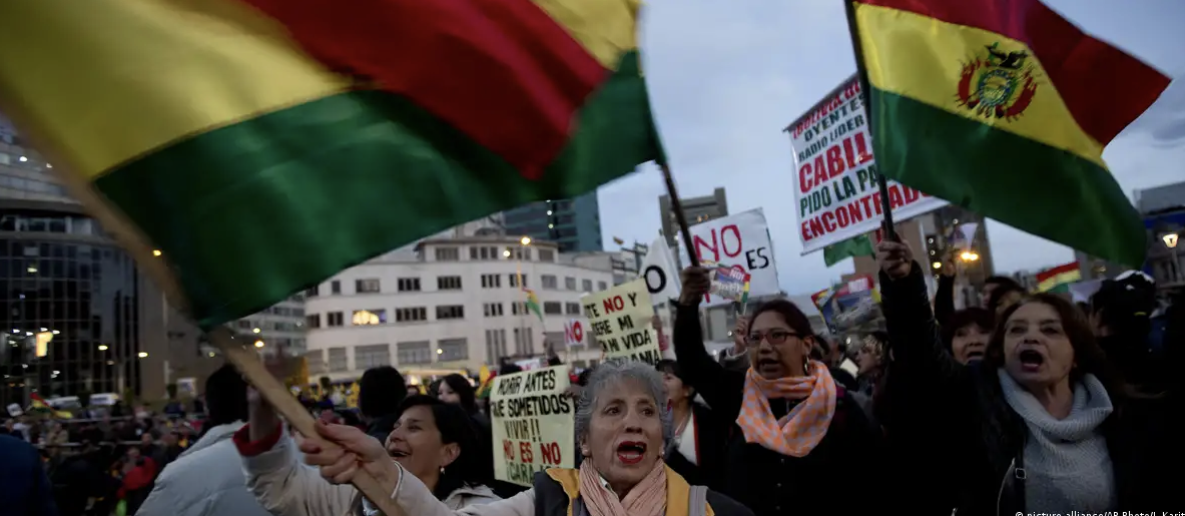
Nevertheless, Bolivia shows different characteristics from other cases of democratic decline. In general, the public’s participation decreases in situations where the system is weak, but in Bolivia, indigenous groups and labor organizations have maintained active political participation. In fact, various social groups and trade unions are actively intervening in the political process by organizing protests against the government’s economic policy. For example, according to AP news reported in December 2025, when the Bolivian government abolished fuel subsidies, protesters, led by miners and trade unions, held large-scale protests in the capital city of La Paz, followed by road blockades and strikes nationwide. These protests reflected citizens’ dissatisfaction with rising prices and increased economic burdens. In addition, during the same period, traffic workers also went on strike against rising fuel prices, paralyzing the functions of major cities.
In addition, in recent years, even various professional groups have appeared to participate in political action. According to a report by AP News in 2026, Bolivian clown trade unions and related workers also staged street protests against the government’s education policy, demanding livelihood issues and policy changes. These examples show that citizens are not simply passive beings, but active actors who exert direct pressure on the policy-making process. (Associated Press, 2026)
An Unstable but Resilient Democracy
Until recently, direct political participation such as street protests appeared actively in Bolivia, and at the same time, a tendency to express political preferences through elections is strengthening. This can be seen as a positive change in that it represents a way of resolving conflicts through democratic procedures. However, at the same time, low trust in the political system, economic difficulties, and unstable political structure remain factors that make democracy vulnerable. (GIGA, 2025). This shows that Bolivia’s regime is still in an unstable state.
Political Transition and the Limits of Democratic Stability
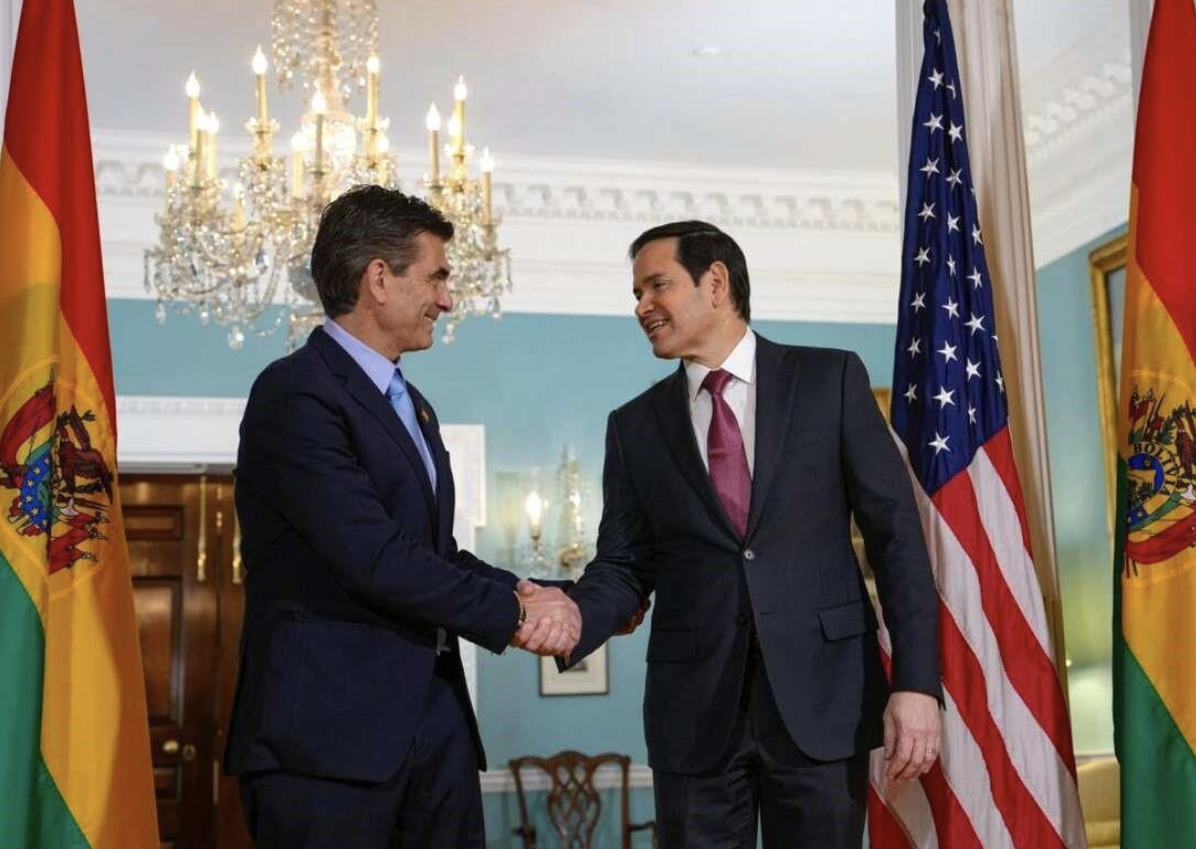
Meanwhile, political alterations are also emerging as the MAS government, which has dominated Bolivian politics for about 20 years, recently lost power. Problems and internal divisions accumulated during the long-term government eroded citizens’ trust in the government, which eventually led to a regime change. However, these changes can be seen as a positive political transition, but at the same time, they show that the institutional stability of democracy has not yet been fully secured. (Romero Ballivian, 2025).
Conclusion: The Vulnerability and Resilience of Democracy
In conclusion, the Bolivian example shows that democracy is not maintained simply by the existence of elections. If institutional checks and balances and the rule of law are weakened, democracy can be easily damaged internally, even if it is maintained on the outside. At the same time, the fact that civic participation is maintained actively seems to be a positive phenomenon that shows the possibility of restoring democracy. Therefore, Bolivia can be said to be a complex example of both the vulnerability and the possibility of recovery of the democracy.
This post does a great job in pointing out the important distinction between holding elections and the actual practice of democracy. With the current state of Bolivia, its severe economic crisis highlights Bolivia’s democracy, or lack thereof. Minimalist definitions of democracy focus on elections, but real democracy emphasizes the rule of law, accountability, and civil liberties required in upholding the people. This distinction between elections and democracy alludes to the idea of electoral authoritarianism. While MAS was able to mask democracy through the election, the highlight of internal repression and dismantling of the democratic government from within provides a perfect example of electoral authoritarianism and the use of stealth authoritarianism, by using legal mechanisms to achieve anti democratic ends. It is great that you highlighted the impact civic resistance has had in recognizing the flaws within the government and mobilizing despite having distrust. Their mobilization highlights the importance of the key to democracy, which goes back to the voices of the people, which always come forward in the end. While the recent shift from MAS to a new presidency signaled a promised change for Bolivia, true democracy cannot be achieved until real enforcement of democratic norms and efforts to stabilize its current crumbling economy are taken.