Voting in the United States of America is portrayed as the foundation of the world’s greatest democracy, the ultimate freedom amongst an endless list of freedoms. But this century has seen a shadow of doubt thrown upon the idea of voting as the outcomes and processes of this sacred act have increasingly resembled a coin flip more than an expression of the general will.
This modern tension can be traced back to the case Bush v. Gore, which saw the Supreme Court effectively determine the outcome of a presidential election by halting a recount in Florida. While the decision resolved an immediate constitutional crisis, it marked a turning point in public perception, blurring the lines between democratic choice and system intervention, and planting seeds of doubt about the neutrality and fairness of the system.
Those seeds sprouted in 2016, when Donald Trump won the presidency despite losing the national popular vote, a result made possible by the Electoral College, which in 2004 crowned George W. Bush victor, had now crowned Trump, making them the only two presidents to accomplish such a feat since Benjamin Harrison in 1888. And although constitutionally legitimate, the outcome highlights a fundamental hypocrisy within American democracy: the possibility that a candidate preferred by a majority of voters can still lose the election at large, which runs antithetical to the idea of democracy. This disconnect between votes cast and outcomes delivered weakens the perceived legitimacy of elections, particularly in an era of intense polarization, where narrow margins carry enormous political consequences.
The decision by the Democratic National Committee in 2024 to rally behind Kamala Harris without a primary process brought concerns about how much influence voters truly have in selecting candidates before the general election even begins. While parties are technically private groups that can set their own rules, skipping the competitive part of the process makes the general election feel like a choice between two pre-selected options. It feeds the narrative that the real decisions happen in backrooms long before anyone reaches a ballot box.
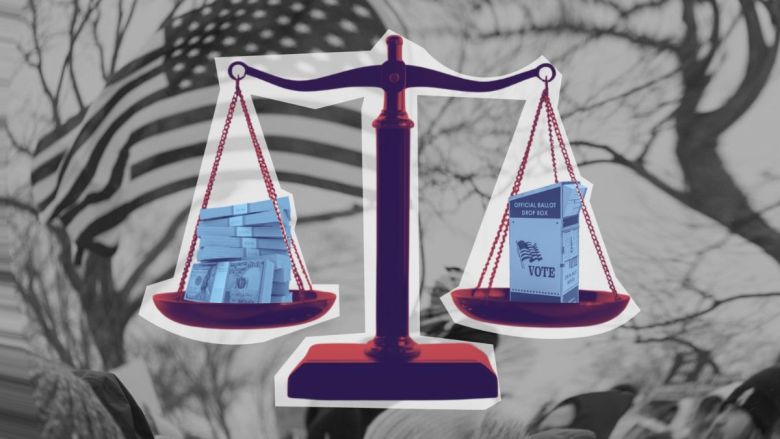
(Illustration by Naomi O’Donnell and photo by Vaughn Wheat/The Beacon)
Underlying all of these ideas is the expanding role of money in politics, particularly after Citizens United v. FEC. By allowing for virtually unlimited independent political spending, we’ve seen an accelerated flow of money from wealthy donors, corporations, and outside groups into elections. Campaigns have since become extraordinarily expensive, reinforcing the dominance of the two major parties and making it increasingly more difficult for outsider candidates, movements, or parties to compete. This might not represent the collapse of American democracy, but it does point toward a pattern of democratic erosion. Each instance of judicial intervention in elections, electoral system inequalities, party gatekeeping, and financial coercion adds another layer of distance between the voter and the outcome. Over time, that distance will further erode public trust, in turn fostering disengagement and cynicism even if the formal structures of democracy remain intact. Contemporary voting in the United States reflects not only the voice of the people, but also the growing influence of institutions and actors that shape, constrain, and at times override that voice, raising urgent questions about the future of democratic participation and legitimacy.
I really enjoyed reading your post! I think you did a good job at highlighting democratic erosion as a slow moving process, rather than something that just falls apart overnight. What voting is supposed to symbolize versus how it actually feels in practice for voters is very different. Instead of a processes that reflects collective action, it more accurately reflects a system which is constructed and manipulated by political actors. I wonder in what ways we’ll see voting change over time.
Bereket, this is such a relevant post! The dwindling trust and confidence that people have, often for understandable reason, with the stability of our democracy is a tough conversation, and such an important one at the same time. I also really appreciate how well you articulated that the issue transcends any one particular party, and how it isn’t a partisan issue, it’s a systemic American one. I think you also articulated the long history of all of this really well!
Hi Bereket, I really enjoyed your post! It’s so relevant to the times and the democratic erosion that the US is facing. I really appreciate how you gave the historical context with Bush v. Gore, as it really highlights this slow rise in undemocratic voting systems. I also really appreciate you bringing up money’s impact on politics, as I often think that is a perspective that flies somewhat under the radar. Do you believe that there is a future where contemporary voting in the United States will become more democratic, and if so, do you believe that shift will come from institutional change, or a shift in the way politicians and political parties operate, or perhaps a mix of both?
This post is very important because it highlights the current issues between the voters’ agency and institutional control. Noting the DNC’s 2024 primary and candidate selection perfectly explains how political parties can act as “party gatekeeping” toward their base. When primaries are bypassed, they risk alienating their base and, importantly, eroding the legitimacy of the party and the democratic process as a whole. The mention of Citizens United was also useful, as it reinforces the argument that democratic erosion can be a gradual process (from restrictions on corporate spending to unrestricted corporate spending). The post highlights both the political party system and the judicial system and explains how they can work to make institutions seem legitimate while not supporting the public will. Well done!
Both the Bush and the Citizens cases are certainly important in understanding the erosion of voting rights in America, but I think something that’s just as important to discuss is the repeated attacks on and dismantling of the Voting Rights Act. With the Supreme Court moving so aggressively against the landmark law in recent weeks, I think we could be witnessing an unprecedented assault on the right to vote in the United States, and I might go so far as to argue we’ll look back on Louisiana v. Callais with the same disdain we do for Citizens United. The people must be emboldened by these attacks to vote for candidates who promise to uphold the rights of all Americans and who promise to move quickly to institutionalize more of our liberties. Great post!