A Never-Ending Crackdown: Daniel Noboa and Ecuador’s Potential Turn toward Authoritarianism
In January 2024, masked gunmen stormed a live television broadcast in Guayaquil, Ecuador. A notorious gang lord had just vanished from his prison cell. The country was clearly in crisis. For Daniel Noboa, Ecuador’s 36-year-old president who had been in office barely two months, the moment demanded a response.
What followed was a series of actions that, although generally popular with Ecuadorians, have eroded Ecuador’s democracy.
Enter Daniel Noboa
Noboa came into power in late 2023, following the collapse of the Guillermo Lasso government and a snap election to fulfill the remainder of his term. Ecuador had been governed for just over a decade before that by the left-wing Rafael Correa and his party. Though enormously popular, Correa’s decade in power saw a serious degradation in the quality of Ecuadorian democracy. Fortunately, the two presidents after him, Lenín Moreno and the aforementioned Guillermo Lasso, brought democracy in Ecuador to a much higher quality.
Noboa, the son of one of Ecuador’s wealthiest men, ran as a political outsider focused on bridging the country’s deep political divides and addressing the alarming levels of violence, best exemplified by the assassination of 2023 presidential candidate Fernando Villavicencio, with radical solutions. He won with 51.83% of the vote. His newly-formed party held just 14 of 137 seats in the National Assembly, meaning he had to govern with a coalition.
A long-time haven of safety in an sea of narco-fueled organized crime, Ecuador had just recently started to experience a startling wave of violent crime. Ecuadorians demanded a response, and Noboa was eager to satisfy the populace with decisive action.
States of Exception and the New Normal
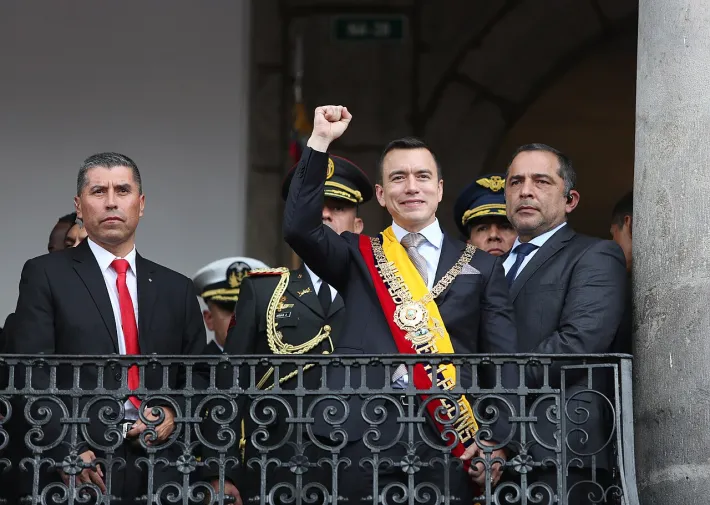
Noboa’s primary tool for addressing the security crisis has been the state of exception, a constitutional mechanism that allows the executive to temporarily suspend certain civil liberties to respond to emergencies. It permits warrantless searches and limits on public gatherings. Shortly after taking office, Noboa declared a 60-day state of exception, and then went further, declaring that the country’s crisis had reached a state of “internal armed conflict” and identifying 22 criminal organizations as terrorists, deploying the military to conduct operations against them.
The problem is that states of exception are supposed to be temporary. Under Noboa, they have become anything but. The decrees have been renewed so frequently in some parts of the country that they have become effectively permanent, allowing Noboa to rule without the normal checks on his power.
This is what political scholars call executive aggrandizement: a slow, creeping power grab undergone by often technically legal maneuvers that over time consolidate power in the executive. Using the legitimate threat of armed violence as a pretext, Noboa has concentrated significant power in his own hands.
Noboa’s Overreach
Noboa’s second term, which began after his reelection in April 2025 with 55.65% of the vote and a slim legislative majority, has been defined by an escalating confrontation with Ecuador’s Constitutional Court, one of the only institutions that still stands in his way.
In August 2025, the Court struck down 17 articles from laws Noboa had promoted, including provisions on media regulation and internal security. His response was striking. That same night, ministers from Noboa’s government went live on TV, backed by military personnel, to say that the court owed the Ecuadorian people an explanation and had violated the will of the people. Noboa then led a march of thousands against the Court in the capital of Quito, calling the justices corrupt and vowing not to allow the will of the people to be stalled by nine people who will not show their faces. His Ministry of Energy then sent the Court a notice to vacate its building, citing an obscure technicality in the agreement that allowed the Court to occupy it.
The confrontational attitude has continued into 2026. In March, the attorney general — appointed by Noboa — opened a criminal investigation into two of the Court’s judges, alleging financial misconduct. Although corruption is certainly present in Ecuadorian politics, it is hard to believe this indictment is not a continuation of the executive’s pressure campaign against the judiciary.
Beyond the courts, Noboa has moved to consolidate his electoral advantage. On March 6, 2026, an electoral judge acting on the request of the attorney general ordered the suspension of Revolución Ciudadana, the main opposition party, for nine months. Just weeks later, the National Electoral Council moved upcoming local elections from February 2027 to November 2026, officially citing concerns about El Niño weather disruptions. The electoral judge’s ruling combined with the election’s rescheduling will make it extremely difficult for opposition candidates to register with new parties in time to run for the next election.
Although none of the aforementioned moves by Noboa are technically illegal, they have eroded the quality of Ecuador’s democracy. By pressuring and threatening the one government institution that still really stands in his way—the Constitutional Court—and strategically manipulating the upcoming elections, Noboa has made it harder for political opponents to contest him and has reduced horizontal accountability and degraded the system of checks and balances.
What Comes Next
Although Noboa has certainly taken actions to weaken democracy in Ecuador, the Constitutional Court has acted as an essential check on his power. By striking down seventeen articles of his laws, the Court has engaged in what scholars call constitutional balancing: blocking efforts to change the rules of democracy in favor of one side. Throughout Latin America, multiple cases demonstrate that courts can successfully resist executive overreach when they maintain their independence.
That being said, Ecuador is about to face a turning point. Noboa has set the stage for the upcoming elections later this year to be in his favor, and he has fomented discontent against the judiciary. These upcoming elections will be ones to watch.
Noboa has weakened democracy in Ecuador by concentrating power in the executive, reducing horizontal accountability, and strategically manipulating the electoral playing field. He has done so through largely legal actions that in and of themselves are easy to justify, but as a whole have shifted the balance of power. Whether Ecuador’s institutions can hold is now the central question for democracy in the country.
0 Comments