
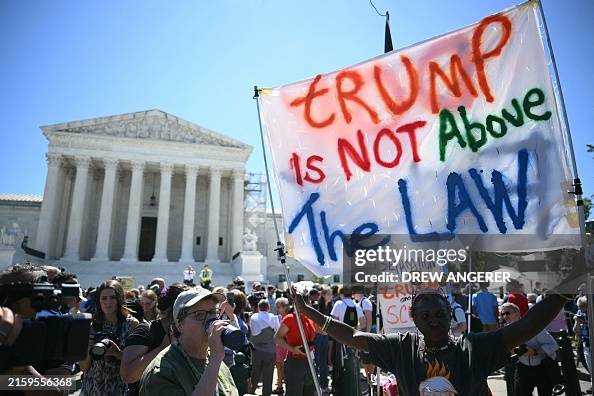
In July 2024, the Supreme Court of the United States issued a landmark decision granting presidents broad immunity from prosecution for actions taken while in office. In Trump v. United States (2024), the court stated that its decision was solely for clarification of the law, holding that in the president’s constitutional roles there must be full immunity, but, as many have criticized, removing critical checks on presidential actions will have significant consequences, now and in the future.
The Court failed in its stated intention, as the result was the reshaping of the balance of power and influence in the office of the president. Throughout the ruling, the Court stated that there is a distinction between the president’s official and unofficial acts. Official acts cannot be prosecuted, as the court holds that they are immune. Unofficial acts of the President can be prosecuted. This, of course, will be challenging to enforce because many of the president’s actions, or even all of them, can be defended or argued as official, thereby affording immunity. The result of this ruling leaves current and future presidents with significant protection from criminal prosecution, giving them the authority to take presidential actions that in the past would not have occurred.
The traditional dramatic coup of government that would result in immediate authoritarianism is not democratic erosion. Legal institutions that slowly but steadily shift the balance of power toward the executive are an example of how democratic erosion can occur in a liberal democracy. It’s also important to note that the Courts are the institution intended to answer questions that neither the legislature nor the executive could, as noted in the Federalist Papers. Instead, they are redirecting power away from the public and reverting it solely to the executive.
Executive aggrandizement is a concept the public can easily ignore because it is quiet. This concept is a methodical expansion of power in which leaders do not break the law; they tweak it to slowly return power to their office. The Court’s ruling is a classic example of this shift. By protecting a president from prosecution for “official acts,” the ruling increases the risk of aggressive executive action. It does not mean a president wakes up the next day and decides to break the law, but it fundamentally lowers the risk of executive abuse of power. When the threat of legal consequences is removed, actions that used to feel unethical or were in a gray area may now be supported. Due to Congress’s inaction, presidents on both the left and the right may also feel pressured to expand the executive branch, as the legislature is unable to pass or support the President’s preferred policy.
This ruling creates an environment in which democratic norms are much easier to chip away at. Future presidents, no matter their party, might find themselves pushing the boundaries of their authority simply because they can, knowing the legal system has effectively handed them a green light for anything they can categorize as official business. Another key framework for understanding this decision is the law. Instead, they reinterpret the distinction between the rule of law and rule by law. In a system governed by the rule of law, legal institutions constrain political power. In a system of rule by law, those same institutions are used to legitimize and reinforce it. The Court’s ruling invites a series of unsettling questions regarding where the United States currently sits on the spectrum between the rule of law and rule by law. While the decision is strictly “legal” in the sense that it was issued through the established procedures of a legitimate court, its practical effect is to position the president partially above the law in several key contexts. This inherent tension is an example of how modern democratic erosion operates: abandoning and reshaping legal frameworks to serve specific political ends. The result is a system that looks democratic on the surface but functions very differently in practice. It is important to note that this ruling is not just about the current president or the politics of this moment. The important aspect is the precedent this ruling sets, as it is just one more chip in the erosion of democracy. Future presidents will operate under a completely different set of expectations, with accountability boundaries less clear and potentially much more limited than before.
Modern is a gradual process shaped by a series of decisions that might appear justified on their own, but collectively shift the entire system in a meaningful way. The Supreme Court’s immunity ruling is a prime example of one of those decisions. It does not dismantle democracy in one go, but it alters the conditions under which democracy operates, resulting in power slowly but steadily shifting to the executive branch, with each president deciding how much authority and power they will maintain.
0 Comments