
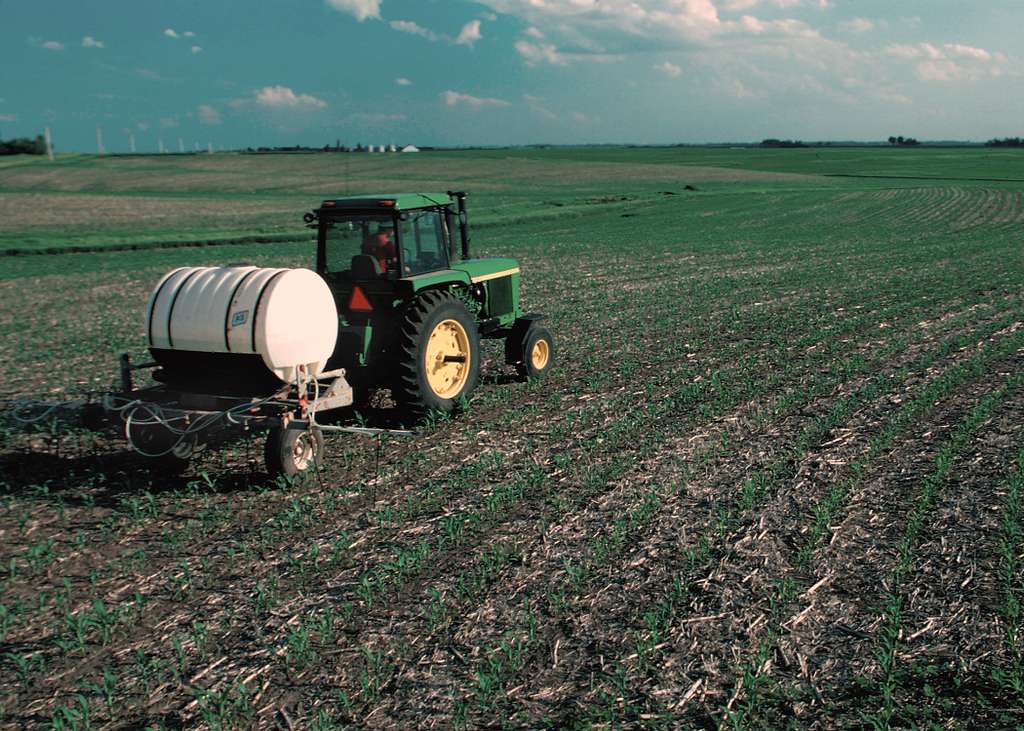
Fertilizer supply chains connect global conflict to farms and food prices at home. Photo: USDA, public domain via Wikimedia Commons.
When conflict erupts in the Middle East, most Americans do not expect it to affect the price of corn in Iowa or groceries at home. Yet global fertilizer supply chains connect geopolitical events abroad to food production at home in ways most consumers don’t see.
The food system does not begin in the grocery store. It depends on energy, minerals, transportation routes, farmers, and the inputs that make crops grow.
American food production may happen largely at home, but it depends on supply chains shaped by foreign suppliers, energy markets, and trade routes vulnerable to global conflict. That means U.S. food security goes beyond what happens on American farms. It is also about whether the country can protect the supply chains that make farming possible.
Modern farming depends heavily on fertilizer to maintain crop yields. In fact, nearly half of humanity is fed by crops grown with synthetic fertilizers, according to research from Our World in Data. These inputs help farmers grow staple crops at the massive scale needed to support the food system.
When fertilizer becomes more expensive or harder to access, it results in lower yields, higher production costs, different food availability, and eventually higher food prices. This is why organizations like the International Fertilizer Association call for protecting fertilizer supply chains as essential for safeguarding global food security.
But fertilizer does not come from one single supply chain. Nitrogen, phosphate, and potash fertilizers, the three main types, each depend on different inputs and sources. Nitrogen fertilizer is tied to natural gas since it is made from ammonia, while phosphate and potash fertilizers come from mined mineral resources, per Farmdoc. This makes fertilizer vulnerable to energy shocks and mineral supply disruptions, especially when trade or production is concentrated in only a handful of countries or regions.
These fertilizers move through global supply chains before reaching American farms. The United States is one of the largest fertilizer consumers in the world, accounting for about 10-15% of global fertilizer use, according to the Purdue University Center for Commercial Agriculture. The domestic fertilizer industry supplies about 60% of demand, but that does not make the U.S. independent. The country still relies heavily on imports for key nutrients and fertilizers.
Potash is the clearest example of fertilizer import dependence. In 2025, the U.S. imported 95% of its potash requirements, according to data from Farmdoc. From 2021 to 2024, Canada supplied nearly 80% of U.S. potash and Russia supplied 12%. Data from Investigate Midwest shows that by 2025, Canada was supplying up to 87%.
US dependence on phosphate and nitrogen imports is lower but increasing. They are also being imported from increasingly concentrated sources. According to Purdue University Center for Commercial Agriculture, imports supplied 16% of U.S. phosphate consumption and 13% of nitrogen in 2025. For the same year, an Investigate Midwest analysis of USDA data shows where those imports come from: Russia and Canada supplied over half of U.S. nitrogen imports, and Saudi Arabia and Mexico supplied about half of U.S. phosphorus imports.
These direct import figures illustrate potential vulnerability, but do not capture the full risk of relying on fragile global supply chains. Beyond direct U.S. fertilizer imports, the Gulf region is very important because it is a major global fertilizer, energy, and transportation hub. Nations like Iran, Qatar, Saudi Arabia, the UAE, and Bahrain account for major shares of global energy and fertilizer trade according to the International Fertilizer Association.
Because nitrogen fertilizer depends on natural gas, and all fertilizers require fuel-intensive processing and shipping, conflict or energy disruptions in this region can raise fertilizer costs for everyone.
As a result, domestic food production remains exposed to disruptions beyond U.S. borders.
The Strait of Hormuz is one example. The waterway is one of the world’s most important routes for energy and fertilizer trade. Data from the Purdue University Center for Commercial Agriculture shows that in 2024, up to 30% of global fertilizer shipments, 20% of liquefied natural gas, and 27% of internationally traded oil passed through the Strait. The effects of conflicts in that corridor do not stay confined to the Middle East. They have global consequences that trickle down to American farms and grocery bills.
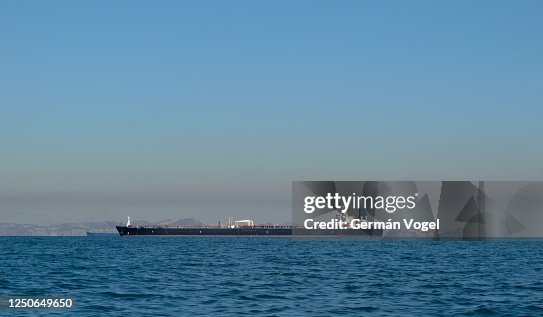
Shipping routes can affect fertilizer costs and food security. Photo: Ghetty Images / German Vogel.
For farmers, these price shocks are not small. Fertilizer is one of the largest costs they face before a crop is harvested. In Illinois, Farmdoc crop budgets show fertilizer as accounting for about 40% of direct corn production costs. When fertilizer prices rise, farmers are forced to make difficult decisions. Less fertilizer can reduce yields and food availability, while higher production costs weaken farms’ economic viability. Farms already operating on tight margins should not be so vulnerable to conflicts, energy shocks, and shipping disruptions far beyond their control.
For consumers, the consequences may appear later. A grocery bill does not itemize the cost of fertilizer, natural gas, or shipping. But those costs are embedded in the prices consumers ultimately pay. When any global conflict can result in increased food growing costs in the U.S., that makes agricultural supply chains like fertilizer a national security issue.
The answer is not to isolate the United States from global trade and supply chains. That would simply not be realistic. Instead, the U.S. should increase its resilience so that food production remains reliable even when global markets experience disruptions. Food security and agricultural production can’t halt or become unviable in the face of conflict.
That means diversifying fertilizer suppliers so that the U.S. is not overly dependent on a small number of foreign sources. It also means expanding domestic production, which both the Biden and Trump administrations have taken steps towards.
At the same time, policymakers should be encouraging farming practices that reduce fertilizer dependence over time. Expanding support for practices like compost use, cover crops, and crop rotation through federal farm programs, subsidies, crop insurance incentives, grants, and technical assistance would help farmers use fertilizer more efficiently and become less vulnerable to price shocks.
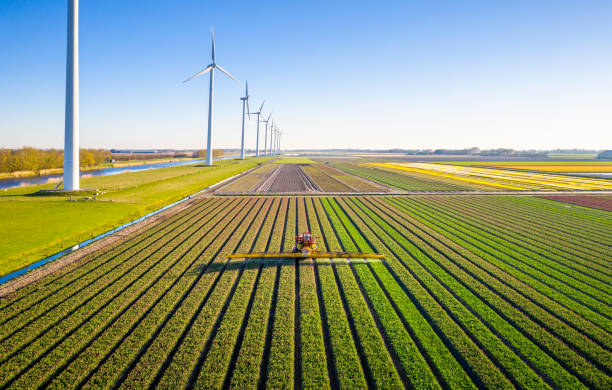
Protecting farms from shocks they cannot control. Photo: Getty Images / Eloi_Omella
Fertilizer, food, and energy trade should be included in national security planning. During conflict or transportation disruptions, protecting the movement of these necessary goods should be treated as essential. That also includes discouraging export restrictions on food and fertilizer and negotiating to keep trade routes open. Food and fertilizer should not be tools of leverage in global conflict.
Food security is rooted abroad because the inputs behind American agriculture are global. A stronger food system would not depend on hoping global markets and affairs stay calm. It would prepare for disruptions before they reach farmers and consumers. Protecting American food security means looking beyond the grocery store and fortifying the supply chains that make farming possible.
This is a very interesting article; it shows how food security, in a highly globalized and supply-chain-sensitive world, is not a given even for powerful countries like the USA. One may think that food production, stability and security is a system based solely on farming productivity and environmental factors (considering how extreme weather is currently affecting crops and output), however, as the article very acutely points out, this whole system is entangled with a web of geopolitics and supply chains that consumers and producers can barely see. Fertilizers are also a key component in this web and can easily be overlooked; learning that 30% of global fertilizer shipments pass through the Strait of Hormuz (currently debated waterway) was baffling to me. This article is nuanced, and its argument is very solid; I thoroughly enjoyed learning about this important aspect of our lives that we may ignore on a daily basis. As much as it was enlightening, the article also left a slightly concerning question for me: if the USA, as one of the wealthiest nations in terms of economic and agricultural means, is this vulnerable to fertilizer and grain supply chain disruptions, what does this imply for Global South nations that may not have the economic capability to pivot once crisis ensues? How can these nations, that are living on the delicate balance of globalization, protect themselves from these shocks that bruise even the wealthiest on the planet?
The article does an excellent job of revealing how interconnected the modern food system really is. Before reading it, it would be easy to think of U.S. food security primarily in terms of whether American farms can produce enough food. However, the article makes it clear that producing food domestically does not necessarily mean being independent from global events. I found the discussion of fertilizer dependence particularly interesting because it is such an invisible part of the food system. Consumers rarely think about where fertilizer comes from or how much agricultural production depends on it. The statistic that the United States imported 95% of its potash requirements in 2025 demonstrates just how significant this vulnerability can be. I wonder whether countries in the Global South, which may have even greater dependence on imported fertilizer and food, face an even more serious version of this problem. If wealthy countries like the United States can be exposed to disruptions in global fertilizer and energy networks, how can less economically powerful nations build enough resilience to withstand the same shocks?
This article does an exemplary job of highlighting the juxtaposition between domestic agricultural production and foreign supply chains abroad. Though the two may not immediately come to mind as intertwined, the article makes the tension between them clearly apparent. By expanding traditional national security thinking and reframing food and fertilizer not just as commodities or agricultural goods, but as essential components of critical infrastructure frameworks and vital elements of grand strategy, this blog encourages a deeper examination of the moral argument that basic human needs should take precedence over geopolitical maneuvering. Until the notion that food security is, in fact, national security is accepted, the question needs to turn to what it would take for this not only to be realized but also to be reflected in future policy frameworks. For if this is not apparent or deemed as of high importance, then what would genuinely need to unfold to make this a prominent area of discussion? Furthermore, when considering the increasing weaponization of food and the lack of respect for humanitarian law, such as the more than 1,000 humanitarian aid workers that have been killed between the years of 2023-2025, according to the United Nations, while trying to distribute necessities such as food, water, and medicine, it raises important questions about whether traditional approaches to national security and grand strategy adequately account for the protection of basic human needs.
This publication does a great job of emphasizing the impact of war abroad on the domestic economy. I don’t think a lot of Americans recognize how reliant our local agricultural economies are on imports from abroad, such as fertilizer. All they see is food prices going up, and they’re not sure who to blame. You are correct that, in light of the current international climate, we need to prioritize innovations in fertilizer and similar products within our borders. The point about making food a national security measure is very interesting, and I agree with it entirely. There is no nation if there is no food, and conflicts such as the one between the U.S. and Iran and the blockage of the Strait of Hormuz highlight how international security issues can impact everyone at home. This publication did a great job of explaining the connection between food security and national security, in many ways I had never thought of prior.
I found your argument that fertilizer should be treated as a national security issue very persuasive, especially because this dependence is largely invisible to consumers. It also made me wonder whether supply disruptions could become a democratic stability issue: when global conflicts raise food prices, citizens may blame domestic institutions and become more receptive to populist or protectionist solutions. How can policymakers build resilience without using food security to justify isolationism?