On July 7, 2021, Haitian President Jovenel Moïse was assassinated at his home, and the suspects and conspiracy theories surrounding the attack have fallen on political opponents, his own wife, Colombian mercenaries, and other outside forces. That so many explanations are plausible says something about the state of Haitian democracy.
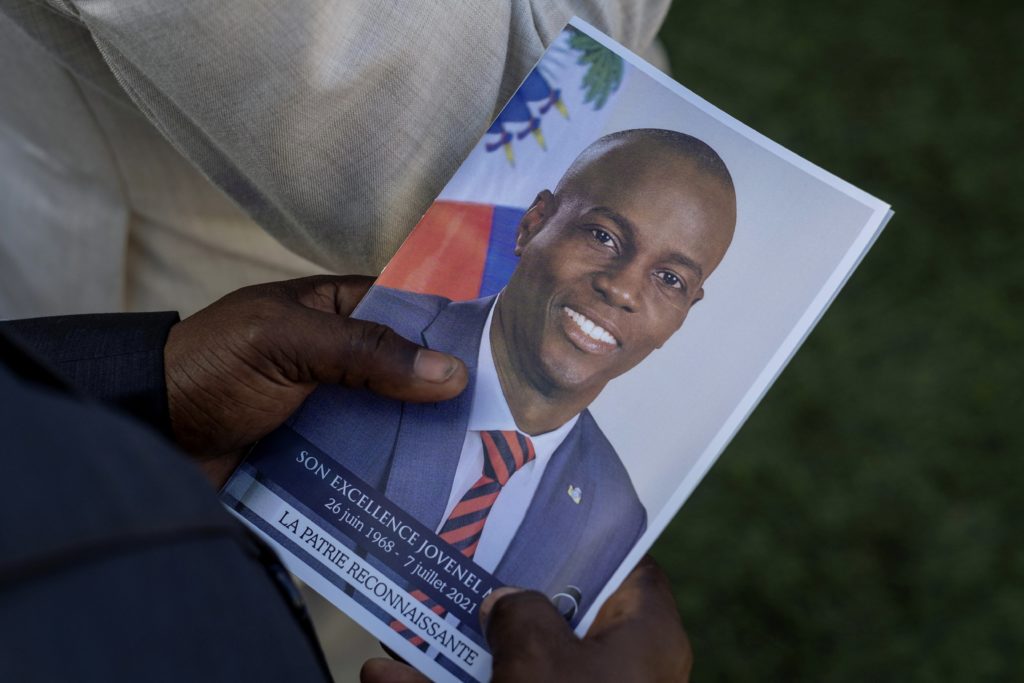
A person holds a photo of late Haitian President Jovenel Moise, who was shot dead earlier this month, during his funeral at his family home in Cap-Haitien, Haiti, July 23, 2021. REUTERS/Ricardo Arduengo
Foreign intervention is central to that story. It has been a norm in Haitian affairs for generations, from French interference to the UN’s presence and the Kenyan-led security mission. Each intervention reinforced the idea that Haiti’s leaders answered to outside powers rather than to Haitian voters. That perception surrounded Moïse’s predecessor, Michel Martelly, who many critics accused of being a U.S. hand-picked puppet, corrupt, and more interested in profiting from outside influence than actually serving the Haitian people. When a president is seen as chosen from abroad, elections lose their meaning as the source of legitimacy, and that was the situation Moïse inherited.
Moïse presented himself to the Haitian people as a populist leader and promised to break the longstanding hold of the elite in the state. In his words, “The corrupt oligarchs who are used to controlling the president, ministers, parliament and judicial system think they can take the presidency, but there is only one way of doing this, through elections.” The promise was an appeal to democratic process itself. Yet the mandate he won was weak. After the 2015 vote was annulled over fraud, he won the 2016 rerun with about 55 percent of the vote on turnout of only about 20 percent, so the electorate that endorsed his message was small. He soon abandoned that message. His presidency was riddled with accusations of corruption, including awarding contracts to foreign businesses, which contradicted his promise of a Haiti run by clean and secure Haitians. The gap between what he said and what he did is a form of erosion in its own right. Voters who had been told that elections were the only legitimate path to power watched the winner behave like the oligarchs he had denounced, and that teaches people to distrust the electoral process as well as the politician.
The dispute over his term then pushed his legitimacy further into ruin. The opposition argued that his five-year term began with the 2016 election and ended in February 2021. Moïse maintained that it began when he took office in 2017 and ran until February 2022. The opposition and much of the public rejected his reading, and mass protests organized by opposition parties erupted across the country. Haiti was left with a president whose authority half the country no longer recognized, and no agreed way to settle the question. Moïse’s plan to hold a referendum on a new constitution actually ended up deepening the distrust. He argued that the constitution needed modernizing, but critics feared the real intention was to remove the clause banning consecutive presidential terms so he could run again. Whether or not that was his intention, the fear itself shows how little trust remained. A leader whose own term was disputed was proposing to rewrite the rules that governed his power, which is why opponents saw the referendum as a threat to democracy and not a reform.
After the assassination, Haiti was left without a formal president and without a stable government. Ariel Henry, who had become prime minister in 2021 after the assination, was locked out of the country by gang blockades in 2024 and resigned, leaving a transitional council to fill the gap. Decades of turbulent, unstable governments had taught Haitians that the state would not protect or represent them, and many looked for power by other means. Today the country is “governed” by gang factions that control territory through violence, coercion, and corruption.
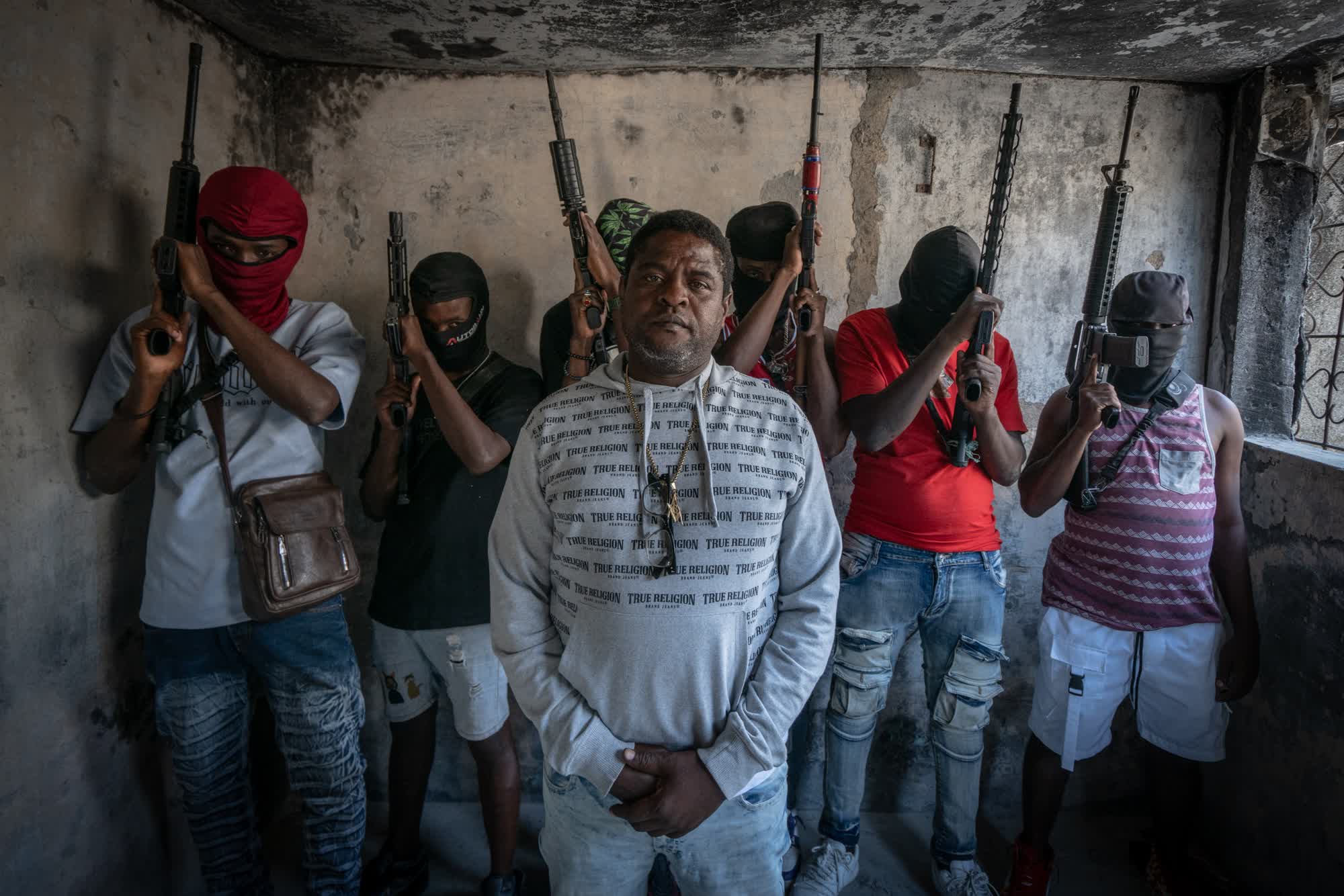
Jimmy “Barbecue” Chérizier stands in front of his masked Viv Ansanm gang members as they carry guns.
The most visible of these leaders, Jimmy “Barbecue” Chérizier, exemplifies how far the erosion has gone. Cheizer uses violence to subdue opponents and maintain control, his nickname a Barbeque comes from his alleged violent burning of political opponents and citizens who oppose his control. He has taken up the same populist language as many Haitian leaders before him have, vowing to end corruption and the oligarchy. Moïse used these same ideas to win an election, and Chérizier uses them to justify control by force. With this Chérizier seeks to gain control of the Haitian government through extra legal means as he puts it, “ The first step is to overthrow Ariel Henry and then we will start the real fight against the current system, the system of corrupt oligarchs and corrupt traditional politicians.”
Chérizier’s political project has increasingly extended beyond territorial control and into claims of political legitimacy. Through Viv Ansanm (Live Together), the gang he leads, he has presented the gangs as an alternative to Haiti’s traditional political structure, arguing that armed groups represent communities left abandoned by the state. In January 2025, Chérizier announced plans for Viv Ansanm to become a political party, although the announcement did not lead to an actual transition into a formal political organization. Chérizier has adopted the language of political reform without relying on the institutions through which democratic authority is normally established.
Both Chérizier and Moïse have framed themselves as opponents of Haiti’s traditional political establishment and have invoked the corruption of oligarchs and politicians to justify their claims to power. Moïse sought legitimacy through an election, even though the legitimacy of his mandate was later heavily contested. Chérizier instead presents armed control as a means of forcing political change. His declaration that overthrowing Henry would be the “first step” before confronting the broader political system demonstrates this shift from electoral competition to coercive political confrontation. The result is not simply that gangs have replaced politicians, but that the language of political representation has become detached from the institutions that traditionally give it meaning.
0 Comments