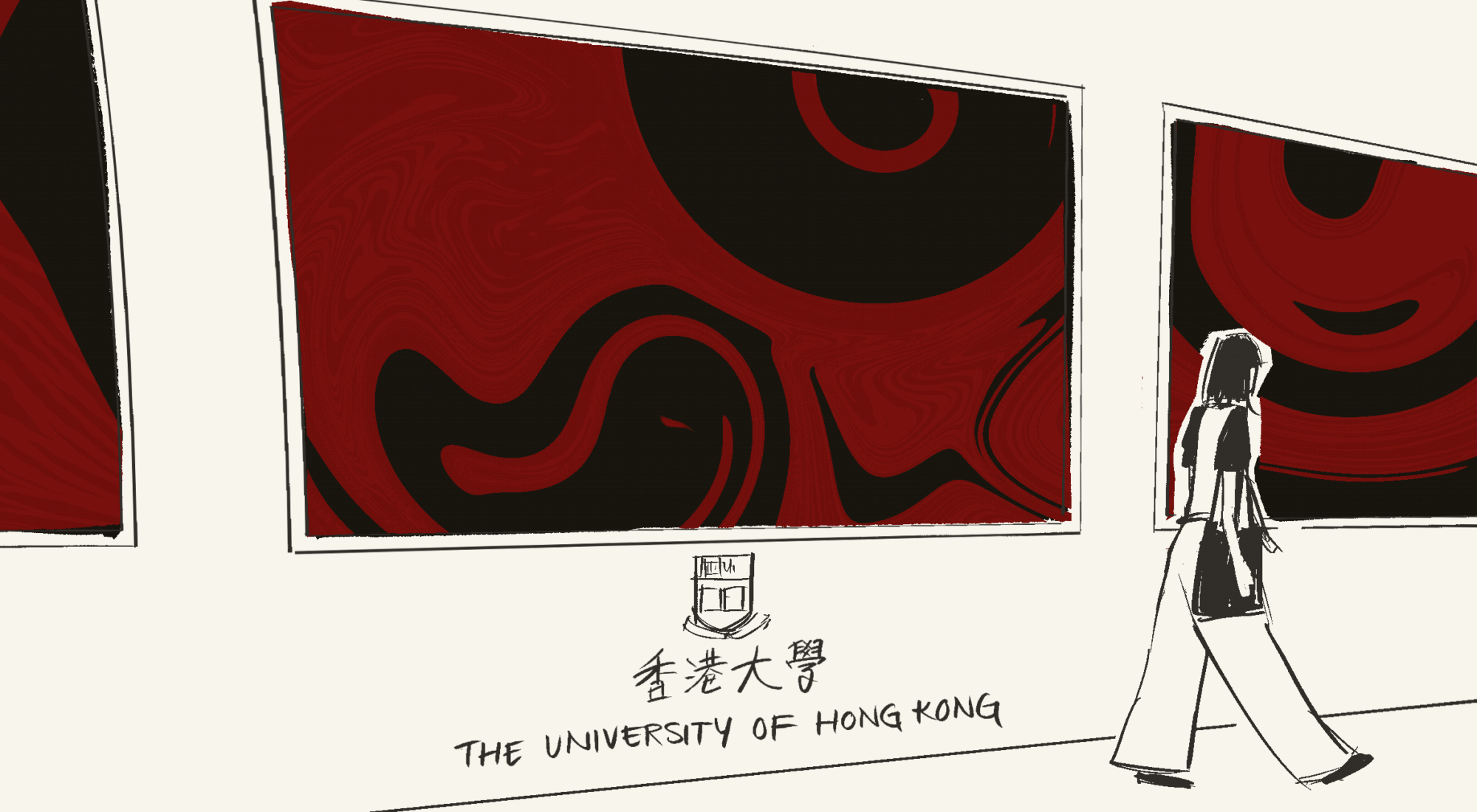
HKU “democracy wall” used to be covered with political materials, now stripped and replaced with digital displays
The Lennon Wall in the University of Hong Kong (HKU), famously known as the “democracy wall” among students, used to have pro-democracy and protest materials as a form of political expression on campus. In July 2021, the HKU student union issued a solidarity statement in support of a man who stabbed a police officer and committed suicide in protest of the handover of Hong Kong to China. This statement received severe backlash, and the university responded by derecognizing its student union and stripping the Lennon Wall bare. After five years, the university unveiled three digital displays on the wall this September, depicting university-produced campus promotional videos.
HKU is not a unique case; seven out of eight universities in Hong Kong have now lost their student unions from dissolution. The Hong Kong Federation of Students (HKFS), a student union coalition across the eight universities, also disbanded in February of this year. Through the last decade of political unrest in Hong Kong, student unions and organizers were leading the 2014 strikes and 2019 campus occupations. With the unions gone, students now lack institutional support in both funding and space, crippling their ability to organize as they once did. The movement therefore loses its student-to-organizer pipeline that replenished skilled organizers year after year.
In 2014, as a response to the Chinese government’s attempts to increase control over the nomination process of the executive election, citizens occupied the central business district of Hong Kong for 79 days. HKFS actively participated in the occupation and led a debate with government officials, calling for electoral reforms. Students acted as public representatives of the movement in negotiations with the political class. Five years later in 2019, an extradition bill that threatened to send Hong Kong citizens to China for prosecution reignited the movement for democracy. Student protesters at the Chinese University of Hong Kong and the Hong Kong Polytechnic University occupied the campus in an attempt to disrupt the city. The police responded with violence, employing teargas, rubber bullets, and tanks. The police standoff with protesters lasted days, resulting in injuries and arrests. Throughout periods of political turmoil, student unions provided financial support to student journalists, encouraging independent reporting to combat censorship on legacy media.
Following protest crackdowns, students pivoted to the international stage and formed the Hong Kong Higher Institutions International Affairs Delegation (HKHIIAD). A student from HKHIIAD testified in a congressional hearing in the United States to garner international support, ultimately passing the Hong Kong Human Rights and Democracy Act (2019) in the US. Despite its international success, HKHIIAD ultimately ceased operations following the enactment of the National Security Law in 2020. The draconian National Security Law defines foreign collusion as “provoking by unlawful means hatred among Hong Kong residents towards the Central People’s Government or the Government of the Region, which is likely to cause serious consequences.” The ambiguous language of the law— “unlawful means” and “hatred” — allows flexibility in its interpretation and expands room for prosecution.
While the National Security Law was the catalyst to the downfall of student unions, the loss of the unions is how institutions suppress future political mobilization. External organizations like the HKHIIAD rely on the student leaders to remain engaged and lack resources compared to a university affiliated union. Agnes Chow, student leader involved in HKHIIAD, declared after resigning from leadership that she will not return to international outreach work, demonstrating the breakage of the organizing pipeline that institution-backed student unions once championed. Experienced organizers are discouraged from participating, let alone passing the torch to future generations.
The decline of violent protests and dwindling news coverage on Hong Kong in the international arena meant that repression turned into legal and institutional reform instead of violent retaliation. Along with its democracy wall, HKU also removed a monument and painted over slogans that condemned the 1989 Tiananmen Square Massacre. Ozan Varol’s 2015 article “Stealth Authoritarianism” noted how modern regimes prefer to pivot from explicit violent takeovers to utilizing legitimate mechanisms to undermine democratic activities. The passage of the National Security Law as well as the removal of the wall, monument, and slogans are all administratively justifiable and lawful. Student unions were not explicitly outlawed, and censorship did not come from an announced ban.
If you didn’t pay close attention, one stripped wall on a university campus might not seem consequential. By the time you notice the removed monuments, covered slogans, and lost funding and space, the torch that would’ve been passed has already been snuffed out.
0 Comments