
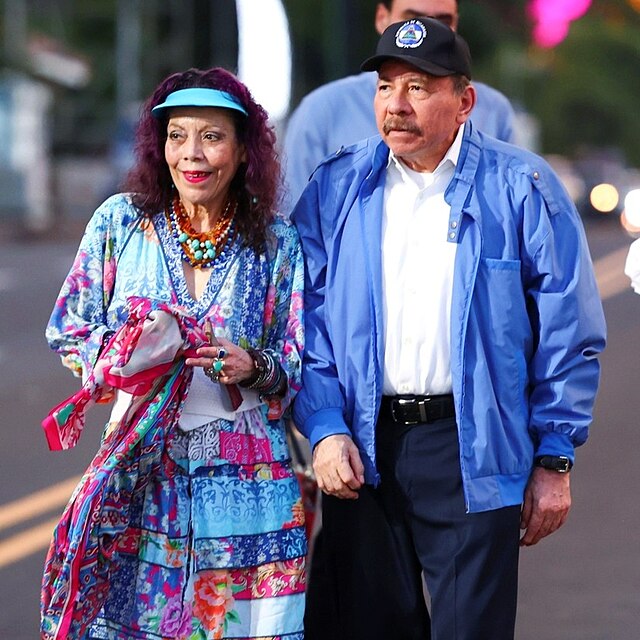
Nicaragua’s experience with true, liberal democracy is limited. Their battle to end United States backed regimes went well into the 1970s. Free, fair, competitive elections were not seen until 1990. However, this success was temporary, as Nicaragua’s liberal democracy index of today has returned to the strikingly low levels seen before their democratic transition – largely due to the stealth authoritarian tactics implemented by Daniel Ortega.
Nicaragua’s Quick Climb to Democracy
After the Civil War, resulting in the demise of the U.S-backed Somoza regime, immediate stability was not reached. Leaders of the Sandinista National Liberation Front (FSLN), led by Daniel Ortega, quickly rose to power, implementing a more progressive, yet definitively authoritarian regime. Throughout this time, rather than receiving support from the global community to achieve democratization, Nicaragua was met with efforts from the United States to unseat this new regime and regain control of the Nicaraguan government. Despite all these internal barriers and external threats, over the next decade, Nicaragua implemented a constitution based on a combination of socialist and liberal principles. In 1990, they held their first free and internationally recognized presidential election, resulting in the Chamorro presidency.
Failed Democratic Consolidation: The Resurgence of Daniel Ortega
At first, small measures of horizontal and vertical accountability, such as a shortened presidential term and legislative control of the budget, were slowly integrated into the foundations of the Nicaraguan government through checks and balances. That being said, the FSLN was determined to maintain and expand their representation in government. They applied continuous social pressure on the president from outside the government and also utilized their role in the legislature to continue eroding executive authority. Eventually, FSLN consolidated enough governmental power and electoral support to reelect Daniel Ortega in 2006.
How to Exploit Power Discreetly: Stealth Authoritarianism
Stealth authoritarianism has been described as a wolf in sheep’s clothing, or as a way to “to protect and entrench power when direct repression is not a viable option.” That is exactly what Daniel Ortega did. In the years leading up to Ortega’s swift and overwhelming victory in the 2016 presidential election, he successfully eliminated the mechanisms of horizontal accountability that had prevailed throughout his first two presidential terms. Six months ahead of the election the Ortega-appointed Supreme Court prohibited the leader of the opposition party from running. This allowed Ortega to use executive aggrandizement through court packing to manipulate election results, which ultimately led to his 72% victory in the 2016 election.
Gradually, Ortega kept garnering more and more power. In 2018, opposition protests resulted in the death of civilians by government law enforcement. In 2019, Ortega rescinded prior agreements for democratic political reforms. In 2020, he used his influence in the legislature to ensure laws were passed limiting freedom of speech and political expression. In 2021, he used these laws to have over 50 members of the opposition party arrested.Today, his family and the FSLN party have acquired ownership of almost all the major local news outlets in the nation.
The Result of Stealth Authoritarianism: What Life is Like in Nicaragua Today
Ortega continues to use stealth authoritarianism in modern day Nicaragua. He is now serving his fourth term as president, alongside his wife Rosaria Murillo, who was made co-president due to 2025 constitutional changes. These 2025 constitutional changes have solidified Nicaragua’s regression from democracy, all while abiding by stealth authoritarian tactics.
Aside from creating a co-president and automatic successor, these constitutional changes have lengthened the presidential term from 5 to 6 years, established a volunteer police force to support his political regime, and amended the text of the constitution to state: “The people exercise the power of the state through the Presidency of the Republic, which directs the Government, and coordinates the Legislative, Judicial and Electoral organs.” This ultimately gives the executive branch direct control over the legislative, judicial, and electoral bodies in the country– legally destroying all vertical and horizontal accountability.
As a result of Ortega and his all-encompassing authoritarian regime, many are choosing to leave Nicaragua, and many others are being forced to leave. An estimated 10% of Nicaragua’s population has left the country, many as a result of poverty and limited economic mobility, and others as a result of political persecution. Over 300,000 Nicaraguans have been expelled, and many others have their passports withheld and citizenship threatened due to their political involvement. In 2024 alone, it is estimated that nearly 100,000 Nicaraguans fled the country as a result of the Ortega-Murillo regime.
Those unable to leave the country, are likely to see continued unchecked power. The Ortega-Murillo regime has been unresponsive to international pressure and there is no end in sight considering the power is set to be transferred to Murillo upon Ortega’s resignation or death. In fact, Nicaragua is now listed as the country with the most stark 10-year decline in freedom out of all countries in the world according to Freedom House– and in 2024 reports surfaced that revealed political prisoners are now experiencing torture, sexual violence, and other crimes that classify as human rights violations.
The reality is, the future looks bleak for Nicaraguans right now. Ortega’s power continues to grow as horizontal and vertical accountability have become virtually non-existent– and currently there is no solution in place. The fate of a prospective democracy in Nicaragua will likely come down to the citizens’ ability to consolidate power again, and the international community’s ability to aid their efforts. In the meantime, the global democratic community must continue to shine light on the authoritarian atrocities being committed every day in Nicaragua, because without thorough monitoring and pressure, the people suffering in Nicaragua could easily be forgotten.
The FSLN has a complicated history. The Somoza regime was one of the most egregious regimes the United States has ever backed in Latin America. Their “democracy” was mere theatrics, while the Somoza family consumed nearly half of all land in the country. They were corrupt, they were torturous, and to put it like FDR, they were “Our Son of a Bitch” (real quote). The FSLN grew as part of a socialist resistance, but they were not alone. Violeta Chamorro, the president elected in the 1990s, was the wife of one Pedro Joaquin Chamorro, who was the Editor of the nation’s loudest, and one of the only, newspapers against Somoza at the time. He fostered the Unión Nacional Opositora, which itself was an offshoot of the Conservative Party which had a large faction that cooperated with the regime as token opposition. The UNO was just about as large as the FSLN, but both groups exploded in popularity with Pedro’s assassination at the hands of Anastasio Jr. in the 70s.
When the revolution was one, it was done with significant bloodshed of the people and groups on both sides. The FSLN was inspired by Cuba’s M26 movement under Fidel Castro in the 1950s, which significantly supported the Sandinistas. Ortega was a commander and leader of the prominent faction of the FSLN and was following the directives of their backer in Havana. The Cubans do not play nice, they play very, very dirty. When the FSLN came to power, they did so doing the same reprisals that the National Guard made, and enacted the “Revolutionary Justice” on former regime functionaries, with show trials and predetermined results, much like Cuba’s infamous “paredónes” in 1959. The only reason that liberal principles were instituted in the Nicaraguan constitution was because the Reconstruction Junta included Pedro’s wife and later president, Violeta. The UNO was brought into the Junta at the behest of many of the ideologues of the FSLN. They took advantage of the struggles of the administration and launched their bid at the presidency. Ortega is not a politician, he is a soldier, and he ran the nation like one. He is trained by the Cubans, which anyone can tell you is not even close to a free democracy.
Ortega has always wanted power and control, ideology aside. His swift and complete consolidation of power shows this, with ridiculous reforms such as making his wife the co-president. He has made the office of executive equal to that of a commander of a military force. His orders are to be heeded to, not debated. The prospect of democracy under the government has died, and the FSLN executed it flawlessly and in the image of their inspiration, Cuba. I am in complete agreement with your statement that the only hopes lay with the people of Nicaragua, but the point must be raised: If a country that has long suffered war, poverty, and misery must now face it again after achieving it, is it even worth fighting for? Or is it simply better for each person and their families to find prospects in a country which may not be their own, but does not require them to fight, bleed, and die to maybe fix? In simpler terms: Is it worth the fight to save Nicaragua? Or to leave it, and secure one’s future?