Figure 1 Ui-martin September, 2025
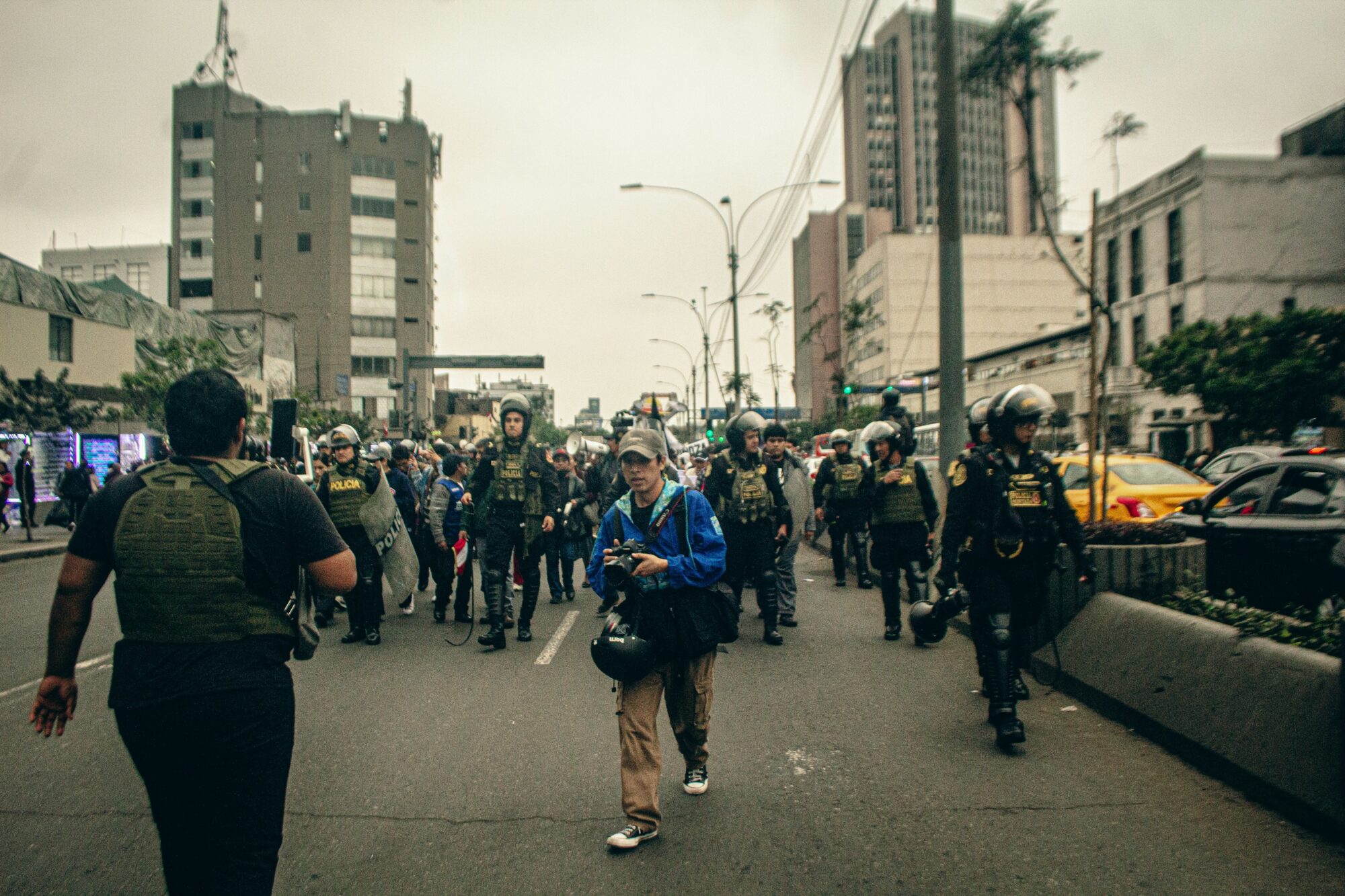
With the murder of over 50 protestors in three years, Peruvian President Dina Boluarte has demonstrated her willingness to suppress opposition. Her actions in Peru align with a long history of corrupt and anti-democratic rulers since Peru’s democratization in the 1980s. This post asserts that President Dina Boluarte is no different from her predecessors in that she represents a significant challenge to Peruvian democracy. Still, unique circumstances make the fight for Peru’s democracy more feasible under Boluarte.
A brief history of Peruvian presidencies:
After narrowly defeating opposition candidate Keiko Fujimori, Pedro Castillo then assumed the Peruvian presidency on July 28, 2021. His administration was immediately plagued by criminal investigations and corruption scandals. Two impeachment attempts followed from the opposition-controlled congress, and before a third impeachment vote could be held, Castillo declared himself the sole power in Peru and dissolved the legislature. Congress held an emergency session, ousting him from office where he was promptly arrested on conspiracy and rebellion charges. The vice president at the time, Dina Boluarte, was sworn in December of 2022. Overall, Castillo’s reign was characterized by the undermining of vertical and horizontal challenges to executive authority.
Backsliding under Boluarte:
Unlike her predecessor, who dealt with impeachment attempts his entire presidency, Boluarte works successfully with a corrupt congress and has utilized their collaboration to consolidate executive power. In her time in office, Boluarte has passed numerous anti-democratic bills, including a recent anti-NGO (Non-government organization) bill, which monitors NGOs involved in political activism and requires them to register with the government. Additionally, in July of 2024, Congress successfully passed a statute of limitations for crimes against humanity and war crimes committed before 2002, effectively forgiving Fujimori-era politicians for their human rights violations in the 1980s-1990s. In addition to the pardons, Boluarte enacted a law that pardoned military and police officers who were accused of human rights abuses committed in 1980-2000. These actions fall under a more subtle category of democratic erosion known as stealth authoritarianism, where politicians wield existing legal pathways for the purpose of democratic erosion. In “Stealth Authoritarianism,” Ozan O. Varol outlines how politicians can erode democratic norms, sue or scare journalists, manipulate electoral laws, and maliciously use surveillance and law enforcement to gain a systemic advantage over their opposition. The recent anti-democratic bills demonstrate Boluarte’s willingness to utilize stealth authoritarianism during her term.
Beyond her removal of congressional checks on past and present executive politicians, Boluarte has moved to remove some of the judicial bodies that check her authority and weakened the electoral system by allowing congress to decide electoral authorities.These actions contribute to the widely agreed upon idea that Peru’s democracy has been eroding steeply since 2020. According to V-Dem’s Liberal Democracy Index, Peru eroded from a moderate .79 in 2020 to a weak .49 in 2024. More than half of the backsliding can be attributed to Boluarte, who took power in 2022 (V-Dem score .63). Freedom House credits the largest part of the backsliding to the erosion of political rights, pervasive corruption, and a lack of inclusiveness of minority groups.
Protests and Progress:
Due to the nature of her ascent to power, Boluarte doesn’t have a strong following, and her popularity continues to decline. There is a growing youth movement against her and she possesses little real chance of re-election following her first term. Peru is therefore in a unique position where both protesting and simply waiting for election cycles have the potential to rid the government of anti-democratic politicians.
Judicial checks still affect Boluarte’s actions, and so, in spite of her repeated attacks on the judiciary, rule of law still stands in Peru. Ongoing investigations into the corrupt practices of Boluarte have led to raids of her home and dismissals of other officials in her government. An investigation by the National Board of Justice into Patricia Benavides’s corruption led to her losing the position of attorney general and chief prosecutor, although Boluarte and congress interfered and allowed Benavides to flee the country. Regardless, there are still institutions holding back the complete degradation of Peruvian democracy. These institutions will be key for the next steps in restoring the rightful powers of the judiciary and cleaning out the government of authoritarian politicians.
The judiciary, in combination with protestors, are capable of rallying enough leverage to force the resignation of the corrupt congress and elect a more suitable group of representatives. Protesting for the resignation of members of congress may seem futile given members of the legislature cannot be reelected and therefore have little care for their current popularity; however, Peru’s rocky past offers a glimmer of hope. The impeachment of Pedro Castillo, while enacted by congress, was largely driven by public outrage at his anti-democratic practices. Likewise, several previous corrupt leaders have been removed from office or voted out following their attempts to steal power. Peru’s citizens have demonstrated an awareness of anti-democratic practices and a willingness to fight for their rights. With Dina Boluarte, the citizens are no different, and have been protesting her executive aggrandizement from the start. According to Michael Bernhard et al. in “Parties, Civil Society, and the Deterrence of Democratic Defection” countries in the past have wielded strong social movements for the removal of corrupt governments. Notably Slovakia was able to remove Prime Minister Vladimír Mečiar from office after a concerted unification campaign. Mečiar, who “constituted a serious threat to undo democracy,” was engaging in blatant stealth authoritarianism while the newly formed democracy of Slovakia struggled to rally opposition. Resistance formed when civic campaigns targeting the youth rallied the underdeveloped civic society and united a divided political society to remove Mečiar. In the face of Boluarte’s authoritarianism, Peru’s active youth protests and unification, which mirror the circumstances in Slovakia, demonstrate the serious potential for change. Growing resentment for the corruption in Peru continues to pose a greater and greater threat to Boluarte’s government; only time will tell how long she can hold on to power.
References:
- Bernhard, Michael, et al. “Parties, civil society, and the deterrence of democratic defection.” Studies in Comparative International Development 55.1 (2020): 1-26.
- Carrasco, Elaine Sandoval. “Peru’s Democratic Backslide: Fujimorismo’s Shadow and the Erosion of Institutions: The College Voice.” The College Voice | Connecticut College’s Independent Student Newspaper, 23 Apr. 2025, thecollegevoice.org/2025/04/23/perus-democratic-backslide-fujimorismos-shadow-and-the-erosion-of-institutions/.
- The Editors of Encyclopaedia Britannica. “Pedro Castillo”. Encyclopedia Britannica, 30 Aug. 2025, https://www.britannica.com/biography/Pedro-Castillo. Accessed 2 October 2025.
- Emanuele, Francesca, et al. “Peru’s President Is the Most Hated in Latin America.” Jacobin, 3 May 2024, jacobin.com/2024/03/dina-boluarte-latin-america-authoritarianism.
- “How Corruption and Nepotism Hinder Peru’s Consolidation of Democracy – Democratic Erosion.” Democratic Erosion Consortium, 5 Jan. 2023, democratic-erosion.org/2023/01/05/how-corruption-and-nepotism-hinder-perus-consolidation-of-democracy-2/.
- Ilizarbe, Carmen. “6 Peru: Democratic Erosion under Neoliberalism.” De Gruyter Brill, Lynne Rienner Publishers, 1 Sept. 2022, www.degruyterbrill.com/document/doi/10.1515/9781955055598-007/html?lang=en.
- “In Peru, Opposition to Democratic Backsliding Is Growing. without Leaders, It Might Not Get Far.” Council on Foreign Relations, Council on Foreign Relations, www.cfr.org/blog/peru-opposition-democratic-backsliding-growing-without-leaders-it-might-not-get-far. Accessed 2 Oct. 2025.
- Little AT, Meng A. Measuring Democratic Backsliding. PS: Political Science & Politics. 2024;57(2):149-161. doi:10.1017/S104909652300063X
- “Peru: Congress Ramps up Assault on Democratic System.” Human Rights Watch, 12 June 2024, www.hrw.org/news/2024/06/12/peru-congress-ramps-assault-democratic-system.
- “Peru: Freedom in the World 2024 Country Report.” Freedom House, freedomhouse.org/country/peru/freedom-world/2024. Accessed 2 Oct. 2025.
- Peru’s Boluarte Pardons Security Forces for Abuses during Decades-Long Internal Conflict | Reuters, www.reuters.com/world/americas/perus-boluarte-pardons-security-forces-abuses-during-decades-long-internal-2025-08-13/. Accessed 2 Oct. 2025.
- Wallenfeldt, Jeff. “Dina Boluarte”. Encyclopedia Britannica, 30 Sep. 2025, https://www.britannica.com/biography/Dina-Boluarte. Accessed 2 October 2025
- “With Blanket Amnesty Law, Peru’s President Adds Insult to Injury.” Human Rights Watch, 11 Sept. 2025, www.hrw.org/news/2025/09/02/with-blanket-amnesty-law-perus-president-adds-insult-to-injury.
0 Comments