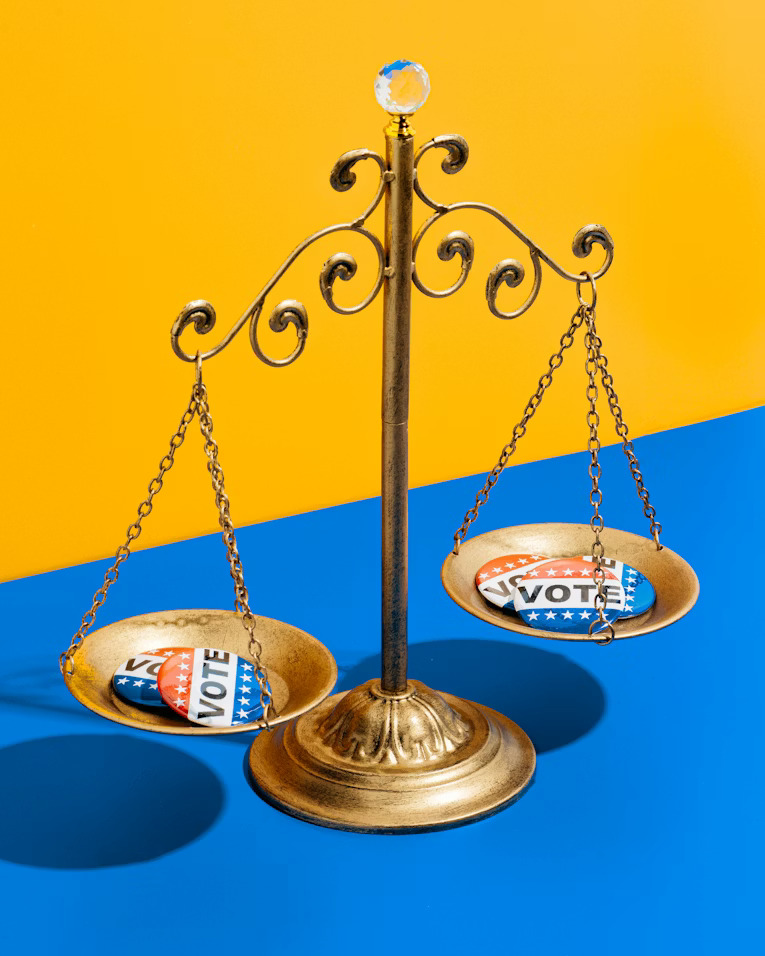
Photo by Katelyn Perry (Unsplash), Unsplash+ license.
Before Illinois voters cast a single ballot on March 17th, outside money had already been working to decide who they would get to choose from.
Roughly $125 million poured into five major Democratic contests that day. Pro-Israel groups spent over $21 million across four Chicago-area House races alone, funneling much of it through super PACs with deliberately innocuous names like “Chicago Progressive Partnership” and “Elect Chicago Women” that gave little hint of their real backers or agenda. The crypto industry’s main super PAC, Fairshake, added another $13 million, while AI-aligned groups contributed an additional $2.5 million. The scale is staggering. What matters more, though, is how that money worked.
Illinois’s 2026 primaries illustrate how democracy erodes quietly and by design, through entirely legal means, with the formal machinery of voting left completely intact.
The Structural Opening
What made these primaries so vulnerable starts with their structure. Many contested seats sat in districts so heavily Democratic that the primaries decided who would serve in Congress. And with more open House seats on the ballot than Illinois had seen in decades, the stakes were unusually high across the board. Whoever could shape the nomination stage would effectively shape the seats themselves.
Outside money understood this. Primary electorates are small, local press coverage is thin, and voters have little time to develop opinions about candidates they barely know. That combination makes primaries cheap to flood and hard to defend. By targeting the nomination stage, wealthy outside groups could exercise maximum influence at minimum political cost. The Illinois dynamic aligns with Martin Gilens and Benjamin Page’s landmark 2014 finding that U.S. policy outcomes track the preferences of economic elites over average citizens. In the Prairie State, donors were not simply trying to win elections. They were trying to shape who got to run seriously in the first place.
The information environment made this worse. Facing mounting grassroots backlash, the American Israel Public Affairs Committee (AIPAC) deliberately concealed its involvement. Its money flowed through shell PACs engineered to mislead, evoking Chicago progressivism and women’s empowerment while pursuing a narrow foreign policy agenda. Voters encountered waves of attack ads with no clear indication of who paid for them. As Axios reported, AIPAC spent millions across the four House races while systematically obscuring its fingerprints.
This opacity is intentional and strategic. Robert Dahl’s case for democracy rested on political equality, which requires citizens to be able to evaluate the arguments placed in front of them. This is very difficult when donors hide behind misleading PACs. The median voter can’t be expected to identify the source behind every attack ad they see on television and social media, and therefore has a much harder time judging their credibility and motives.
This is also where Illinois connects to a much bigger pattern. In their research, Steven Levitsky and Daniel Ziblatt found that democracies rarely collapse through dramatic ruptures. What actually happens is a quieter series of incremental moves that hollow out the institutions people depend on to hold power accountable. Primary elections are exactly that kind of institution. They function as democratic gatekeepers, the stage through which ordinary people shape the pool of viable candidates. When outside money overwhelms local campaigns and distorts the information environment at precisely this gatekeeping moment, the gate stops working. Elections still happen and voters still cast ballots, but the range of who counts as a viable candidate has already been pre-sorted by donors operating far outside those districts.
What the Results Do and Don’t Tell Us
Two of the four House races went to AIPAC-backed candidates. In IL-08, former congresswoman-turned-investment banker Melissa Bean won with support from AIPAC, Fairshake, AI-linked PACs, and affiliated donor networks, despite being outspent roughly 5-to-1 on local grassroots fundraising. Outside money did not win everything, though. Daniel Biss won IL-09 despite AIPAC spending millions attacking him. La Shawn Ford won IL-07 despite the $2.5 million Fairshake spent trying to stop him. These outcomes matter. They show that organized, locally rooted campaigns can survive the onslaught of private funding.
But they do not prove the system is working correctly. Resistance is possible, but it requires candidates with deep local ties and grassroots organizations built up over several years. Most candidates do not have that. And the bigger problem is what happens between elections. Each time outside groups pour money into a primary, they learn which messages landed, which districts moved, what spending threshold triggered a backlash, and what fell just under it. Stephan Haggard and Robert Kaufman have shown that economic inequality destabilizes democracy because it gives economic elites both the incentive and the means to subvert the processes that might constrain them. Illinois is another data point in that accumulation. AIPAC and Fairshake are already active in primaries later in the 2026 calendar, and they will return to future cycles better targeted and better disguised than they are today.
No election was stolen, and no laws were broken. But the subtle erosion of trust in a core democratic process, one that worked exactly as designed but fostered unaccountable consequences, is discouraging and troubling. What appears to be a trend for the 2026 cycle and beyond is only going to start ramping up from here.
0 Comments